
Sculptor Eva Hesse was one of the few female artists to garner acclaim for her minimalist work in the 1960s New York art scene. So when brain cancer took her life at the age of 34, her critics and collectors were shocked; she had just begun what looked like a landmark career. But just as notable as her works — which are currently on display at the Berkeley Art Museum — is what some speculate was responsible for her untimely death: the toxic resins and plasters she worked with.
Since Hesse’s death, artists have become much more aware of the hazards of certain art products. But it turns out that contemporary art supplies are just as dangerous — and seriously underregulated. On shelves of art supply stores, in private studios, in print shops, and in art schools, all kinds of toxic products are still in use, either because artists and instructors feel that they know how to use them safely, or because their nontoxic alternatives are viewed as less effective.

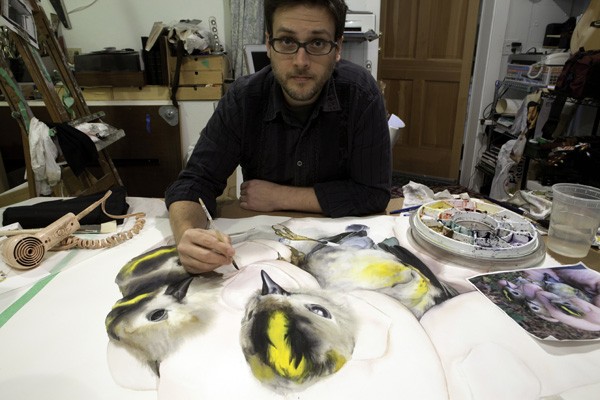
Painter Michael Hall says almost every artist he has worked with has complained of symptoms related to the materials they work with. Credits: Joseph Schell Rebeca Garcia-Gonzalez is careful to teach her students about working with hazardous materials. Credits: Joseph Schell Chris Coquia says he did not receive special training about working with hazardous materials at CCA. Credits: Joseph Schell Sasha Petrenko says she lost two of her UC Berkeley art professors to cancer. Credits: Joseph Schell


“People don’t know what’s really in this stuff,” said Teresa Smith, the senior lab mechanician for UC Berkeley‘s sculpture department. “They don’t even read the labels most of the time. It’s a serious problem.”
Label warnings are easy to ignore, since they’re written in miniscule fine print, and even if artists read them, many lack the proper training to use them safely. And because artists often use materials in unintended ways and live and work in small, stuffy spaces, they may be ingesting, inhaling, and absorbing untold amounts of chemicals. The consequences can be serious. Exposure to paints that contain heavy metals, solvents, and varnishes that emit volatile organic compounds (VOCs), or to the toxic fumes from heated plastics and resins can lead to respiratory illnesses, kidney malfunction, and various cancers.
There’s also environmental damage resulting from the mining and production of these materials, and from their improper disposal. At a time when the American public is becoming hyper-vigilant about lead in toys, BPA in plastic, CO2 emissions, and pesticides on produce, it’s surprising that so few artists are talking about how art supplies figure into sustainability.
It’s unclear just how widespread the problem is. In general, amateur artists are particularly at risk, because if they haven’t been trained to be cautious about their supplies, they may misuse them. Older artists who learned to use products in the days before warning labels may have ingrained preferences for the more toxic stuff. And while younger artists tend to be more aware of possible hazards and exposures, and are more sensitized to environmental issues, nearly all institutional art studios contain some hazardous substances, unless they have deliberately gone green.
In a mortality study done by the National Cancer Institute in 1981, artists who devoted their lifetimes to working with toxic solvents and pigments were found to have a statistically higher risk of developing terminal cancer than the general population. The study has not been repeated since then, but many of the conditions noted in the study have not changed significantly for artists in the past thirty years.
San Francisco painter Michael Hall says his doctor blamed his exposure to oil paint solvents and varnishes for a serious case of pneumonia he contracted while in art school. He said that almost every artist he’s worked with has complained of various symptoms — dizziness, lightheadedness, headaches, and nausea — induced by their materials. “I think a lot of artists end up creating problems for themselves, but they won’t back down from it, they wear a badge of honor,” said Hall. “They are suffering for their art.”
Getting artists to talk about the conditions of their work and the status of their health can be difficult. Given the chance to publicize what they are doing, nearly everyone would, understandably, rather talk about the art itself. This “mystique of suffering” — putting up with various symptoms — may be why several prominent Bay Area artists declined to speak about their health issues, including an internationally known painter who teaches at a local college and may have chronic symptoms due to working with oil mediums and varnishes.
And art departments and art schools perpetuate the mystique by not implementing institution-wide safety or environmental training for students, depending mostly on individual instructors, studio managers, and graduate students to teach how to properly use and dispose of hazardous materials. In some circumstances, this appears to be in violation of Occupational Safety and Health Administration (OSHA) workplace regulations.
Mark Gottsegen, who runs a web site from Cleveland, Ohio, that claims to provide unbiased information about art supplies (AMIEN.org), has been asking for decades why toxic materials in art supplies are treated so much more casually than the exact same substances in a chemistry lab. “Why is art different from chemistry? I think it’s just the culture of creativity,” he said. “A lot of people think that if you try to inject technicalities into your artwork and learn about the materials then you are going to stifle it. But it isn’t true.”
As bad as things are now, the situation used to be much worse.
Between the 1950s and 1970s, it was common to experiment with completely un-tested industrial materials, and traditional supplies didn’t have warning labels. Artists didn’t understand the repercussions of heating and cutting plastic, metal, and resins, or the risks of inhaling VOCs. Rarely did artists wear masks or protective gear.
Before 1978, lead was a common component in paint. Now we know that exposure to lead can cause neurological problems, as well as blood and kidney disorders. As recently as the 1990s, the concentration of heavy metals like cadmium, cobalt, and manganese were far higher in artist pigments than they are today. Most of these heavy metals are carcinogenic and can also cause lung and kidney diseases. Solvents used for cleaning up paints and inks once contained large amounts of lung-damaging chemicals like toluene, xylene, and phenols. Ordinary rubber cement once contained n-hexane, a volatile solvent that causes severe peripheral nerve damage.
The first warning bells about toxicity sounded in the early-1970s, when a high incidence of bladder cancer was identified in Japanese kimono artisans working with benzidine in fabric dyes. After asbestos was proven to be carcinogenic and Love Canal, a neighborhood in Niagara Falls, New York, was found to be sitting atop 21,000 tons of carcinogenic chemical waste, the government gained tighter control over toxic substances, including art materials.
Hazardous materials laws passed in the United States in the 1980s and 1990s have induced art materials manufacturers to reformulate and replace many of the more toxic pigments, solvents, adhesives, and inks. The federal Labeling of Hazardous Art Materials Act (LHAMA), which took effect in 1990, provided a clear directive to test art supplies with the American Society for Testing and Materials, and to label any products that may have acute and chronic impacts on human health. Those labels read, “harmful or fatal if swallowed” or “may cause skin irritation.”
In California, the passage of Proposition 65 mandated that any materials sold in the state that may cause cancer, birth defects, or other reproductive harm must be labeled as such. Today, Prop 65 labels can be found on items as seemingly harmless as Moleskine notebooks with covers made from PVC, oil pastels, and crafting clay.
But it turns out the labeling system does not protect consumers as much as one might think. Unfortunately, to find out exactly what chemical is prompting the Prop 65 label, consumers have to seek out a Materials Safety Data Sheet (MSDS) from the manufacturer because the law doesn’t require full disclosure of ingredients on labels. Reading an MSDS can be quite an undertaking; the scientific language is often indecipherable for the layperson.
Beyond the Prop 65 and LHAMA label mandates, consumers are also urged to look for the Art & Creative Materials Institute (ACMI) Approved Product seal of approval that has been phasing in over the past twelve years and appears on about 85 percent of all art supplies sold in the United States. Art & Creative Materials Institute is an industry trade group composed of hundreds of manufacturers who voluntarily submit their products to be independently certified “non-toxic” through toxicological testing. The group claims that it is more stringent than the guidelines set forth by the American Society for Testing and Materials, called the D4236 standard, which is now used to test all art materials in the country. But even the ACMI designation of “non-toxic” keeps generating controversy.
“In most cases, the ‘nontoxic’ label is meaningless and should be ignored,” said Monona Rossol, an industrial hygienist and chemist based in Manhattan who has written safety guides for artists and recently published Pick Your Poison: How Our Mad Dash to Chemical Utopia is Making Lab Rats of Us All. She pointed out that although there are usually (but not always) warning labels on products containing known carcinogens like cadmium, and on lead-containing paints, less than 1 percent of the 150,000 chemicals used in consumer products have been thoroughly tested for cancer, birth defects, or other long-term hazards. This includes nearly all of the organic pigments found in artists’ paints and inks, which produce colors like alizarin crimson, phthalo blue, and fluorescents.
So while these untested chemicals may legally be labeled “nontoxic” under the federal Labeling of Hazardous Art Materials Act, that may not be true.
Knowing which hazardous products to avoid and how to properly use them is one major hurdle; the other is how to responsibly dispose of products once they’ve been used.
Mark Gottsegen of AMIEN.org (which stands for Art Materials Information and Education Network) advises artists to consider any waste generated during art-making as hazardous. “If you make a bad painting and crumple it and put it in the trash, it is hazardous. So you should collect it and have someone take care of it, and that includes wash water,” he said, referring to the water used to clean anything that has paint on it.
Michael Hall collects all rags in his San Francisco studio that may have oils or other non-soluble materials and separates them in appropriate bins that are then given to municipal hazardous waste collection. He also steers clear of all cleaning solvents. “One of the best things for artists to use is just some baby oil or vegetable oil and some soap to clean your brushes,” he said. “This is the very traditional way of cleaning, which got eliminated when modern chemistry came into the picture. Going back to the basics is an excellent way to turn your studio around into an ecologically sound space.”
But he admits that many of his colleagues don’t follow these best practices. And by law, they actually don’t have to. The Environmental Protection Agency exempts most private art studios from its hazardous waste laws.
But there are regulations that govern institutional art studios. By federal law, OSHA mandates that all employers must provide their employees with a safe workplace. This requires the training of workers, including teachers, who use potentially toxic materials.
Under OSHA’s “right to know” provision, teachers are entitled to know everything about the risks and hazards of the materials and processes that they will be expected to use. To be in compliance with the law, employers must formally identify all of the potential health risks and provide MSDS sheets and instruction for faculty in how to read them. Faculty members then have an obligation to ensure a safe work environment for students, which would include training them to recognize flammable, toxic, and hazardous materials and respond appropriately to spills, fires, and other emergencies.
Anecdotally, it appears that many schools are violating OSHA standards. Over the past ten years, OSHA conducted investigations of several major East Coast universities and found science and art departments non-compliant with the faculty right-to-know provision. These schools were fined and had to develop curriculum to come into compliance. Monona Rossol said that OSHA won’t cite a school for not protecting their students under their regulations, but failure to provide untrained and inexperienced students with the same or even greater protection than is required for teachers puts the school at risk of liability.
Mark Gottsegen estimates that “there are probably ten US schools that have a dedicated course on materials and the rest don’t.” In the Bay Area, the Express found no schools that offer this type of in-depth class on art materials composition. A lot of schools tend to wait to implement health and safety instruction until OSHA or the EPA has cited them for costly violations. Rossol contends that most art schools don’t follow the laws. If they did, then both teachers and students would understand how to evaluate MSDS sheets.
Several local schools say they are providing appropriate information to teachers and students. But others are not forthcoming with information and some students report that training is inadequate or nonexistent.
At the San Francisco Art Institute, faculty are required to attend an annual training with Rossol in which she presents a thorough overview of safety and hazard information that educators then pass on to students. The ceramics department has banished lead, which is commonly found in various firing glazes.
UC Berkeley’s art department works with the university’s Office of Environmental Health and Safety to ensure that studios are properly ventilated, that hazardous waste is collected, and that all materials are labeled and have MSDS information. The Office of Environmental Health and Safety also offers workshops three times a year for students working in the campus’ fifty shops and studios. Yet Teresa Smith of the sculpture department says that some faculty members see the training and precautions as a joke and complain that they limit creative options. “It’s always a mystery as to why they don’t take it more seriously,” she said. “We’ve had a number of faculty die in this department. Fifteen years ago, Joan Brown got killed by her own work falling on her. It’s a very real concern.”
Smith herself is a cancer survivor, and now is vigilant about protecting herself from exposure to dust and fumes, even avoiding simple glue guns. “People still don’t understand that when plastics get heated up, they off-gas toxic chemicals, and there is still not enough information about how plastics play with your hormones. I always ask people, ‘Don’t you want to open the window?’ They aren’t that aware,” she said.
At the Academy of Art University in San Francisco, Vice President Susan Toland wrote in an e-mail that “faculty members and technicians are fully trained in safety protocol,” and “as part of their training, students are provided with full hazard material safety and disposal protocols based on OSHA guidelines.” But Jennifer Davidson, a master’s student in the Interior Architecture and Design department, says otherwise. “I personally have not been given or offered training to mitigate damage from hazardous chemicals,” she said.
When this reporter was employed for two years as an adjunct instructor at the Academy of Art University, I never received any hazardous materials training. But I did witness several colleagues instructing students improperly about the use of spray fixatives and modeling glues, and several times I watched students ignore safety protocols for spray booths.
Mark San Buenaventura, an industrial design student at the Academy of Art University, said that while he did receive adequate training for working with potentially toxic materials like spray paints and modeling foams, he wished that he had been taught about non-toxic alternatives to those dangerous supplies. “They just leave that part up to us, if we care about it enough,” he said. A master’s student in the graduate graphic design program, who requested to remain anonymous, felt empowered that the academy didn’t provide information about how to properly use spray adhesives or how to source less-toxic inks for her projects. “They expect you to have the basic skills, so they leave it up to you to learn it if you don’t know it. Students have a choice about their own materials,” she said. However appealing, this lax policy constitutes negligence.
The California College of the Arts, on the other hand, has banned spray adhesives from its two campuses in San Francisco and Oakland, along with fiberglass and pressure-treated lumber, some of the more hazardous model-making materials. But ceramics graduate student James Coquia reported that he did not receive specific training about hazardous art materials. Coquia also commented generally that the clay studios at CCA are similar to other places he’s worked in. “These studios are atrocious in regard to the amount of clay dust that’s put into the air,” he said.
Long-term exposure to clay dust leads to various respiratory illnesses, including silicosis, a terminal disease of the lungs that potters frequently develop. But there are no professional-quality ceramics studios that can fully mitigate these dangers — it goes with the territory. And in other ways, CCA is at the vanguard of sustainable creativity, offering numerous events and exhibitions dealing with environmental issues every year. From April 1-3, CCA is hosting the CraftForward symposium, which specifically addresses sustainability in the current crafting resurgence.
Foothill College in Los Altos stands out as a leader in integrating health and safety training into art education, but this seems to be mostly due to an individual professor’s passion. Kent Manske, who runs the college’s Print & Book Arts program, maintains what he describes as a non-toxic studio. He has inserted art materials education into the state-mandated curriculum, and has gone beyond what is required by the EPA to prevent dumping toxic materials into the solid waste or water waste streams. “I go overboard with cleanliness in the studio and try to create a culture of respect for materials,” he said. “We cast an illusion that the studio is as clean as your kitchen — we only clean with vinegar, ammonia, and water.” Manske also makes sure to source his printing materials locally, teaching students about the carbon footprint of their classroom activities.
Art schools aren’t the only institutions that must educate workers about art materials. Professional printers, large-scale art studios, and art supply stores also fall under OSHA’s right-to-know provision. Casual inquiry reveals that most of these places aren’t abiding by the law either. One worker at the celebrated FLAX art & design store in San Francisco admitted that he had received no safety training in dealing with the myriad toxic materials in the store. “But all of us went to art school, so we know how to handle these materials,” he said.
Yet if these employees attended Bay Area art schools, it’s likely that they are not fully informed about the risks of leaks, spills, or emergencies. FLAX CEO Howard Flax confirmed that they don’t do a special training for employees, but they do have MSDS sheets available for the most toxic products.
But just implementing thorough training won’t get rid of the ultimate problem. Artists are still committed to using some toxic materials because they believe that they are the only means to create a particular texture, color, or effect. And in contemporary art, ideas reign supreme over choice of material. “My work, and work in general, should be pushed by the concept, and materials selection should always be secondary to the idea,” said CCA student James Coquia.
CCA-trained sculptor Shane Selzer, who now lives in New York, says that in her field, “the most toxic stuff is the two-part urethane foam, which is increasingly popular as costs lower. It requires a full hazmat suit and respirators with proper filters, but even with these precautions, it’s hazardous.”
Mark Van Proyen, an associate professor in the painting department and the School of Interdisciplinary Studies at the San Francisco Art Institute, finds this regrettable. “Artists tend to minimize long-term safety in favor of short-term artistic satisfaction,” he said.
But when legal restrictions make toxic materials too burdensome to use, artists must find substitutes. Maroger medium, for instance, was used by the Old Masters to increase oil paint transparency and is rapidly losing favor. It’s made by boiling lead with oil and mastic, so it falls under OSHA’s lead restrictions. Studios that use it are required to undergo very expensive lead monitoring and testing at regular intervals.
Similarly, the web site for the paint manufacturer Golden Artists Color predicts that regulatory pressure will soon prevent the use of cadmium and other heavy metals in artists’ paints. And the green consumer movement, which has spurred major reforms in household products, could potentially do the same for art supplies, making urethane foam and turpentine as unpopular as BPA in baby bottles.
Karen Michel, who wrote the 2009 Green Guide for Artists, said, “I think the art world is very slow in catching up with the eco movement. When I was doing research for my book, I was surprised to learn that most of the major artists’ paint manufacturers were not looking towards developing VOC-free paints like the interiors paint companies have. If Benjamin Moore can do it, then why can’t artists’ paint manufacturers do the same?”
It’s not only a contradiction for the artists’ paint industry, but an uncomfortable double standard for artists who live a green lifestyle and address environmental themes in their artwork. Artist Michael Hall notes that “some of the greenest people I know are artists, but then their practice is not so green.” Surprisingly for the Bay Area, where so many consumers are committed to organic food, hybrid cars, and non-toxic dry cleaning, local art stores like Utrecht and Blick report having very few, if any, inquiries about environmentally-friendly products.
Manufacturers do offer art supplies that have been detoxed, like water-based paints and vegetable inks, low-VOC solvents, and adhesives. If these can gain mass adoption, they could be quite convenient because they allow artists to use the methods they have been trained with and don’t require an entire makeover of the artistic process.
But artists are skeptical about these eco-friendly options. “It’s nice to say you’re green,” said Gottsegen, “but it’s very hard to be green.” Because artists want their work to last — perhaps for centuries — they’d rather not put their masterpieces at risk by using new products whose durability and longevity are as yet unknown.
San Francisco artist and curator Kate Stirr is interested in challenging the reigning idea of permanence with work that is more ephemeral, but she admits that it’s nearly impossible to avoid traditional art supplies. “There is something really alluring about all of the art materials out there, and it can be paralyzing if you want to be totally green,” she said. “You can’t remove yourself from what your practice has been, because then you just stop making work. You have to just allow yourself to do what you can.”
Also, the new green materials may not perform the same way. Rocket Caleshu, who is the marketing and communications coordinator at the San Francisco Center for the Book, says that even though the traditional print-making shop aims to green most of its inks and cleaners by fall 2011, “it’s easy for us to fall back into using an old product because the non-solvent cleaners might take twice as long to work, and then not clean half as well as the noxious stuff.”
The low-VOC and natural materials, like other green consumer goods, are also more expensive, and sometimes use misleading marketing, known as greenwashing. Citrus oil, or turpenoid paint thinner made from orange rinds, is commonly touted as a nontoxic replacement for turpentine and is promoted with the word “natural,” even though the active agent in citrus oil, d-limonene, is classified by the European Union at the same level of toxicity as turpentine.
There are artists who believe that toxicity needs to be completely eliminated from creativity. They advocate a total shift in art practice that involves either bringing back pre-industrial art materials, like egg tempera; by reusing and recycling existing materials; doing digital art; or creating “social practice,” a genre that creates art out of human interaction.
Suzanne Husky is a San Francisco multimedia artist who works almost exclusively with trash. “I find it totally irresponsible and criminal that in the 21st century, with all of the information we have about toxic art supplies, people are still using them,” she said. In the fall of 2010, Husky completed a residency with Recology, the company that runs the San Francisco waste transfer station. Husky found the dump a treasure trove for her art. “I don’t even know if it is obvious that my materials are made of trash,” she said.
A group exhibition called Manufactured Organic that runs through March 26 at Root Division gallery in San Francisco features work that addresses the overall environmental impact of the art world, from the materials used to make the art to the energy used to prep gallery walls, light the gallery, and pack and ship the work. All of the artists featured in Manufactured Organic have gradually shifted their practice toward more ecological materials, using things like found umbrellas, discarded fruit peels, fungi, and live plants.
Berkeley-based Julie Seltzer is almost finished writing an entire Torah scroll at the Contemporary Jewish Museum in San Francisco, using millennia-old materials. She hand-writes each letter of the text with a discarded bird feather dipped in plant-based ink on calf-skin parchment. In this case, the materials will almost certainly last; Torah scrolls have survived hundreds of years with proper care.
San Francisco Art Institute ceramics professor John Roloff wants to prepare students to make informed choices about materials by teaching them about their full life cycle — from mining and manufacturing to use and disposal. In the fall of 2010, Roloff taught a class called “The Ecology of Materials and Process” in partnership with Mexican art collaborative ToroLab. His students researched the ecological, hydrological, and waste systems of Mexico City. Then they developed proposals for a range of art projects that may get implemented in Mexico City or the Bay Area that engage repurposed trash, bio-remediation, urban agriculture, and community composting.
San Pablo painter Rebeca Garcia-Gonzalez leads a group of East Bay figure painters and because she has asthma, she’s has always been sensitive to how her art materials affect her. Unlike most of her colleagues, Garcia-Gonzalez takes care to instruct her students about proper ventilation and the hazards of working with paints and solvents in her classes at Richmond Art Center. “After we had an incidence of bad fumes, we banned oils from our shared studio,” she said.
Artist Sasha Petrenko recalls how losing two of her UC Berkeley art department professors, Wendy Sussman and Irene Pijoan, to cancer, frightened her away from using any toxic materials. “I started out as an oil painter, smoking cigarettes, rubbing paint thinner on my hands, and playing with cadmium,” she said. “Then Wendy got cancer and everyone was talking about how it most likely came from the materials she was using to make these enormous oil paintings where a whole wall was covered with VOCs, and she would be working in that for hours.”
Petrenko is now a sculptor working with found objects, and in her position as the studio manager for the University of San Francisco, she instructs students about the environmental impact of their art. “I put pictures of small, cute animals that have been victims of oil spills above the sink so they don’t pour oil down the drain!” She thinks that the younger generation is growing up using less-hazardous media, and though younger artists are not fully informed about the environmental and health impacts of their materials, they are certainly more aware than their predecessors.
Teaching future artists about the full impact of art materials is a powerful step on the path to a sustainable art movement. But there’s also a need for large-scale organization and action around issues of toxicity, waste, and the ecological impact of art. The related field of sustainable design has been quite successful in creating a mass movement: Designers and design schools are increasingly partnering with businesses and product manufacturers to implement principles of sustainability. And education in sustainable design is becoming a required part of the curriculum at most design and architecture schools.
Ian Garrett, who co-directs the Los Angeles-based Center for Sustainable Practice in the Arts, says the art world is lagging behind in this movement. “Unfortunately there’s no Designer’s Accord for artists yet,” he said, referring to a prominent coalition of designers, educators, and business leaders who commit to five guidelines for integrating sustainability into design.
For now, artists can start to make more informed choices about materials and try to use their artwork to educate the public about sustainability issues. Karen Michel believes this will add up. “The eco revolution really starts in these choices,” she said.
A Responsible Approach to Art
How to Handle Toxic Art Supplies:
1. Wear gloves — non-latex might be best. And wear masks, especially if you have respiratory problems, even when the vapors or dust particulates are from “non-toxic” products.
3. Never eat, drink, or smoke while working with art materials.
4. Wear dedicated aprons or smocks for messy work.
5. Wash your hands thoroughly at the end of your work session.
6. Don’t store food in a refrigerator used for chemical storage.
7. Don’t hold a paint brush or other tool in your mouth.
8. Never use solvents to clean your skin.
9. Remember that “Use with proper ventilation” means using spray paints and adhesives outside, away from people.
10. Know what to do in an emergency. Contact Poison Control: Throughout California, call 800-222-1222.
11. Request and store Material Safety Data Sheets (MSDS) for toxic art supplies
Proper Disposal of Art Materials:
In Alameda County, artists can drop off hazardous waste, including most used art supplies, rags, and containers at several locations coordinated by StopWaste.org. In San Francisco, the Recology San Francisco Dump accepts hazardous waste during business hours.
Toxic Art Supplies to Avoid:
1. Turpentine, citrus oil, and odorless mineral spirits used to clean oil paints
2. Any paints containing heavy metal pigments like lead, cadmium, chromium, barium, mercury, arsenic, selenium, manganese, cobalt, antimony, nickel
3. Model-making materials like plastic resins, foams, fiberglass, pressure-treated lumber
4. Rubber cement with hexane
5. Model cement, airplane glue with acetone and toluene
6. Spray adhesives, super glues
7. Spray paint, enamel paint
8. Pottery glazes with heavy metals, especially lead
9. Permanent markers (containing xylene, solvent-based)
10. Soft pastels
Safe Art Supplies:
1. Elmer’s glue, wood glue, rice paste adhesive, gum Arabic glue
2. Milk paint, casein paint, and water-based paints without heavy metal pigments. Locally, Glob paints is a great choice for natural paint: GlobItOn.com
3. Recycled paper, hemp paper
4. Plant and vegetable dyes, some can be home-made
5. Modeling beeswax, non-toxic carving wax
6. Beeswax crayons
7. Inks made from indigo, the galls of oak and nut trees, from berries, and from squid and octopus
8. Balsa wood, balsa wood foam
9. Home-made gelatin gesso
10. Home-made papier mâché (flour, water, and a bit of glue)
Most materials available at Blick Art Materials and at Utrecht in Berkeley, Oakland, and San Francisco.
Reused/Recycled Art Materials:
East Bay Depot for Creative Reuse (4695 Telegraph Ave., Oakland, 510-547-6470, CreativeReuse.org)
The Scroungers’ Center for Reusable Art Parts (SCRAP) (801 Toland St., San Francisco, 415-647-1746, Scrap-SF.org)
The ReArt Store at Whole House Building Supply (1000 S. Amphlett Blvd., San Mateo, 650-558-1400, DriftwoodSalvage.com)