It was a fair-to-middling year at the movies by ordinary standards, but 2012 also had a hidden dimension that’s cause for celebration. A gratifying number of talented filmmakers from around the world has decided — no doubt at one of their secret meetings — to forsake what we like to call White Elephant projects and similar safe-and-sane, front-loaded concepts, in favor of the relatively uncomplicated field of genre movies: Westerns. Horror flicks. The perennially popular crime thriller. Disaster pics. Sports comedies. Even the car chase quickie has been revived. What a wonderful way to get back to the basics.
You could skip ahead a few paragraphs and read all about this promising new development, but then you’d miss the triumphant entry into the Hall of Mirrors of the Ten Best Movies of 2012. They are, in no particular order:


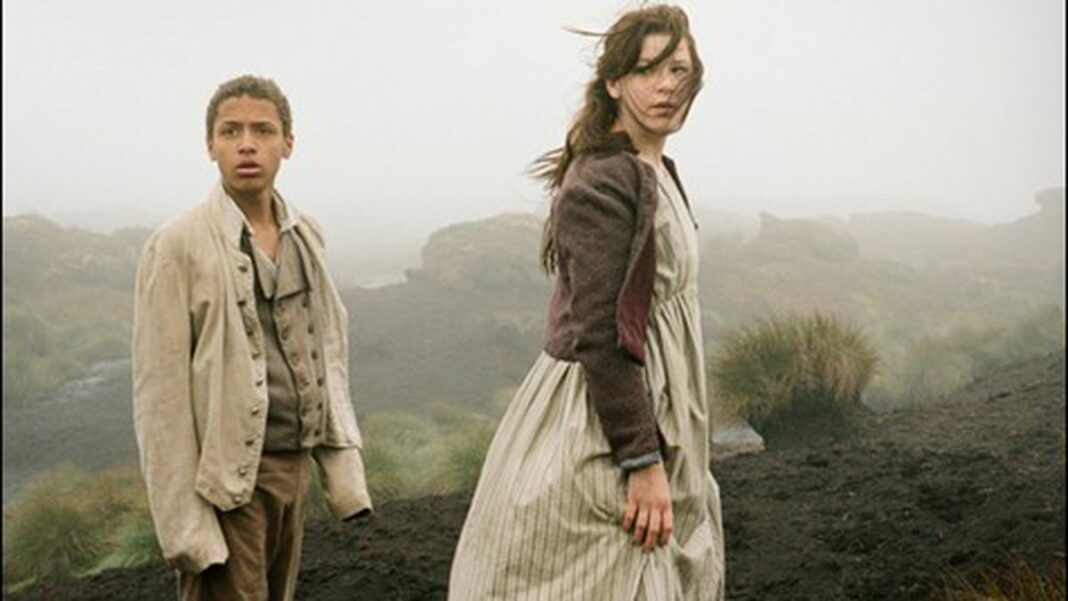
Andrea Arnold’s Wuthering Heights updates Emily Brontë’s 1846 novel for a 21st-century audience. Todd Solondz’ Dark Horse, starring Selma Blair and Jordan Gelber, is excruciatingly funny. Wake in Fright, made in 1971 but rereleased this year, was a landmark in the annals of Ozploitation shockeroos.


Léos Carax’ Holy Motors
Quentin Tarantino’s Django Unchained
William Friedkin’s Killer Joe
Craig Zobel’s Compliance
Peter Nicks’ The Waiting Room
Andrea Arnold’s Wuthering Heights
Todd Solondz’ Dark Horse
Ben Lewin’s The Sessions
Ursula Meier’s Sister
Ted Kotcheff’s Wake in Fright
Bright-eyed culture hounds will see at once that at least three, maybe four, of this Ten Best qualify as genre staples: Django Unchained as a hybrid of Western and plantation slavery exploitationer; Killer Joe a salacious crime thriller; and the revived Wake in Fright as a difficult-to-pigeonhole Australian nightmare odyssey concentrating on drunkenness, humiliation, and cruelty to animals. Think of these as the anti-Cloud Atlas, or perhaps as the illegitimate bohemian sons of a stuffed objet d’art like Life of Pi.
The Waiting Room may be the very best film of the year. It’s certainly the most important in terms of immediate real-world impact and the neglected art of speaking truth to power. The emergency room of Oakland’s Highland Hospital is the ideal place to witness dozens, hundreds, thousands of routine, everyday, life-or-death dramas as they flit by our eyes, courtesy of documentary filmmaker Peter Nicks. Instead of tarting it up with a tufted TV-special-type cast of actors, Nicks gives it to us straight with real people, in classic fly-on-the-wall cinema-verité style, starring the worried father and his very sick little girl, the poor guy trying to fix his testicular cancer on the cheap, a diabetic senior, a philosophical doctor doing his best to avoid talking about economics in a medical setting, and Certified Nurse Assistant Cynthia Y. Johnson, the doorkeeper, a triage nurse in charge of putting band-aids on souls, the original angel of mercy. Filmed over a five-month period in 2010, the doc resonates with humanity in the midst of this country’s health-care debate. With any luck, The Waiting Room will be able to find audiences long after fluffier entertainments have been forgotten.
Need more social problems? Compliance, Dark Horse, The Sessions, and Sister cover the bases — docile submission to authority, the misanthropic antics of a man-child, a paralyzed individual seeking physical love from a sex surrogate, and the lonely career of a juvenile thief, respectively — with a maximum of style. It’s the cinematic style and bravura, not the therapeutic angle, that makes these generally overlooked indies so memorable.
Dark Horse writer-director Todd Solondz once again takes us to his beloved New Jersey hinterlands, where a thirtyish nebbish named Abe Wertheimer (in a miraculous performance by Jordan Gelber) scoots around in his Hummer, drinking Diet Coke, playing backgammon, and fastening his attentions on a female version of himself named Miranda (Selma Blair), who also lives with her parents (Abe’s are played devastatingly by Christopher Walken and Mia Farrow). Abe and Miranda don’t exactly get along, but that’s the least of their problems. Keep your eye on Donna Murphy as Marie, the office manager at Abe’s father’s business. She has one or two other dimensions, as does this excruciatingly funny character study by the maker of Welcome to the Doll House, Happiness, and Life During Wartime.
We’ve reviewed The Sessions, Sister, and Compliance at length in these pages. If the three have any commonality other than their shared social quotient, it’s their insistence on burrowing into marginal, face-in-the-crowd characters and revealing what goes on beneath the surface. Writing and acting, as always, are the twin keys, with the trio of John Hawkes, Helen Hunt, and William H. Macy converting a potentially mawkish situation into the sweetest of romances in The Sessions, journeyman director Ben Lewin’s late-inning home run. Nothing at all sweet, but a whiff of redemption, in the otherwise repellant duo of Kacey Mottet Klein and Léa Seydoux carrying on their sullen, doomed version of class warfare on the poor downhill side of an Alpine ski resort, in Ursula Meier’s Sister.
Compliance is another kettle of fish entirely. Literal-minded commentators have been tearing their hair out over the film’s verisimilitude. Did this dramatized incident of an unseen voice convincing the employees of a fast-food restaurant to humiliate themselves really happen, or not? Please. It’s a piece of fiction — a particularly well-written one by filmmaker Craig Zobel, who covered similar ground in Great World of Sound. Underlying the drama is a discussion about the nature of power, in those who exercise it and in those who acquiesce. The performances of Ann Dowd and Dreama Walker, in the roles of the store manager and a victimized staffer, are among the strongest of the year in film, as is Pat Healy’s as “Officer Daniels.” What is gained by watching these people squirm for ninety minutes? Insight into the murky depths of human nature, and maybe a clue to our own predicament. Rather we should ask what would be lost if artists like Zobel shied away from the story in the first place.
Rereleases are not usually fair game for Ten Best consideration, but we had to make an exception for Wake in Fright, a singularly grotesque 1971 melodrama by Canadian international director Ted Kotcheff. The story of John Grant, a solitary Australian Outback school teacher on vacation (English actor Gary Bond,) and his bizarre layover in the town of Bundanyabba would require several psychological and zoological textbooks to adequately describe, but can be summed up with two iron-clad caveats: Limit yourself to only two beers your first night in a strange town, and: Never trust a sheriff. Peripatetic filmmaker Kotcheff’s termitic skill at delineating madness combined with oppressive dry heat helped make Wake in Fright a landmark in the annals of Ozploitation shockeroos alongside such epics as Razorback and Turkey Shoot. And now it’s back. But be warned: If the sweaty close-ups of Donald Pleasance don’t put you off your popcorn, the graphic depiction of a kangaroo hunt by a truckload of beer-sodden ockers surely will. The film enjoyed a week or two at Landmark houses in the fall, but if it were up to us, Wake in Fright would be on permanent rotation in the Midnight Show Hall of Fame.
Wuthering Heights and Killer Joe also received lengthy reviews during the past year. The former evidently struck some viewers as drastically dour, but for us, Andrea Arnold’s rethinking of Emily Brontë’s tragic romance illuminates dark corners, and updates that 1846 novel in unmistakable fashion for 21st-century audiences finally ready to put 19th-century racism and intolerance in a box and bury them forever. Director Arnold and writer Olivia Hetreed see fit to make their Heathcliff a newly freed slave stranded in the Yorkshire Moors through an ostensible act of kindness. It is Heathcliff’s beloved Cathy, however, who wears the chains, shackled to her family’s menfolk and her rich husband in turn. The setting is as chilly and forbidding, with just as many expressive emotional overtones, as Cary Fukunaga’s sterling Jane Eyre adaptation last year. Although both films were first released in the UK in 2011, Wuthering took longer to reach us.
Killer Joe is the fourth pic to open this year to feature Matthew McConaughey, alongside Bernie, The Paperboy, and Magic Mike. The real stars of this thinking-person’s drive-in programmer, however, are director William Friedkin and writer Tracy Letts, adapting his own stage play. Sex, violence, dirty talk, dirty deeds, drumstick sucking, and an homage to John Steinbeck’s Of Mice and Men all figure prominently in the story of a family of dolts hiring a crooked cop to murder an inconvenient relative. But Friedkin is having too much fun toying with his cast — McConaughey, Thomas Haden Church, Gina Gershon, Emile Hirsch, and Juno Temple as the catalytic agent Dottie — to spend time worrying about things like underage sex and full-frontal female nudity. That’s why the audacious, whole-heartedly vulgar Killer Joe arrived in theaters with an NC-17 rating. Friedkin served it up raw, and we’re still digesting it. A funky taste.
We spent the first ten minutes of Holy Motors hating it, until it dawned on us that just because writer-director Léos Carax jettisons most of the narrative niceties we use as a crutch, it doesn’t necessarily follow that the tale of the enigmatic Monsieur Oscar (brilliantly conceived by actor Denis Lavant) has no meaning. André Breton once declared, in his novel Nadja: “Beauty will be convulsive or will not be at all.” That wily old Surrealist might find something to admire in the way M. Oscar, in a succession of outlandish personas, traverses the city of Paris, dropping in on an increasingly weird series of tableaux that culminate in him going home to his lover, an ape. Holy Motors is truly convulsive. It’s also maddening, elusive, and nakedly joyous. What more could we ask from a movie? The filmmaker offers his thanks to Georges Franju and Henry James in the final credits. Remerciements are also due to actress Édith Scob, veteran of Franju’s Eyes Without a Face and Judex, Luis Buñuel’s The Milky Way, Raoúl Ruiz’ Marcel Proust’s Time Regained, and Olivier Assayas’ Summer Hours, for her portrayal of M. Oscar’s secretary Céline.
We’re reviewing Quentin Tarantino’s Django Unchained in this issue’s movie pages, so we’ll merely reiterate that this delightfully salty neo-exploitation history lesson is Tarantino’s finest since Jackie Brown, and an important milestone in the careers of both Samuel L. Jackson and Leonardo DiCaprio.
Now about “genre.” What is it, how can we recognize it when we see it, and what does it mean to a film fan interested in digging a little deeper? From the early days of cinema more than a hundred years ago, when motion pictures progressed from a purely documentary form to a more narrative one, the term “genre” has referred to clearly defined narrative themes that have proved resilient enough to establish their own turfs. Horror/fantasy and Westerns are two of the earliest genres, and the former, at least, is still ubiquitous. Without getting too academic about it, a genre movie is one we can categorize quickly and describe in a short phrase: heist flick, young doctors in love, etc.
As with any critical shortcut, we have to be careful. It’s wrong to reflexively label every movie according to its theme and then hurriedly file it away. For our purposes, genre refers to broadly accepted narrative archetypes rather than stylistic touches. The idea is not to establish some sort of critical pecking order, but to recognize that movies travel the same thematic routes as novels or stage plays or pop music. Some take the road less traveled, others the well-worn way.
Michael Haneke’s Amour is an example of a film that tries to break out of ordinary avenues and tell its unusual story — of an elderly married couple dealing with illness and death — frankly and starkly; as opposed to, say, Andrew Dominik’s Killing Them Softly, a familiar tale of thugs and hit men. Amour is considered an art film mostly because of its style, although its subject matter is certainly non-commercial. Killing Them Softly, however, is a clear-cut genre flick because its story ingredients, regardless of the director’s style, are so well established they’re recognizable at first glance. Genre films continually run the risk of being labeled by lazy critics as clichéd at face value, on account of their subjects. But many first-class filmmakers have honed their skills in genre, and many are still attracted to it.
The beauty of genre is that by working inside a set of well-established guidelines — for instance, that Westerns always have a man on a horse, or that in horror films something generally jumps out and goes Boo! — the creative filmmaker is set free to use his or her imagination in reinterpreting the form. What might have been limits for a lesser talent become points of departure for individual stylistic exploration, like a musician improvising on a riff.
Thus, when Steven Soderbergh takes a whack at a martial arts actioner, as in the case of Haywire, he’s demonstrating that there are no “untouchable” categories in which a cinematic artist can work. A head-buster spy flick can ultimately prove as meaningful as a “serious” issues-oriented star vehicle à la Erin Brockovich. Everything depends on the director’s style, and of course the twin virtues of writing and acting.
As it turns out, Soderbergh is responsible for a pair of genre pieces released in 2012: Haywire and the male-strip-club buddy movie Magic Mike. He wasn’t the only blue-chip auteur “slumming” in the genre ghetto. Oliver Stone (Savages), David Koepp (Premium Rush), the tag team of Michael Apted and Curtis Hanson (Chasing Mavericks), and Kathryn Bigelow (Zero Dark Thirty) all chimed in, with a drug-ring actioner, a bike-messenger urban thriller, a surf movie, and a war movie, respectively.
Of course, it could be said that certain directors like Christopher Nolan (The Dark Knight Rises) and Joss Whedon (The Avengers) don’t make anything other than genre items, but that’s their decision. If David Cronenberg wants to float a social commentary (Cosmopolis) this time around instead of such gangster sagas as Eastern Promises or A History of Violence, that’s his choice as well. The net effect is that genre is no longer the poor side of town. There are no longer any unfashionable genres, only inept — or, conversely, well equipped — filmmakers. When Alfred Hitchcock, in Sacha Gervasi’s Hitchcock, wondered out loud, “What if someone really good made a horror picture?” he was expressing a common artistic impulse for 2012. With Hitch’s typical foresightedness, he said it in 1959. We’re finally catching up with him.