
The biggest shift in Bay Area journalism in years came not suddenly — with champagne and crying, or, alternatively, with quickly emptied desks and a different kind of crying — but in something like slow motion, whispers building to rumors building to point-blank questions, and, finally, press releases and official paperwork. After months of speculation, first internal and then external, the nonprofit news organization The Bay Citizen — roiled by the resignations of its editor-in-chief, Jonathan Weber, and its CEO, Lisa Frazier, in the fall, and then the death of its founder and primary benefactor, Warren Hellman, in December — officially announced in March that it would be merging with Berkeley’s Center for Investigative Reporting, effective May 1.
And just like that, one of the most promising young journalism outlets in the Bay Area became part of one of the most respected news organizations in the country, and the East Bay became home to the biggest investigative journalism nonprofit in the nation. Local papers and national media blogs alike ignited with the news, and for good reason: This was big. In an era when newspapers are shrinking, the new CIR would be working with a comparatively massive $10.5 million operating budget and a staff of seventy people — up from just seven when Robert Rosenthal, the director of CIR, came on in January 2008.

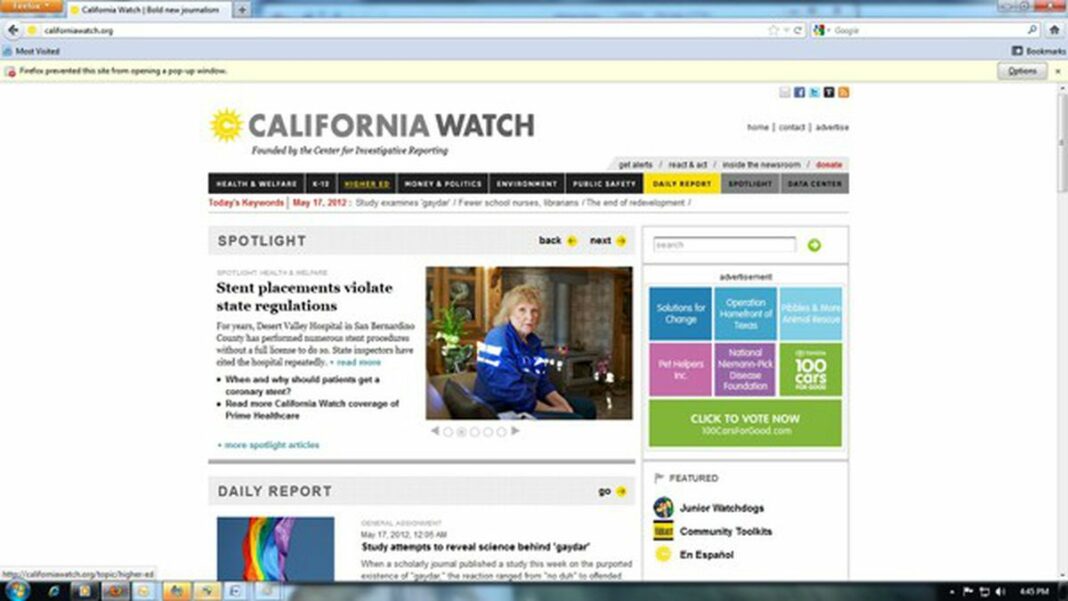
California Watch relies on an aggressive distribution model. 
Robert Rosenthal of the Center for Investigative Reporting says the downsizing of newsrooms began long before the model for nonprofit investigative reporting. The Bay Citizen mostly focuses on relatively small-scale civic issues — stories that, theoretically, could be coverrered by daily newspaper reporters. Kevin Davis, the CEO of Investigative News Network, said the problem with the IRS is having a chilling effect.



The idea, according to Rosenthal, was to make the new Bay Citizen something of a local analogue to CIR’s already existing (and highly lauded) California Watch project — the smallest of three geographically specific concentric circles, with The Bay Citizen focusing on the Bay Area, California Watch continuing to cover statewide issues, and the Center for Investigative Reporting working on stories of national and international import. All three brands would — and now do — fall under the CIR umbrella and leadership structure, and focus on investigative and “solutions-based” journalism rather than breaking news and culture reporting. The Bay Citizen and California Watch/CIR are still working out of their old office spaces on opposite sides of the bay, but when they find a new building, all seventy employees will be working together under one roof.
It’s a big change, to be sure, but it’s not necessarily new, nor is it confined to the Bay Area: In fact, this merger is but the biggest and latest example of a tectonic shift that’s been underway for years now, as newspapers continue to founder and as nonprofit news organizations increasingly come to fill the holes left by layoffs and cutbacks.
Perhaps the best-known — save for the new CIR, maybe — is ProPublica, which made headlines in 2010 when its 13,000-word investigation into malpractice at a hospital in post-Katrina New Orleans, published in the New York Times Magazine just two years after the news organization’s founding, won both a National Magazine Award and a Pulitzer Prize — the first ever for a nonprofit news organization. Since then, it’s gobbled up another Pulitzer — that time, the first such prize awarded to stories that never appeared in print — as well as a handful of other major awards, and has come to be heralded as something of a silver bullet for an ailing industry. As Gerry Marzorati, then the editor of the Times Magazine said in his Magazine Award acceptance speech, “a lot of [newspapers] are going to look at places like ProPublica” for support moving forward.
And they have. In the last three years, nonprofit news organizations — and traditional-media’s reliance on them — have exploded. According to data from Harvard University’s Hauser Center for Nonprofit Organizations, there are now dozens of journalism nonprofits operating in the United States. Some, like the Associated Press, Harper’s, and San Francisco’s Mother Jones magazine, have been operating for decades (the former two for more than a century, in fact), but just as many have been founded in the last ten years. Many — like, again, Harper’s and Mother Jones — operate with the same distribution model as a for-profit publication, but an increasing number are using a system more like that of the Associated Press: That is, they have no means of distribution of their own, but rather create content which is then sold or given away to other publications, like what ProPublica did with its Times Magazine piece. This is the model that CIR, California Watch, and now, the Bay Citizen, tend to use; according to its website, California Watch has partnered with or provided content to seventy local papers up and down the state, including the Express.
In many ways, it’s a good setup for everyone. When the one-two punch of the Internet and the recession hit newspapers, the cuts were deep, devastating, and almost universal. But a nonprofit news organization like California Watch or ProPublica, shored up by foundation money and freed of the overhead costs associated with hiring ad-sales and circulation staff, is now taking on the work left undone by newspapers — and, in many ways, doing it more effectively.
At the same time, though, it’s dangerous for newspapers to rely too heavily on content supplied by outside sources, especially when it’s cheaper than bolstering one’s own staff. While champions of news nonprofits argue that they’re simply fixing an existing deficit in the mainstream news world, it’s also clear that their very existence depends on that deficit.
In order to justify itself as an ancillary investigative unit for a publication like the San Francisco Chronicle, CIR has to ensure that the Chronicle needs that service. Thus, it’s in CIR’s best interest that the Chron buy content from an outside supplier, rather than save the money to hire a reporter.
And that’s where things get tricky: The nonprofit investigative model exemplified by ProPublica and CIR certainly depends on traditional journalism — but it also may be hastening its demise by providing cheaper content, facilitating more cutbacks, and, eventually, eroding brand recognition.
The new journalism model, meanwhile, is also being threatened by an outside source: the Internal Revenue Service. The explosion of nonprofit news organizations hasn’t just spelled big changes in the newsroom, it appears to be wreaking havoc on the federal government’s aging precedents for educational nonprofits, forcing the IRS to all but halt 501c3 approvals as it tries to contend with journalism’s next wave.
Maybe the future of the future of news isn’t so bright after all.
The success of nonprofit journalism relies on a rather unsettling paradox: It needs for-profit journalism to survive. One of the main goals of nonprofit news organizations is to effect change by reaching the widest audience possible. And since most nonprofits don’t have tremendous reach by themselves — imagine the traffic for CaliforniaWatch.org versus SFGate.com — the best way for them to operate is by leveraging other people’s audiences. That means forming partnerships with newspapers, TV, and radio stations or distributing content to them.
Take, for example, the award-winning series “On Shaky Ground,” a California Watch investigation that exposed the state’s systemic failure to heed earthquake construction codes for schools. The project took nineteen months to complete, involved nearly forty reporters and producers, and ultimately went out to more than a dozen media partners, including the Chronicle, the San Jose Mercury News, the Sacramento Bee, KQED public radio, several Patch.com sites, ABC-affiliated TV stations, and the PBS News Hour. California Watch also made an iPhone app and published a coloring book in several languages to make the story accessible for young readers. Within a few weeks of publication, the story spawned major reforms — including two internal investigations at the state architect’s office, new legislation to change seismic standards at schools, and the release of $200 million in bond money repairs. It was nominated for a Pulitzer.
That’s the journalism equivalent of going triple-Platinum, and a major feather in the cap for California Watch. But it couldn’t have happened without an aggressive distribution model. Videos on the organization’s website show staff sitting at a roundtable, creating their game plan and discussing ways to maximize the story’s audience. In many ways, it resembled a product launch.
It was also a fundamental part of California Watch’s business model. Nonprofits can’t mimic the practices of a commercial enterprise — to avoid raising suspicion from the IRS, they have to show that every new revenue stream has an educational purpose — but they have to persuade donors of their efficacy, which means reaching a wide audience. The reason that foundations donate to journalistic enterprises, after all, is to produce blockbuster stories like “On Shaky Ground,” which expose a severe social injustice, encourage readers to call or write their local policy-makers, and ultimately put pressure on legislators to enact reform. CIR is a stalwart proponent of new media models — social media networks are a critical part of its armature, and it even curates an investigative channel on YouTube. Proponents argue that the best way to effect change, as a news organization, is to reach many readers.
And the funders agree. Daniel Silverman, communications director for the James Irvine Foundation — which is one of CIR’s main benefactors — said that audience definitely matters. “Not to put too fine a point on it, but our goal is to educate Californians on governance and political issues,” he explained. “So the more Californians we reach, the better.” Jeff Okey, communications manager for the California Endowment, concurred. “There are so many ways that people consume news; we want to make sure it’s distributed across all platforms,” he said. Eric Newton, the senior advisor to the president of the John S. and James L. Knight Foundation, was a little more tentative, admonishing that sometimes it’s more important that a story reach “the right eyes,” rather than simply reach many eyes. But he agreed that, more often than not, volume factors into a news organization’s ability to impact readers.
As such, it’s in a nonprofit’s best interest to provide content to as many news outlets as possible. (In fact, when the Bay Citizen ended its relationship with The New York Times after the merger, Rosenthal, in an interview with Neiman Journalism Lab at Harvard, cited as a partial cause “concerns” about the exclusivity of the two organizations’ relationships.) And in order to do that, nonprofits have to convince potential buyers to purchase their content. In most cases, that’s actually not too difficult: By virtue of being nonprofit, a news organization like CIR is obligated to sell stories at or below cost, to show the IRS that its purpose is wholly philanthropic, rather than mercantile. Many mainstream news partners see that as mutually advantageous. Chronicle Managing Editor Stephen Proctor said that forming partnerships with CIR and other outlets, such as the USC Annenberg School of Journalism, has allowed his newspaper to bulk up resources, and cover certain local issues in much greater depth.
But what’s symbiotic today could turn malignant tomorrow. Clearly, there’s an inherent tension to the new news economy, one that could, conceivably, be the undoing of both for-profit and nonprofit news organizations. Right now, most journalists and media observers would likely agree that the relationship is working out on both sides of the equation: Nonprofits get distribution and a chance to effect change, making their donors happy, while newspapers get content for far cheaper than it’d cost to produce in-house. But at a moment when papers are laying off their staffs in droves and cutting costs at every juncture — and, at the same time, when nonprofit news is growing like never before — it’s not hard to see a future in which that balance shifts. The great promise of nonprofit news is that it provides a cheap and reliable way for papers to fill pages with fewer people — but what happens if and when newspapers come to rely on it too heavily?
Proponents of nonprofit news argue that there’s no causal relationship between the rise of nonprofit news and the demise of commercial news, even if the former benefits from the latter. Kevin Davis, the CEO of Investigative News Network — a consortium of more than sixty news nonprofits — argues that the problems facing mainstream newspapers are endemic to their advertising model, which started deteriorating once advertisers found better options than “juxtaposing [a] display ad with content that may or may not be on point with its marketing message.”
Jeff Hermes, founder of the Digital Media Law Project, agreed that most nonprofits have a mutually advantageous relationship with their for-profit partners, particularly in an age of newsroom bloodletting. Rosenthal, who himself was ousted by The Philadelphia Inquirer for cost-cutting reasons far earlier than the existence of organizations like ProPublica and California Watch, pointed out that “the downsizing of newsrooms began long before there was this model for nonprofit investigative reporting.” News analyst Steve Outing argued, furthermore, that traditional periodicals have always relied on the AP, and so far, it hasn’t rendered them moribund.
The problem, though, is that even though newspapers have been in trouble for a while, the ante has been upped considerably in recent years — and, moreover, that a nonprofit like CIR is quite different from a wire. While it’s understandable that a metro newspaper like the Chronicle wouldn’t have adequate funds to open a bureau overseas to cover the European debt crisis, the notion of hiring another outlet to cover local news because it’s cheaper is a much dicier proposition. In reality, Chron reporters are perfectly capable of covering most of the stories that California Watch publishes — the real problem is that there aren’t enough of them. And the danger of running CIR stories to supplant regular Chron reportage is that an influx of outsider bylines would undermine the Chron brand.
Whether or not readers actually notice journalist bylines has long been a point of contention in the news world. Rosenthal insists that they don’t. “To be honest, I don’t believe people outside the journalism world pay attention to bylines,” he said, offering an example: “The average person, if they read a story by Zusha [Elinson, The Bay Citizen’s transportation reporter], they won’t tell their friends it was by Zusha. They’ll tell them it was from California Watch, or in the Chron. You don’t say, ‘I read a story by the AP,’ you say, ‘I read a story in the Merc.'”
To a newspaper, though, the whole point of having a vessel is to fill it with unique content. Even Proctor, who generally sees the value in nonprofits, admitted that everything on the front page of the Chron is usually staff-generated — an acknowledgement of the perceived importance of the paper providing its readers with stories they can’t get anywhere else. A mere glance at the paper’s May 10 issue proved as much; all four stories on Page One were written by Chron reporters, including a piece about President Obama declaring his support for gay marriage. If any story could have been easily outsourced (to AP, for example), it was that one. But the Chron editors obviously thought it was important to produce the Obama story in-house — a further admission of the value of brand uniqueness.
Thus, if the Chron were to start filling its front page with stories purchased from CIR, it could wind up on the slippery slope toward brand dissolution: After all, what’s the Chron‘s value if its front page looks more or less like every other paper up and down the state? And why subscribe to the Chron anymore when you can find much of its content in the LA Times, or, better yet, for free at California Watch’s website? From there, it’s not all that hard to see the endgame: Brand dissolution means readers have less reason to pick up a specific newspaper — and in a news economy in which most papers are still earning the majority of their revenue from print readership, that’s the kiss of death.
For an outlet like ProPublica, this is may be less of an issue: That organization typically only gives a story to one paper at a time, and it’s largely focused on deep investigative work — work that is, by definition and design, time-consuming and labor-intensive, and which for that reason has by and large already been excised from many newsrooms. ProPublica stories wouldn’t show up on front pages across the country, both because of the organization’s exclusivity clauses and because of its relatively slow rate of production. And even if they did, it wouldn’t have been a choice between a newspaper printing the story and having a member of its investigative team produce it, because there is no investigative team any more.
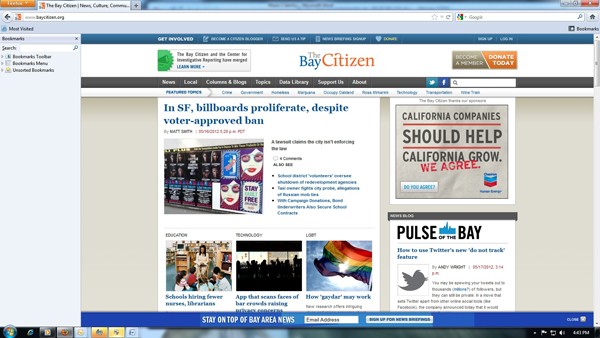
But that’s not the case with The Bay Citizen. Despite its self-proclaimed commitment to “solutions-based” reporting — that is, according to Rosenthal, journalism that spawns results in some way, whether that’s increased awareness, changed behavior, or, ideally, legislation and regulation — The Bay Citizen mostly focuses on relatively small-scale civic issues. Take the BayCitizen.com landing page from May 15. Of the seven lead stories, three were produced by Bay Citizen staffers, three by California Watch staffers, and one by the wire service Bay City News. The three by Bay Citizen writers were about San Francisco billboards; a mobile app that scans bar patrons’ faces; and tightening state oversight on vocational schools. All were important stories, to be sure, and thoroughly reported and well-written — but none were pieces that a beat reporter for the Chron or Bay Area News Group, which publishes the Oakland Tribune, the Contra Costa Times, and the San Jose Mercury News, couldn’t have covered. But buying stories from The Bay Citizen is cheaper for newspapers and easier than assigning a staff writer. And with papers struggling to save money in any way possible, it’s not hard to imagine the Bay Area News Group, for example, replacing more and more of its content with Bay Citizen stories, thereby coming to look more and more like every other paper in the region.
In other words, it wouldn’t take much to tip the precarious balance that nonprofits and for-profits have set up, in order to co-exist. If nonprofit news continues to cover stories that for-profit papers traditionally have, and continues to allow papers to lay off their staff (or not hire new staffers), for-profit newspapers will, fundamentally, come to be devalued. Then there’s a spiraling effect: the more newspapers that go out of business, the fewer places nonprofit news organizations will have to run their content. The fewer vessels nonprofits have, the fewer staff they need. And so on.
In short, the new news economy is operating on a tightrope, and doesn’t seem to know it.
There’s another wild card that could easily throw a wrench into the system: the IRS. Although the agency hasn’t issued a specific ruling, it has set up roadblocks in the past two years preventing journalism start-ups from attaining tax-exempt status, and the delays have been paralyzing. SF Public Press, for example, has waited two years to become a 501c3. Executive Director Michael Stoll said that if its application isn’t cleared soon, the news organization will probably wither and die. So will many other organizations, said Davis of the Investigative News Network. “I can tell you that this problem with the IRS is having a chilling effect,” he said. “The difficulty of getting this very necessary designation means the movement is stifled.”
Traditionally, nonprofit journalism would fall within the “educational” category for tax-exempt organizations, since their purpose is to disseminate information for public benefit. As such, current laws prohibit them from weighing in on political campaigns, privileging “mass appeal” content over fact-based news, and using business methodologies that resemble those of a commercial operation. They also have to sustain distribution models that hew to their mission of effecting change.
In the past couple years, a spate of journalistic organizations applied to become nonprofits — enough that high-profile donors like the Knight Foundation would get up to a dozen applications from a single city from start-ups all claiming they were “doing something new.” The IRS noticed it, too, and suddenly became wary. After all, it set most of the precedents for nonprofit tax exemptions prior to 1970. (It created a rubric for educational organizations in 1967.) Nonprofit journalistic organizations existed back then, but they certainly weren’t as numerous, and they operated in a completely different news environment. Since the onslaught of nonprofit journalism applications could be grounds for a new precedent, the agency has been proceeding with caution. Hermes of the Digital Media Law Project surmised that the news start-ups warranted consideration as a group, rather than on a case-by-case basis — though, that said, the IRS evidently made an exception for the Investigative News Network, which became a bona fide nonprofit in March.
While there’s no evidence of ill will on the part of the IRS, the delays have created a huge financial setback for young outlets, many of whom can only sustain themselves by partnering up with an existing nonprofit that can serve as a financial sponsor. SF Public Press formed a relationship with Independent Arts & Media that falls along those lines — it can solicit grants under the auspice of the larger organization, but it has to pay a fee for every donation it receives. “So it’s like a 7 percent tax that’s slowing down our growth,” Stoll explained. He added that it’s very difficult to approach foundations without the 501c3 imprimatur. “Fiscally sponsored projects may get a third to a half of what an independent 501c3 gets,” Stoll lamented. “No one’s said that explicitly, but that’s been our experience. So we’ve lost many thousands of dollars.” Not to mention that SF Public Press misses out on Google grants, discounted software from Salesforce and Tech Soup, and reduced-cost insurance.
To make matters more difficult, the SF Public Press’ foundation funds often come with the admonishment that the organization needs to become a 501c3 as soon as possible. The implied message: Without that designation, more money isn’t forthcoming. “So we’ve had to plead with our funders,” Stoll said. He acknowledges that while this “intermediate” tier of philanthropy might work as a temporary Band-Aid, it’s ultimately not a viable business model. Davis agrees.
If the IRS continues to drag its heels, then many agencies with the same intentions as CIR could quickly die. That would, in effect, strengthen the existing nonprofits. They would have access to a greater share of a finite amount of foundation money, which, in turn, would allow them to boost their staffs and widen their reach. CIR’s current staff of seventy dwarfs that of most daily and weekly newspapers.
More problematic, though, is the fact that if mainstream newspapers have to rely heavily on one nonprofit for a large portion of their content, then all of them would start looking the same. But that wouldn’t necessarily be true if the outside content were culled from a variety of sources. A newspaper that purchases some of its content from an outside supplier can still distinguish itself as an aggregator. But that’s not possible without multiple suppliers to choose from.
Paradoxically, having a healthy variety of nonprofit news outlets might actually be good for for-profit newspapers, especially since nonprofits aren’t allowed to act as commercial operations — SF Public Press only earns 20 percent of its revenue from content-sharing, versus 50 percent from foundations. Yet, a sudden onslaught of 501c3-certified news start-ups might also pose threat to the for-profit press. If the IRS were to have a change of heart tomorrow, and suddenly loosen its standards for journalistic tax exemptions, then newspapers would suddenly face an onslaught of competition from outlets whose very purpose is to be as widespread and voluminous as possible. At a time when many for-profits are putting up paywalls and cutting their circulation, it could be extremely damaging to suddenly have a new peer that offers similar content for free.
Davis suggested that the two paradigms are actually at cross-purposes: “As newspapers continue to turn to paywalls, and close off their news, and make it available only to those who can afford it, they actually become less attractive,” he said. “If you look at the mission of the majority of nonprofit news organizations, it’s to get that content out and have an impact.”
Commercial newspapers don’t compete with nonprofits for advertising dollars, but they do compete for readers, which are indirectly related to advertising dollars — given that the product a newspaper sells to advertisers is its audience. If the Chronicle, for example, publishes a lot of California Watch stories, and California Watch offers the same content for free on its website, then readers would have less incentive to pay for a Chron subscription. More audience-share competition would impact the Chron‘s website, SFGate.com, as well. If more people click on CaliforniaWatch.org to get their news, rather than clicking on SFGate, then the overall page views for SFGate would decrease. That’s dangerous for a publication that relies on pageview metrics to make advertising revenue.
Still, nonprofits have a point when they say that they’re simply trying to stanch a wound that already exists. Davis argues that the model isn’t an indictment of any one newspaper — it’s acknowledgment that the system, at large, is broken. People aren’t even relying on old-school rubber-banded, paper-and-ink newspapers to get their news anymore. They’re using social media — the folks who, ten years ago, might have looked for a paper on their doorstep every morning are now checking Twitter as soon as they wake up, and using friends’ status updates on Facebook as their news feed. It’s a brave new world for journalism, Davis says, and you just can’t expect the old paradigm to work anymore.
Yet, if the new model of free, mass-distributed, donor-funded, high-impact news eventually supplants the old one, is that any better for readers? There’s a finite pool of professional journalists in the Bay Area, and if you look at the masthead of CIR, you’ll see it consists, largely, of refugees from for-profit outlets. That alone suggests that the relationship between nonprofits and for-profits is somewhat problematic. As the new system grows, it enables the old system to cut back, which could, ultimately, be deleterious to both sides.
After all, fewer newspapers mean fewer vessels for nonprofits to distribute their content — and if the goal is maximum impact, then even a robust nonprofit might fall short.