The radio station is little more than a back office tucked into a strip mall on the outskirts of Sacramento, just past a lonely Home Depot and two different Starbucks drive-throughs. Filled with one desk and a short stack of electronics — primarily a CD player and some sort of jet-black transmitter with blinking red lights — KDEE pumps a feeble 100 watts into the Sacramento Valley, pushing radio waves only as far as the foothills a few miles away.
But with its unique programming — a fearless song choice that bounds from thumping GrandMaster Flash to lesser-known Stevie Wonder songs (music that commercial stations rarely play) and earnest public-service announcements that urge black men to get their diplomas and tell women to eat more healthfully — the station is, in fact, part of what may be one of the most important trends in broadcast media. “Radio needs to speak to something,” said Tristen Hayes, a forty-hour-a-week DJ and self-proclaimed talk show host who is one of only three paid staffers at KDEE, a micro-broadcasting station managed by the California Black Chamber of Commerce. Hayes added forcefully, “but let’s not do it to make money.” A former Penn State offensive lineman, Hayes has softened in his post-college decades, yet he still has the presence to stop a locomotive.


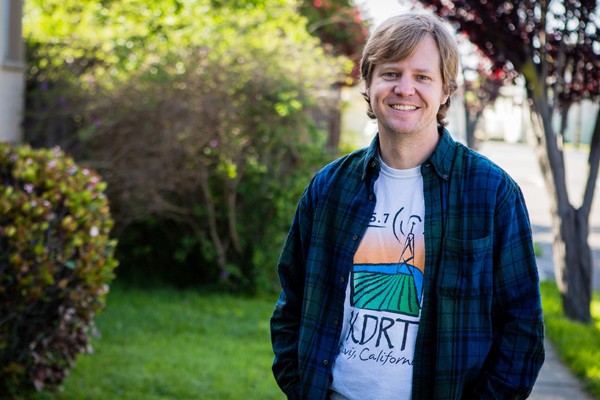
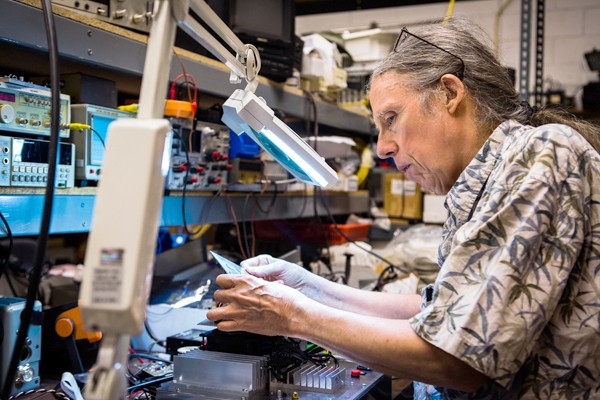
Jeff Shaw, station manager at KDRT in Davis, says the station has about seventy volunteers. Credits: Stephen Loewinsohn Stephen Dunifer created Free Radio Berkeley. Credits: Stephen Loewinsohn Susan Galleymore of Alameda Community Radio hopes to score an LPFM license. Credits: Stephen Loewinsohn


Hayes pushed away a crane-neck microphone bolted to the desk, leaned back in his chair, and crossed his broad arms over his middle-age belly. He wears Ben Franklin glasses, and a knuckle-size diamond earring. “Radio is broken,” he said, “and no one is speaking to us.” He paused before clarifying, “In Sacramento, nothing spoke to Afro-Americans, unless it was for some political advantage.” He talked over a Chaka Khan song. “Now we have The Chocolate News. We have shows about how the White House affects your house, how health care affects you. We talk about real estate at eye-level; there’s not a whole lot of Ebonics here,” he laughed. “We lock people in by playing great music, and then talk about real issues.”
Historically, radio has represented its sense of place better than other forms of media — consider iconic shows like the Grand Ole Opry and A Prairie Home Companion, or even music itself, often labeled as the Seattle-, Minneapolis-, or British-scene. But over the past fifteen years, radio, more than any other medium, has experienced the quick consolidation of ownership and control of stations by corporate interests. In the mid-1990s, the nation’s 10,000 radio stations were owned by some 5,000 entities. By 2008, four companies — most notably, Clear Channel — had gobbled up more than half of the radio airwaves, and were increasingly elbowing out locally produced programming in favor of formulated playlists and nationally syndicated talk shows.
Yet in a quixotic effort to counter this trend, community organizers and pirate radio station enthusiasts tried ten years ago to convince the Federal Communications Commission to open up the airwaves to small, community-focused stations. Surprisingly, they won approval, and over the past several years roughly 800 hyper-local stations have popped up around the country — including 61 in California, like KDEE in Sacramento, as well as a Hawaiian-music station in Watsonville, an environmentally focused one in Mendocino, and a station in Oroville with six hours of programming exclusively for nearby Hmong residents.
And, in the coming months, this plan for “locally-grown radio” is set to double in size, scope, and, correspondingly, impact. In January, President Barack Obama signed into law the Community Radio Act, an order to open up the airwaves to a second batch of 1,000 or so micro-broadcasting stations — or, in FCC parlance, LPFM stations (low-powered frequency modulation). The FCC currently is hammering out final details, but as soon as this summer, an opportunity for those licenses will become available. And, for the first time, the FCC is looking to open up airwaves in urban areas like Berkeley, Oakland, and San Francisco, where the crowded radio band precluded any LPFM stations during the first round of licensing.
So far, the battle over America’s airwaves — and how these new LPFM stations could help change the tenor of radio across the country — has mainly been fought in Washington, DC. Traditionally, the FCC has sided with large broadcasting conglomerates that seek to dominate the radio dial. But recently, the agency pushed back against these corporate interests and created more openings for community radio stations in even more cities. Yet these new opportunities will hardly be a slam dunk for groups like California Black Chamber of Commerce or other community organizations: For starters, the competition for these new licenses promises to be intense, and if past practices are any indicator, the FCC tends to favor religious organizations when it hands out licenses.
In Sacramento, one of the few urban areas to receive permission for a LPFM license, these micro-broadcasting stations are critical for defining communities, a duty ignored by the syndicated programming from the mega-chains, Hayes said. “We have a space for Curtis Mayfield,” he said, “and we’ll also tell you about some great job opportunities, and help you go back to school, if that’s what you want. We’re a radio station designed to speak to people.”
Nearly 20 percent of Sacramento residents are African American, but the black community there traditionally has not been well-defined. It wasn’t until two years ago that the city elected its first black mayor, Kevin Johnson, a former NBA standout, and only one of fifteen Sacramento commercial radio stations, 102.5 KSFM, ostensibly plays to a black audience — and that station is owned by CBS and plays pre-programmed set lists. Hayes claims that listenership at 102.5 KSFM has dropped ten percent over the past year as KDEE has gained popularity.
Hayes admits that he has no idea how many people listen to KDEE, but the studio phone rings steadily. During an hour-long interview, he received five calls and each time answered with a booming, “Good morning, family.”
Yet that rising popularity doesn’t directly translate into economic security for KDEE — or for any LPFM station. Unlike commercial radio stations, where a boost in listeners often converts into more ad sales, LPFM stations don’t enjoy that luxury. FCC rules demand that LPFM stations be hosted and managed by nonprofits, ruling out opportunities for commercial ads or similar revenue streams.
Hayes is more interested, though, in talking about the role that the station plays in building community rather than making money. “I left Clear Channel,” he explained, leaning forward, his voice gaining pitch and momentum. “I was just tired of it. You couldn’t pay me enough to play the same old stuff. I’m a grown-ass man, and I had to listen to that crap.”
Accordingly, his morning, drive-time, radio is called “Grown Folks Music,” which is followed on Thursdays by the award-winning “Going Green Radio Hour,” hosted by a DJ he calls “Enviro-Bro.”
But economics are a reality, and an Achilles’ heel for LPFM stations. The California Black Chamber of Commerce, like most nonprofits, relies on grants and donations, a revenue stream particularly susceptible to economic ups and downs; over the past two years, according to filed IRS returns, donations to the California Black Chamber of Commerce have fallen almost 50 percent. In 2010, the organization raised only $305,000, yet retained its $500,000 annual budget (which includes expenses beyond the radio station).
And, while KDEE’s operating expenses may seem bare-bones, with only three full-time employees, the Sacramento station actually enjoys what seems like a princely budget when compared to other LPFM stations. LPFM proponents report that stations can be launched for as little as $10,000, and most LPFM stations don’t have enough funds to pay staff. In nearby ag-town Davis, for example, is the aptly-named KDRT — and, like most LPFM stations, it’s run by volunteers.
“From eight to eighty years old,” asserted station manager Jeff Shaw. All told, about seventy volunteers staff the Davis radio station, working the front desk, cataloging recordings, and hosting various call-in shows that provide advice on everything from sex to soil conditions.
Shaw pointed out that, last year, KDRT put one person on the payroll, a sound engineer who spends dozens of hours each month recording local bands, as well as hosting a popular show that plays those live-recorded tracks, all for an annual salary of $2,000. “He certainly earns it!” exclaimed Shaw. The sound engineer’s brother, Bill Buchanan, a retired journalist, also hosts a show for KDRT, a top-notch interview program that focuses on heated local issues like water rights and ballot measures; he provides that show for free, as a hobby.
In addition to the tight economic constraints in which LPFM stations must operate, they’re also hamstrung by other FCC rules. Commercial radio stations treat them as unwanted step-siblings. Technically called a “secondary service,” LPFM stations cannot interfere with any commercial broadcast. When Congress and the FCC hammered out rules for the first round of LPFM stations a decade ago, they were successfully petitioned by a bevy of existing, full-powered stations to place large buffer zones on the radio dial to protect existing signals from interference and static from the community radio stations. In particular, the group lobbying for these rules included an unlikely foe for community radio: National Public Radio.
What resulted was called the “third adjacent rule,” perhaps the greatest constraint for LPFM stations. In the simplest terms, the rule said that LPFM stations could not be within three clicks on the dial from any full-power station. “The pie isn’t growing any bigger,” Shaw lamented, referring to the limited number of frequencies on the FM dial, and that the third adjacent rule effectively more than halved those available. “It is how we decide to slice it up.”
The combination of the secondary service status and third adjacent rule proved to be a potent one-two punch against LPFM stations. If a commercial station moved into the area, it could bump a LPFM station from its frequency — which is exactly what happened to KDRT in Davis five years ago when KMJE, an “adult contemporary” station, decided to expand into Sacramento Valley and requested the very frequency — 101.5 FM — on which KDRT was broadcasting. The request threatened to knock KDRT off the dial and out of business.
Davis’ mayor stepped up and declared a “Media Democracy Month,” and several local bands held benefit concerts. Support and small donations poured in. On the studio door, there are still taped notes of support, including a lengthy letter explaining one man’s $5 donation in support of KDRT’s jug band hour. But all that community backing was to no avail. The commercial station was granted its license, and KDRT was pushed from its home on the dial. KDRT later found another radio frequency in the area where it could shoehorn its broadcast signal without interrupting any commercial broadcasts. The station now resides at 95.7.
During the past year, the FCC has been busy negotiating new rules for LPFM stations, deciding what allowances and restrictions would be in place for this next round of licenses — and, not surprisingly, the most heated debates flared up over the third adjacent rule. NPR was steadfast in its support to keep the buffers — a position that made few friends in the LPFM circles but has helped it add 150 more stations to its 635 affiliates over the past decade, stations that would have had a decidedly more difficult time finding adequate space on the airwaves if not given priority over LPFM stations.
Yet in spite of the heavy lobbying, the FCC released in March a tongue-tying report entitled, “The Fifth Report and Order, Fourth Further Notice of Proposed Rulemaking and Fourth Order on Reconsideration.” It was a shocker; it sided with LPFM stations and tossed out the third adjacent rule. It was a remarkable decision, and will allow more LPFM stations to squeeze in on radio bands around the country, especially in urban areas.
Not surprisingly, micro-broadcasting has its roots in the ideals, movements, and personalities of the Berkeley Free Speech Movement. “It is electronic civil disobedience,” said Stephen Dunifer.
Sitting in a windowless warehouse in Emeryville, wearing faded blue jeans and an unbuttoned flannel shirt, his long gray hair pulled back tightly, Dunifer looks like he came directly from central casting for “aging hippie.” Cluttered with motherboards and boxes of circuits, the bunker-like space is as unassuming as the back room of a Radio Shack store. Two college-age interns scurry in the background, assembling radio transmitters and antennas. “People should occupy FM radio,” he added in a slow, careful cadence. “If we’re going to do anything meaningful and long-term, we need to build alternative institutions.”
Dunifer is so legendary among pirate radio enthusiasts that more than one radio manager interviewed for this story claimed that Dunifer inspired the movie Pump Up the Volume, the 1990 film starring Christian Slater as a ham radio operator who hijacks local radio frequencies to titillate his fellow high school students with brooding and horny soliloquies, and the only teenage romance ever to feature the FCC as the villain. In fact, Dunifer did not, but he has gone toe-to-toe with more FCC agents than any living radio operator. And his pirate radio station helped inspire a nationwide — if not global — movement toward micro-broadcasting, a trend that in recent years has matured into a steely alternative to the increasingly cookie-cutter — and corporately owned — stations that populate the airwaves.
Almost twenty years ago, Dunifer started broadcasting a Sunday-evening pirate-radio show from his house in the Berkeley Hills, talking about everything from the Gulf War to Earth First. After agents came knocking — somewhat ironically, Dunifer explained, because they arrived just as he was talking on the radio about how free speech allows public nudity — he took the show mobile, hiking into the hills with a transmitter, a battery pack, and an antenna.
Unable to track down his pirate radio broadcasts, FCC agents took legal action and tried to stop him with an injunction in federal court. But when that injunction failed, Dunifer took advantage of the resulting legal ambiguity to set up a round-the-clock station in a flophouse that made WKRP seem like a monastery: “The point was to make a free-speech statement,” Dunifer said.
Part performance art, part anarchy, the Free Radio Berkeley station aired shows from some four or five dozen people, including a steady stream of punks and what Dunifer calls “various shades of black and piercings,” and shows by homeless men and women.
Like many pioneering movements, Dunifer’s local efforts were part of an uncoordinated golden era: Throughout the Nineties, several other pirate radio broadcasters also used radio as a means for community organizing; most notably, a small-scale station, Black Liberation Radio, broadcasted — and continues to do so — news to housing projects in Springfield, Illinois. The station ran stories not being covered in the mainstream media, including how the AIDS epidemic was disproportionately affecting the black population. (Perhaps not coincidentally, a young, recent Harvard law school graduate, Barack Obama, started his career as a community organizer in those housing projects.)
A smattering of other pioneering micro-broadcasting stations also popped up across the country, including a Black Liberation Radio spin-off station in nearby Decatur that paid particular attention to a contentious union struggle against the machinery behemoth Caterpillar, and a station in southern Florida that championed the rights of local tomato pickers.
At the same time, pirate radio was taking on even more dramatic conflicts internationally. B-92 in the former Yugoslavia operated from unknown studios to chronicle the military conflict there (and continued to play music throughout the Bosnian War). A quasi-station known as Bush Radio organized anti-Apartheid forces by recording shows in Cape Town and distributing them on cassette tapes around South Africa.
But then, in 1996 (cue needle screeching across a record), President Bill Clinton signed into law the Telecommunication Act of 1996, effectively overwhelming the trend toward more locally grown radio stations. Most notably, the law reversed decades of ownership restrictions that prohibited a single corporation from holding multiple media stations in one market.
Norm Stockwell, a radio manager for community radio station WORT in Madison, Wisconsin and a longtime advocate for LPFM, calls the Telecommunication Act a “massive giveaway” that set up a “land grab” by corporate interests. Clear Channel, in particular, was busy, increasing the stations it owned from 43 in 1996 to more than 1,000 five years later. “In terms of what we should be doing with media in this country,” Stockwell said, “this was the exact opposite.”
But then something completely unexpected happened, and it came from a surprising source: William Kennard, who had been the FCC’s general counsel, took over the agency and embarked on an international tour to learn about radio in other countries. He was particularly interested in pirate radio stations in South Africa and their role in that country’s move toward democracy. “It is important to note,” Stockwell said, “Kennard is African American and, in particular, the ownership [of radio stations] by African Americans had dropped off a cliff” after the 1996 Telecommunication Act.
When Kennard returned from overseas, he floated the radical idea of inviting community groups to start their own radio stations. It would be like ordering all the media moguls at Rockefeller Center in New York City to invite Occupy Wall Street activists to host their own shows from ham radio kits. Kennard proposed to issue eight hundred licenses for LPFM stations to nonprofit groups.
Not surprisingly, corporate interests railed against the idea, including heavy lobbying from NPR, which complained that the new stations would clutter the airwaves, especially the lower frequencies on which most NPR stations exist.
Remarkably, the proposal survived largely intact and, during the first round of applications, the FCC was overwhelmed with reportedly more than 12,000 applicants. Ultimately, eight hundred new licenses were issued, a glut of new voices on the air.
Compared to reality TV shows that tend to profile Americans as middle-class suburban dwellers, micro-broadcasting stations around the country provide a platform for diverse demographics. A coastal town in New Hampshire, for example, broadcasts All Things Gay. And a station in Louisiana provides a mix of zydeco music and tips about starting small businesses.
Perhaps also as an accurate mirror of “real” American life, half of the LPFM licenses issued during the first round were given to religious organizations and churches — certainly a reflection of the current political and social dichotomies that tend to split Americans between liberal and conservative.
When asked if the FCC’s allowance of the community radio stations is a David versus Goliath story, Dunifer waved the question away. “That’s a bit hackneyed,” he said. Dunifer’s hands are knobby and bent. He has always been a righteous thinker: At age thirteen in rural Kentucky, he once spent an afternoon documenting decrepit county bridges and submitted the photographs to the local newspaper; the resulting two-page spread sent county officials scurrying. “It is a lot of Davids; it shows the power of grassroots organizing to affect change from below.”
Dunifer does recognize the irony in the fact that the agency he fought for more than a decade, the agency that sent agents chasing him into the Berkeley Hills and dispatched lawyers from Washington DC for a full-court, years-long legal battle, is now the very agency championing — or, at least allowing — these stations to take to the air. “It is absolutely a big step forward,” he said. “We basically forced the FCC to do something they said they would never do.”
But Dunifer’s enthusiasm is tempered. “We’re reclaiming resources that belong to us, but when you go into licensure … you compromise certain things,” he said. “I don’t care if it is a driver’s license or fishing license, it is basically a contract. When that agency is the FCC, for example, you give up constitutionally protected rights.” He listed a few examples, like, the seven dirty words you can’t say on air, and the fact that the FCC can enter a radio station without a warrant.
Dunifer is hosting a series of four-day workshops starting May 25 to help individuals and nonprofits apply for a LPFM license, and to launch their own LPFM stations, teaching everything from legal aspects to the nuts and bolts of building a transmitter.
One local group is already jockeying to be one of the Bay Area’s first LPFM station. Starting two years ago, Alameda Community Radio began gathering at the local library every other week to figure out how to convince the FCC to award one of its coveted LPFM licenses to the island city. “It was amazing the radio backgrounds that have been brought out,” said Susan Galleymore, one of the primary organizers.
“Former radio hosts, engineers, people who had been involved with college radio — a bunch of radio experience already existed in the community,” she continued. Galleymore’s own background includes journalism and radio production. After her son served in Iraq and Afghanistan, she wrote a book, Long Time Passing: Mothers Speak About War and Terror.
Galleymore affectionately refers to Alameda as “this little town” and noted that, although situated near major cities, it has its own unique personality — along with its own politics and controversies. But those “little town” comings and goings are often overwhelmed by powerful personalities in nearby San Francisco, Oakland, and Berkeley, and ignored by the area’s TV, radio, and newspapers, which focus on the bigger cities.
To gather interest in local issues — and as a preface for the potential radio station there — Galleymore has been creating podcasts over the past year, called “Alameda Topics,” on everything from golf courses to a recent controversy over an animal shelter. While her podcasts are only available online, Galleymore said she prefers real radio, especially as a means to build community. “The access is so immediate and the access is so easy,” she said. “It is easier to turn on the dial in your car or in your house, and it is so much better than sitting down in front of a computer.” Galleymore agreed that there is something “old-style” about radio, and believes that is also part of its resurgent appeal.
Based on the response to the first round of LPFM licensing ten years ago, the competition in these coming months will be heated. The FCC considers each applicant based on a scorecard that looks at a community’s need for a unique voice and at the general organization of the nonprofit applying — considerations that could favor an organization like Alameda Community Radio, which has been preparing for the past two years.
But these very considerations also have tended to favor churches and religious organizations, which have built-in audiences and tend to have strong organizational track records. In the last round of licensing, roughly half of the licenses issued were given to religious organizations. The FCC even split one license in Madison, Wisconsin between two applicants — a church and a group of self-declared secular progressives. The two groups split the day with twelve hours of programming each. Progressives follow the church group’s programming with an “atheist hour.” Of 61 existing LPFM stations in California, 27 were given to churches, including stations like KKJD, hosted by Borrego Springs Christian Center, and KCYC in Yuba City, which is run by North Valley Calvary Chapel.
But Alameda Community Radio does have one unique competitive edge in its application: It already has infrastructure for a radio station. Several decades ago, KJAZ, a once-popular music station, broadcast from the island’s western edge. In 1994, though, the station was purchased by a Texas corporation and eventually moved. But the antenna is still standing, unused, near the library where the group currently meets. According to Galleymore, the owner is excited to rent it out again.
Galleymore admits that her group had begun to lose steam over the past year as the FCC remained vague about when it would begin to consider applications. But now that deadlines are being announced, Galleymore is seeing a return of enthusiasm. “Everyone wants to host their own program,” she said, laughing. “It is really exciting.”