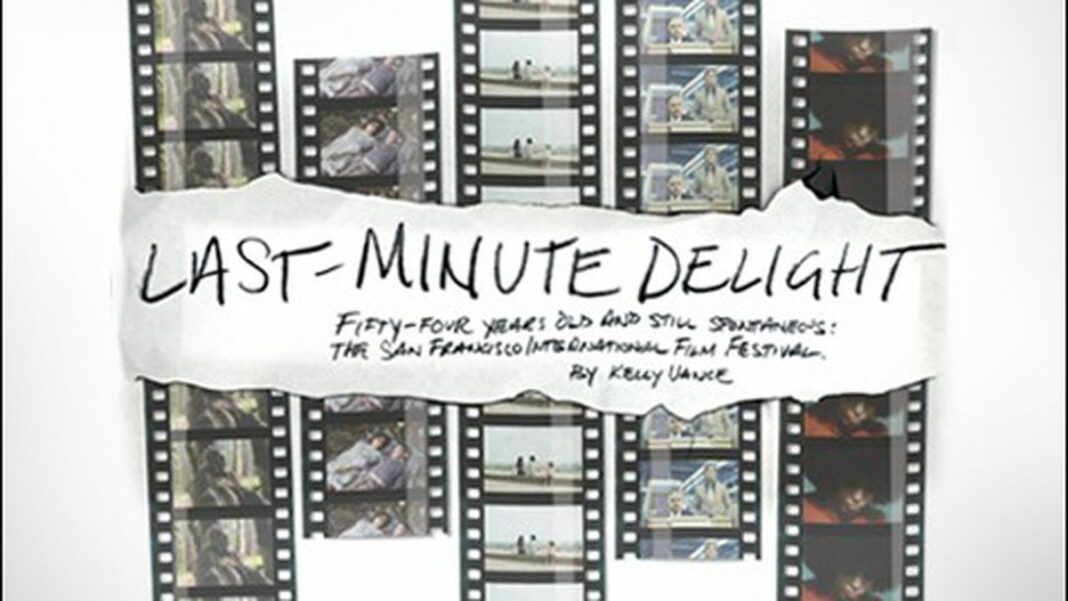
When Graham Leggat, executive director of the San Francisco Film Society, got up in front of a press conference on the top floor of the St. Francis Hotel on Tuesday morning, March 29, and admitted that the 54th San Francisco International Film Festival was still, at that late date, somewhat of a work in progress, it was a refreshing bit of candor in a business that’s notable for the lack of it.
Wiry, affable Leggat, the very model of a leading cultural bureaucrat, has the polished arts presenter’s knack of spinning complete disasters into minor glitches, and anything less catastrophic into full-fledged triumphs. “The single hardest part of my job,” he explained that morning, “is getting the festival honorees to show up, on time and under budget.” Evidently Leggat had had more than usual trouble in that regard this year or he wouldn’t have mentioned it.


A young boy learns about class strife, sex, and politics in the aftermath of the Spanish Civil War in Black Bread. Better This World follows a pair of political activists during the 2008 Republican Convention.


Lots of last-minute arrangements were still being made, he confided to the gathered hundred or so reporters and film folks in the hotel’s Alexandra Room. One prospective special guest was under the impression that San Francisco was part of Los Angeles. That meant logistical problems, so that particular program was scratched. And so on. The festival brass were still trying to figure out who would receive the Founder’s Directing Award and the Peter J. Owens Award for acting. But not to worry, Leggat assured the audience, the show would go on.
And it will, and no one who buys a ticket will feel short-changed. In fact, the longest-running film festival in the Western Hemisphere could afford to dispense entirely with movie stars — it had them aplenty in the Sixties and Seventies — geographically challenged filmmakers, and other talent, and just show its 188 films without the publicity ballyhoo, with nothing lost. It’s always a pleasure to encounter the odd director, writer, or actor in person at the annual festival, but for Bay Area audiences the films themselves are the big draw.
This year’s crop — the first full festival put together by director of programming Rachel Rosen — doesn’t overwhelm us at first with bright lights and brash showmanship, but insinuates itself in the collective audience consciousness by degrees, until we’re ready to declare that it’s been a remarkable year for festival-weight international movies. Under the circumstances.
Three and a half years into the Great Recession, we’re starting to see the full effect of the worldwide economic slowdown as a thematic point. There’s a decided whiff of bust in the air, and a wistful, farewell-to-all-that mood to go along with it. Hence the clump of films that might as well go out under the rubric “Things Ain’t What they Used to Be.” Detroit Wild City is just such an experience. Florent Tillon‘s documentary on the economically battered Motor City stumbles into all the obvious pitfalls of a French filmmaker trying to draw sweeping conclusions about American power based on shots of Detroit’s empty downtown and rows of abandoned homes. And yet, if we view it as an impressionistic tone poem rather than as reportage, Detroit Wild City comes across as a sympathetic portrait of survivors — the men and women who plant vegetables amid the ruins. As one urban gardener declares: “They fed themselves once. They stopped, started making cars. Now they can’t eat them. So maybe they’ll go back to farming.” See it at the Pacific Film Archive, May 4.
No such sense of hopefulness in My Joy, writer-director Sergei Loznitsa‘s rambling narrative visit to his Russian homeland (shot in Belarus). Loznitsa, usually a documentary maker, uses a string of central characters, each less trustworthy than the last, to populate a chaotic countryside where crooked highway patrolmen, violent thieves, a teenage hooker, a bitter old veteran of the Great Patriotic War Against Fascism, and desperate, demented villagers all lie in wait for the unwary — essentially anyone who passes by. If you’re crazy enough to turn your back on one of these people, they will bash your head in and steal your shoes — obviously destined to work wonders for tourism to the former USSR. A bit hard to take, but filmmaker Loznitsa manages to turn misery into art. My Joy screens April 30 and May 3 at the Kabuki.
Mette and Annemette Beckmann are also having money problems. The subjects of Eva Mulvad‘s documentary The Good Life, a mother-daughter pair of formerly well-off Danish expats trying to keep their heads above water in Portugal, bear a distinct resemblance to the women of Grey Gardens — but a notch or two lower on the grandeur scale. Daughter Annemette, a one-time debutante, doesn’t seem to grasp the situation: “I’d rather die than work.” They survive by penny-pinching and borrowing, and filmmaker Mulvad hovers over them like a vulture. Good, clean, morbid fun. Plays the Kabuki on April 22 and 28, and May 1.
The “Things Ain’t What They Used to Be” tour continues with The Last Buffalo Hunt, another stealth social commentary by Cal Arts film prof Lee Anne Schmitt (she made the brilliant California Company Town). Schmitt’s doc packs us along with the modern-day cowboys who escort wealthy hunters and trophy-tourists on licensed hunting trips in search of wild bison near Hanksville, Utah. Business is good (at $3,000 for a four-day hunt), but the hunters’ dirty jokes and “dominant individualism” are growing stale. Meanwhile, tubby townsfolk are content to see pictures of buffalo in a museum. Warning: You will watch a buffalo die, slowly. For that and other reasons, it’s one of the saddest movies you’ll ever see. Showing April 23 and 26 at New People (1746 Post St., San Francisco) and April 27 at the Kabuki.
The “Things Ain’t What They Used to Be” movies are not uniformly depressing. Residents of the small Quebec town in The Salesman are doing their best to put a positive spin on tough times, especially avuncular Marcel Lévesque (played by Gilbert Sicotte), who sells cars and trucks at a dealership in snowy Lac Saint-Jean. Business is slow but Marcel maintains the upbeat patter, even when tragedy strikes. He’s disconcertingly cornball, but writer-director Sébastien Pilote follows Marcel through the eye of the needle and makes us care. The Salesman screens at the PFA, May 3.
Meanwhile, in the Willets Point corner of Queens, New York, just across the way from the new Citi Field home of the New York Mets, the last of the auto-parts junkmen are playing out the string. Their muddy car-parts row is scheduled to be torn down for redevelopment, and documentarians J.P. Sniadecki and Véréna Paravel are on hand to introduce us to the local characters. Foreign Parts, a relaxing rainy-day character study of real-life lovable losers, plays the PFA on April 23.
Of course, not every film in the festival is a Recession Special. There are monsters, lovers, and monster lovers. Those three types of characters interact gratifyingly in Christopher Munch‘s Letters from the Big Man, the outdoorsy story of an environmentalist named Sarah (Lily Rabe) and an unnamed sasquatch (Isaac C. Singleton Jr.) who relate to each other — in their way — in the Oregon forest. It would make a terrific horror movie, mainly because writer-producer-director Munch abandons the most annoying clichés of the genre (rumbling bass soundtrack, etc.) while retaining the hushed dread of the unknown, lurking just outside the window wherever Sarah goes. The bigfoot is shy and Sarah is complicated. Possibly the most entertaining film in this festival. Catch it at the Kabuki April 29 and May 3, or at New People, May 5.
Black Bread, a narrative feature by writer-director Agustí Villaronga, is the sort of well-written, carefully cast, unobtrusively political European drama that has been the staple of film festivals ever since film festivals began — not to say that it’s hackneyed or predictable, just reassuringly familiar. In the aftermath of the Spanish Civil War, a Catalan boy named Andreu (Francesc Colomer) learns about class strife, sex, politics, and ghosts — not necessarily in that order — while the ubiquitous Sergi López once again, as in Pan’s Labyrinth, portrays a sadistic Fascist with “Reds to purge.” Worth a look at the Kabuki, April 29, May 2, and May 4.
Most of the titles discussed above fit into well-established categories common to film festivals around the world. But in our heart of hearts, we know that the films we take home with us and cherish in our memory aren’t always the safe, comfortable ones. The unexpected, the unfamiliar, that’s where the flavor is — and we’re not talking about zombie flicks, the most horrendous cliché of programmers eager to latch onto the elusive “yoot” demographic.
Documentaries don’t come any more unexpected than The Black Power Mixtape 1967-1975, a glorious mishmash of American history and pop-cultural riffology from Swedish television. What do Swedes like director Göran Hugo Olsson know about African-American life in the age of the Black Panthers? How much time have you got? After a disclaimer that Olsson’s nine-chapter collage of footage shot in the US by Swedish reporters “does not presume to tell the whole story of the Black Power Movement, but how it was perceived by some Swedish filmmakers,” the doc blasts off for Backthensville: Malcolm X, Martin Luther King Jr., Angela Davis, Stokely Carmichael, the Vietnam War, CIA drugs in the ghetto, Oakland, Harlem, etc., with vivid after-the-fact commentary by Erykah Badu, Melvin Van Peebles, Bobby Seale, Kathleen Cleaver, Harry Belafonte, and Abiodun Oyewole of The Last Poets. To see that convulsive era — and the enigma that is America — through the global perspective of Swedish film crews is remarkable. Don’t miss this one when it screens at the Kabuki, April 30, or at New People, May 3.
As long as we’re aboard the time machine: A “lost film” by Rainer Werner Fassbinder is always a find, especially when it’s as dynamic as World on a Wire, the late German auteur’s purple analysis of high technology and the crazy people who sell it, made for German TV in 1973 and seldom shown in this country. The satiric action revolves around scientist Fred Stiller (Klaus Löwitsch), who takes it on himself to investigate the murder of a colleague at a large corporation. Stiller is aided in his detective work by a gadget called the Simulacron, a virtual reality prototype that looks like a wired automotive crash helmet — the user sees into the future, and bystanders are simultaneously treated to the same vision on connected video screens. The Fassbinder stock company — Barbara Valentin, Ivan Desny, Günter Lamprecht, Gottfried John, Ingrid Caven, El Hedi ben Salem, et al — turns out in force, and the music score is a typical Fassbinder helter-skelter grab bag of needle drops, plus electronic sounds. Three hours long and full of laughs and spy gunplay. Showing at the PFA, April 30.
Romanian films have been a cause célèbre for several years in art-film circles, but few have been as easy to digest as Aurora, a 2010 drama by writer-director Cristi Puiu (The Death of Mr. Lazarescu). From the moment he awakens one morning until he comes to a halt on a particularly turbulent day, we observe the comings and goings of a preoccupied man named Viorel (played unforgettably by the filmmaker), who seems ready to snap at the slightest provocation. Creators of the new Romanian cinema are inordinately fond of filling their films with the minutiae of human existence, but Aurora holds us spellbound as Viorel nervously skulks around Bucharest neighborhoods on an endless succession of apparently innocuous errands — all too many of them involving shotguns. Highly recommended. Aurora is at the PFA on May 5.
Two documentaries deserve special mention. In Better This World, filmmakers Kelly Duane de la Vega and Katie Galloway take us step by step with David McKay and Bradley Crowder, a pair of young left-wing political activists from Midland, Texas (no, that’s not a typo) who let their enthusiasm and lack of basic street smarts get the better of them on the streets of Minneapolis-St. Paul during the 2008 Republican National Convention. De la Vega and Galloway produced the thought-provoking doc as part of the Investigative Reporting Program at UC Berkeley. It shows at the PFA, April 26. The Bay Area is the setting for Dan Geller and Dayna Goldfine‘s Something Ventured, a nifty capsule history of the business of venture capitalism — essentially the folks who brought us Apple, Genentech, Power Point, Cisco, Tandem Computers, and what would become the entire home video game industry. Who knew capitalism could be so beneficial? See it at the PFA on May 1.
A healthy percentage of feature films in the festival have already acquired theatrical distribution deals and are designated “Hold Review,” so as not to steal the thunder from their eventual commercial release. Among the Hold Review films are four we’ll undoubtedly want to talk about at length, later on when they open. Werner Herzog‘s new documentary, the Herzog-ishly titled Cave of Forgotten Dreams, ventures into Chauvet Cave in the South of France, where wall paintings (mostly depicting animals) dating back 35,000 years have been found — the oldest art works in the world. Its first US engagement begins April 29 in New York, with eventual stops in the Bay Area.
Also in the Hold Review category: the art western Meek’s Cutoff, directed by Kelly Reichardt and starring Michelle Williams as a headstrong pioneer woman, circa 1845 on the Oregon Trail (opening May 6 in the Bay Area); Norwegian helmer André Øvredal‘s Blair Witch-like horror pic The Troll Hunter, probably the gooey-est monster movie of the year (June 24); and Page One: Inside The New York Times, an informative documentary overview of the state of print media which benefits greatly from the participation of Times media critic David Carr (July 1). You can brag to your friends you saw them first at the SFIFF.
Also recommended: Position Among the Stars, a Dutch-produced documentary about one family’s everyday life in Jakarta, Indonesia, directed by Leonard Retel Helmrich; The High Life, director Zhao Dayong‘s light-hearted narrative look at a group of former factory workers living the post-industrial life in China; Koji Fukada‘s quirky Japanese comedy Hospitalité, about a print shop owner who simply cannot say no to uninvited guests; Cinema Komunisto, a documentary history of the former Yugoslavia’s movie industry, with footage compiled by filmmaker Mila Turajlic; The Redemption of General Butt Naked, a documentary postscript to the bloody 1990s civil war in Liberia, directed by Americans Daniele Anastasion and Eric Strauss; and one of those films you’d think you would only see at a film festival (but which opens in theaters here June 10), Michelangelo Frammartino‘s doctored doc about an Italian village whose main occupations seem to be herding goats and making charcoal, Le quattro volte.
The festival opens Thursday, April 21, at San Francisco’s Castro Theatre with Mike Mills‘ Beginners, starring Ewan McGregor and Christopher Plummer. For tickets and up-to-date festival info, visit Fest11.sffs.org and BAMPFA.berkeley.edu By the way, Leggat and his staff managed to fill most of those special-guest holes. Filmmaker Oliver Stone receives the Founder’s Directing Award, and actors Zoe Saldana and Clifton Collins Jr. share the Midnight Award. As of press time there’s still no word on whom they dug up for the Peter J. Owens acting prize.