
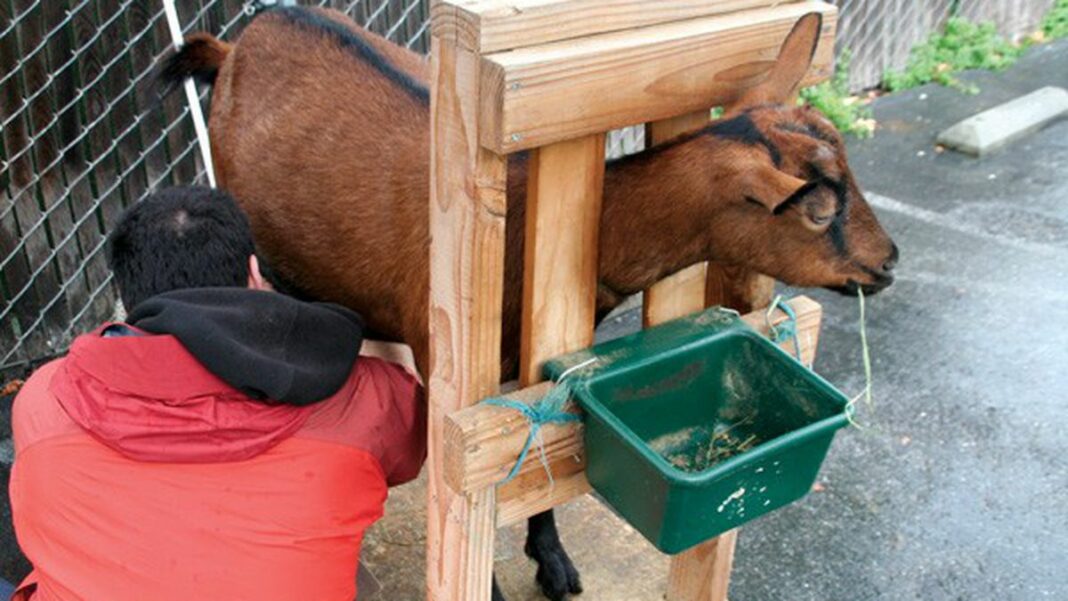
It seems like everyone has a goat these days. It’s technically legal in Oakland, as long as you don’t sell the milk or slaughter the animal on your property — or keep the goat in an apartment building or hotel, which seems reasonable.
A few weeks ago, Oakland goat-keeper Crow (who wanted to go by his first name only) gave a goat-milking demonstration at the North Oakland Farmers’ Market just off Market Street. Crow was recruited by Max Cadji, the outreach coordinator for Phat Beets Produce, a food collective in Oakland. Crow showed up on a rainy Saturday morning with Prima, his three-and-a-half-year-old Oberhalsi. Prima is a Swiss dairy goat common among Bay Area urban farmers. Depending on the age and condition of the goat, Crow estimates an Oberhalsi costs between $175 and $250.
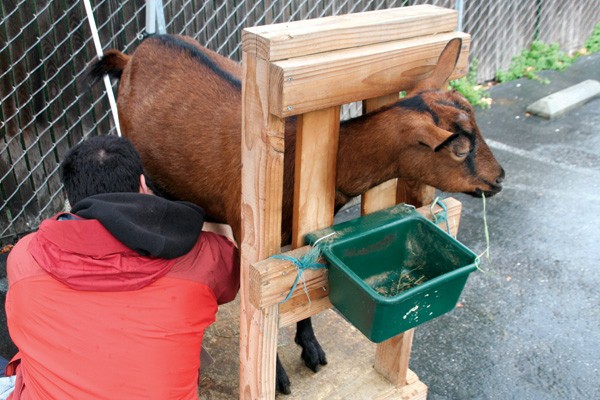
Crow and his goat, Prima. Credits: Keith Esch 

Crow co-owns his goat with about twelve other people, so they rotate the twice-daily milking responsibilities. That said, keeping a goat is easier than it may seem. “Just like with a cat or dog, everyone shouldn’t have a goat,” Crow said. “It does take effort.”
A few years ago, Crow’s wife suggested the family get a dog. “And I said, why don’t we get goats?” Crow recalled. So they turned the garage and yard into a goat-barn-slash-milking-parlor. They spend about $10 a week in hay, plus the cost of molasses treats and diet enhancements like flax seed, kelp meal, and probiotics. In return, the goat provides about four cups of milk, twice a day, which the family drinks unpasteurized or turns into cheese, garlic-herb spread, and caramel. “We haven’t bought milk from the store in a year and a half,” Crow said. “We definitely do better than break even, but it’s not a financial thing. If you’re not into caring for your goat — trimming hooves, mucking the yard in the rain — it wouldn’t be worth it.”
Crow and friends also get to eat the goat’s babies. They recently slaughtered — about thirty miles outside city limits — Prima’s six-month-old kid. “If you’re going to eat meat, it’s nice to know where it’s coming from,” he said. “A lot of our industrial meat [problems] stem from large batches of poorly processed meat.”
Crow’s message fits the broader theme of the farmers’ market, located in the parking lot of the Arlington Medical Center in North Oakland. Cadji said he was approached by one of the doctors at the clinic who asked him to start a market like the one he already had going on Tuesdays at Children’s Hospital down the street.
Unlike many small markets, vendors at the North Oakland market accept food stamps, senior checks, and Women, Infants, and Children (WIC) funds. They offer fresh produce at reasonable prices by working with small, start-up farms through ALBA, or Agricultural Land-Based Training Association, a nonprofit organization that leases land at below-market prices to Latino farmers. The association provides training and connects growers to markets.
As for Phat Beets, it runs largely thanks to volunteers. It also has nonprofit status, which allows it to apply for grants and keep prices low. “A lot of these communities don’t have the privilege of a fresh farmers’ market,” Cadji said. “There are all sorts of ways people get hustled out of what little money they have — a lot of cash-checking places, liquor stores.”
Residents of West and North Oakland are already looking for ways to get healthy food on the cheap. People grow sugarcane along Mandela Parkway, and yards are rife with fruit trees, avocadoes, chickens, rabbits, ducks, and even goats. “These aren’t people who have blogs or work for nonprofits,” Cadji said. “These are refugees from Southeast Asia, these are people who left the south before World War II. … These are low-income seniors who learned to pluck a chicken or skin a rabbit when they were young. And you’d never guess someone living in Oakland for the past thirty years knows how to do this stuff.”
The market isn’t just about selling food, Cadji said, it’s about community. And by bringing back the skills people have slowly lost over time — like goat milking — Cadji hopes to reconnect the generations while improving health.
It’s also about bringing neighbors together, Crow said, as he washed Prima’s udders with hydrogen peroxide, gave Prima’s udder a pull, and smelled the first bit of milk to shoot into the pail — he was checking for mastitis, one of the biggest threats to urban goats. “We walk the goat around the neighborhood,” Crow said. “There are a lot of kids in the neighborhood who just love her. Parents stop by so their kids can feed the goat.”