
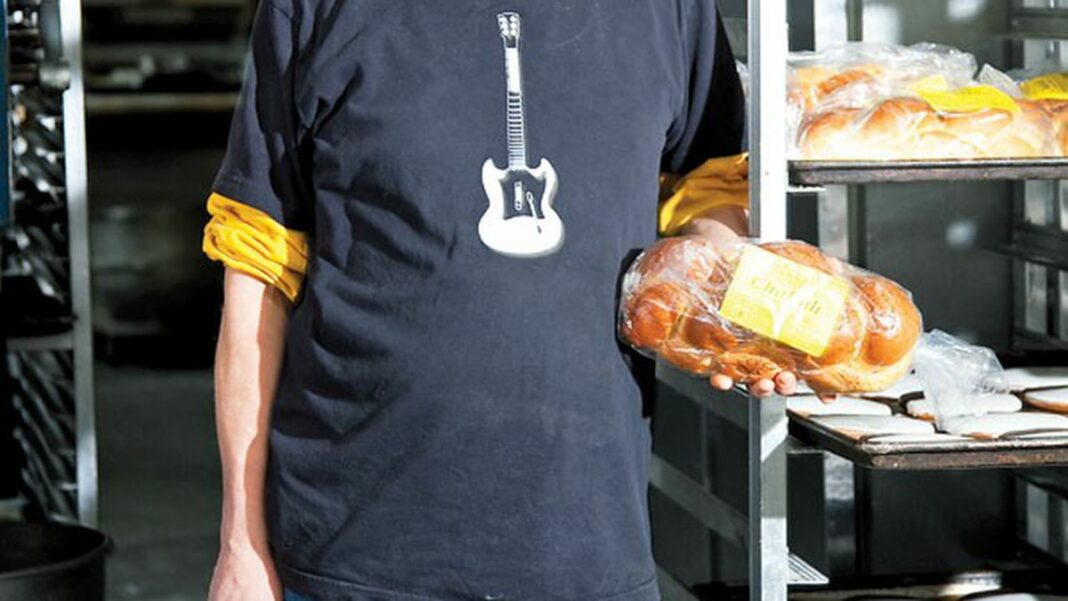
The aroma of fresh breads and pastries wafts out onto Grand Avenue, effectively luring even the most satiated of stomachs. It’s a snare used by most bakeries to turn pedestrians into patrons, but once people enter this business they will quickly notice that it’s not an ordinary bakery, and its owner isn’t your ordinary purveyor of pastries.
Bob Jaffe runs the Grand Bakery (3264 Grand Ave., 510-465-1110) in the Grand Lake neighborhood of Oakland. He specializes in kosher foods and the Grateful Dead. Indeed, the fridges are stocked with freshly made exotics like baba ghanoush and hummus, and the walls are a tribute to Sixties icons like Bob Dylan, the Blues Project, and, of course, Grateful Dead paterfamilias Jerry Garcia.
In a roundabout way, the two motifs belong together. It was the Grateful Dead that led Jaffe to become the owner of the bakery. “I used to come to this neighborhood often because the Oakland Auditorium [now known as the Henry J. Kaiser Convention Center] was the best place to see the Grateful Dead play,” Jaffe said. He liked the neighborhood and retired from his former profession as a wholesale distributer and started a shop that specialized in kosher baked goods.
Fifteen years later, Jaffe is a neighborhood impresario who is as familiar with the local businesses as he is with the names of the kids who come in to buy his cookies. He has seen a lot of changes in the neighborhood over the years but still recognizes some smoldering embers of a hippie fire that once engulfed the bay.
“The anchor of the neighborhood is the Grand Lake Theater,” Jaffe said. “The owner uses the marquee to put up pretty left-leaning statements.” During the height, or rather depth, of the Iraq War, the owner put up messages decrying the tactics of the Bush administration.
He also lauds the neighborhood’s abundance of good restaurants. Next door to his shop is Mijori Japanese Restaurant (3260 Grand Ave., 510-465-8854). “I never ate sushi till it was here,” he said. “I know that every day they have fresh sushi delivered.” For fine dining he recommends Camino (3917 Grand Ave., 510-547-5035, CaminoRestaurant.com), the wood-fired restaurant headed by Russell Moore, who put in years at Chez Panisse.
As far as bars go, Jaffe likes the Alley (3325 Grand Ave., 510-444-8505) and listening to house pianist Rod Dibble. “He’s been singing and playing for, like, fifty years,” Jaffe said. And, of course, Dibble plays in accompaniment of the songs selected and sung by patrons.
On Sunday mornings Jaffe goes down to Smitty’s Cocktails (3339 Grand Ave., 510-834-1591) to watch football. The place has a modest decor and a shuffleboard game, and was described as the definitive old-man bar in Grand Lake by the San Francisco Chronicle.








Kamagra bestellen aus der Apotheke Dosierung zu Beginn ist 25 mg pro Tag mit Wasser vorzugsweise in nüchternem Magen etwa eine Stunde vor einem geplanten Geschlechtsverkehr eingenommen werden.
This is a great inspiring article.I am pretty much pleased with your good work. You put really very helpful information. Keep it up. Keep blogging. Looking to reading your next post….
Cobra120mg Wenn Sie also beim Sex keine Erektion aufrechterhalten können, wird Ihnen Kamagra auf jeden Fall helfen.