

When Kurt Johnson and Dale Scott Heineman set up the Dorean Group in late 2003, they promised homeowners that just by filing a few simple documents with the county they could completely wipe out hundreds of thousands of dollars in debt. Their theory was a gumbo of paranoid conspiracies and self-help gibberish based on an idea known as “vapor money.”
According to this fantasy, which has a cult following, all electronically transferred money is inherently fraudulent, the Federal Reserve Bank is controlled by a secret bankers’ cabal, and gold and silver are the only legal tender recognized by the Constitution. In spite of the delusional quality of this argument, hundreds of homeowners paid the two men millions of dollars to help eliminate their mortgage debt.

More real-estate activity means more real-estate fraud. 
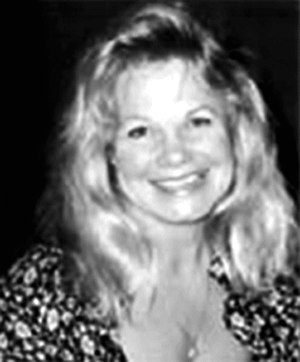
Johnson and Heineman allegedly promised to erase at least 574 mortgages. Doreen Bunnell fell for the pitch. Credits: Craig Sanders Gayle Marie Bradshaw


Johnson and Heineman allegedly amassed a fraudulent fortune from homeowners and lending institutions, depositing some of the funds in offshore accounts, according to documents assembled by the Federal Bureau of Investigation. On the blog where he has railed for months about his fight with the feds, Johnson himself estimated that he and Heineman made close to $5 million through their Union City operation. Even while he was a fugitive from the law, Johnson published rambling, almost-daily manifestos defending his scheme and declaring himself a servant of the Lord working to thwart the agents of darkness.
Federal law enforcement officials, some of the agents of darkness Johnson had in mind, say the two men presided over one of the most ambitious national real-estate frauds in years. The officials claim that the Dorean Group concocted an arcane, almost delusional racket to fraudulently erase the mortgages of up to 574 homes around the country, defrauding lenders of more than $94 million. Johnson and Heineman have been charged with 68 counts of conspiracy, bank fraud, mail fraud, and contempt of court. After six months in custody, the men are finally approaching their day in court. And if a recent preliminary hearing is any indication, it should be a colorful affair.
On February 17, in the Oakland courtroom of U.S. District Judge Lowell Jensen, Johnson and Heineman were dressed in blue jumpsuits with “Alameda County Jail” stenciled on the backs. Heineman, a skinny young man who looked to be in his thirties, wore his hair in long, curly brown locks; Johnson was fortyish, stocky, and bald. The men had decided to represent themselves, and the judge was about to schedule a hearing to make sure they understood how complicated that would be. That’s when Heineman declared that his and Johnson’s purpose in court was to expose the sinister secrets of American justice.
As Johnson stood quietly to the side, Heineman claimed that Jensen’s court was a “supercilious, Machiavellian” star chamber that carried out the orders of a mysterious, extralegal cabal. Judge Jensen, however, still had a chance to reclaim his honor if he would open his heart to “Christ Jesus.”
Jensen briefly humored Heineman. “I think it’s a matter of individual choice,” he said. “We’re here on a matter of civil law, under civil authority.”
“The agency exists for you to administer justice under righteousness,” Heineman retorted.
As Jensen soldiered onward, and outlined the next step in the trial, Heineman had another point to make. “You also mentioned that we’re human beings, and I wanted to verify that,” he said. The government, he explained, had declared its intent to prosecute the fictitious entity known as the Dorean Group, as well as Heineman and Johnson. Yet Heineman and Johnson weren’t fictitious entities, but human beings. Heineman suggested the government, in some kind of grand existential blunder, had indicted two abstractions. “I don’t believe the flesh and blood human beings standing here are being tried or indicted,” he concluded.
In court, Heineman and Johnson seemed like colorful fanatics, but as mortgage-elimination gurus, countless otherwise normal American families went along with them anyway. They convinced hundreds of homeowners that they could wipe out their mortgages with just a few signatures on some fancy legal paperwork. Such is the superheated housing market that hundreds of formerly law-abiding citizens were offered an allegedly illegal scam to defraud their banks and said yes, even though some will certainly lose their homes as a result.
Thanks to the surreal housing market, and an explosion of new forms of credit, real-estate fraud has become a quiet epidemic. The FBI recorded more than 21,000 cases of fraud last year — 600 percent more than in 1999 — but since two-thirds of the nation’s mortgage lenders didn’t report the cases they discovered, the real number may be as high as 60,000. At least $1 billion was stolen from borrowers and lenders in 2005, and just this month the Mortgage Bankers Association urged Congress to commit millions of dollars to a new effort to prosecute mortgage fraud.
But there’s more to the story than greedy crooks and unsophisticated borrowers. As the housing market reaches unprecedented levels, members of the middle-class “ownership society” so celebrated by a certain president are choosing to become crooks. When homes were worth $100,000, there wasn’t as much incentive to welch on the mortgage. Now that East Bay homes are worth about five times that amount, more homeowners are tempted to imperil their futures on even the most transparent cons.
“We’re seeing more real-estate fraud because we’re seeing more real-estate activity,” says Rachel Dollar, a Marin County attorney and specialist in mortgage-fraud litigation. “More and more borrowers are experiencing payment stress, and that’s when it happens.”
Hundreds of Americans did business with the Dorean Group. No one knows how many lost their homes or ruined their credit as a result. No one knows how many marriages were destroyed by the stress. But the Dorean Group isn’t the country’s only “mortgage elimination” business. A Google search can find countless other groups promising that electronic debt is illegal, and that they will help you erase it for a fee. If the housing market cools, and interest rates rise, thousands of homeowners who gambled on risky interest-only loans may feel pressured to fall prey to such schemes.
Very little is known publicly about Kurt Johnson. He tried to call this newspaper once from his Utah jail cell, but did not respond to further requests for comment forwarded through his father, a South Bay physician.
Kurt Johnson was born roughly 43 years ago in Trenton, New Jersey, but his father declines to disclose anything else about his son’s background. Johnson freely admits that in the early 1990s, he was sentenced to almost six years in prison for securities fraud. He was paroled after two years, according to the Sacramento Bee.
Sometime in the last few years, Johnson and Heineman began reading about mortgage elimination programs on the Internet. Such schemes aren’t just a way to make money; they’re a longtime staple for conspiracy theorists who claim the American monetary system is based on a massive fraud perpetrated by a cabal of bankers. The godfather of this movement is G. Edward Griffin, the founder of American Media, a Southern California company that distributes books and videos about conspiracies ranging from the banking system, to the September 11 attacks, to the secret society Skull & Bones. In the early 1990s, Griffin published The Creature from Jekyll Island, the movement’s bible, in which he claimed that ever since the United States replaced the gold standard with paper money, the country has been plagued by inflation, while banking elites print money out of thin air to secretly enrich themselves.
“I don’t think anybody in the movement is doing it because they’re trying to get something for nothing,” says Scot Runyon, spokesman for the mortgage elimination business Li-Bo Enterprises. “They just know they’re in a system that’s not working for anybody except those who know you can turn money out of thin air. … You ever see the movie The Matrix? Go back and look at it a couple times. That movie is a lot deeper than most people think.”
Like many other such businesses, Johnson and Heineman created the Dorean Group to invalidate hundreds of mortgages based on this theory. Homeowners gave the two men a fee ranging from $1,500-$4,500 and signed their property over to them. Dorean representatives then sent the lending institution a document, according to the federal indictment, demanding that the lender prove “to the unilateral satisfaction of the Dorean Group” that the loan was not based on fraud. Failure to respond within ten days, the document added, constituted tacit assent that the loan was fraudulent and invalid. After ten days, the indictment said, Johnson or Heineman filed documents with the county government stating that the debt on the property had been wiped out. Sometimes, they used the supposedly debt-free property as collateral to take out a second mortgage, proceeds of which they split with their client. In theory, they could invalidate the second loan with the same process and borrow more money against the property in perpetuity.
Johnson and Heineman even used their theory to sue lending institutions to force them to acknowledge their loans were fraudulent. In January 2005, federal judge William Alsup categorically rejected their claims, calling their operation “an elaborate Internet scam” and fining their lawyer Thomas Spielbauer $10,000.
Spielbauer declined to comment for this story. But Judge Alsup wrote, “The court here has seen the scam at work. Greater bad faith would be hard to imagine.”
Johnson and Heineman’s legal rationale may be difficult to comprehend, but the pain and anxiety their “clients” have gone through is all too real. From Alaska to Florida, credit collection officials are knocking on doors and threatening to seize the homes of families who trusted the wrong people.
Doreen Bunnell knows she did something stupid. Bunnell spent years making the drive from Stanislaus County to Silicon Valley, where she worked a number of blue-collar gigs. She slept at her father’s house, worked twelve-hour shifts, and returned to the Salida home she’d dedicated her life to financing. Then in 2002, she lost her job, and the bills started mounting. Someone told her about the Dorean Group. “There is now a PROVEN legal and moral way of eliminating your mortgage while adding $50K to your pocket,” the company claimed on its Web site.
Bunnell signed the title to her property over to Dorean, and in August 2004, she was allegedly told her that debt was gone and she could stop making her mortgage payments. “I asked if properties were getting cleared, and they said, ‘On a regular basis,'” Bunnell recalls. “They said when this is over, I’m gonna come out way ahead, and ‘we’re looking out for you,’ blah blah blah. I was sort of brainwashed.”
Then came the threats from Bunnell’s lenders. Then came the foreclosure process. Then came the man from the Stanislaus County District Attorney’s office. That’s when Bunnell realized the Dorean Group was the subject of a criminal investigation. Far from clearing out her debts, she had gotten so far behind in her mortgage she would almost certainly lose her home.
Bunnell tried to sell her house or refinance her loan. But the Dorean Group still held title to the property, and they allegedly refused to release her title unless she paid them $5,000. She filed for bankruptcy in October. She went on food stamps and antidepressants, and took a part-time job distributing food samples at Costco. A few months ago, she says, she thought about killing herself. “At one point, well, I didn’t want to be here no more,” she says. “Let’s put it that way.”
Now she spends most of her time waiting for the day she must surrender her house. Bankruptcy court officials recently promised to help get her title back, so she could at least get a piece of the equity. But her life as she knew it is over. “It was my mistake, and I’m paying for it,” she says. “I lost everything. I sold most of my furniture just to pay for bankruptcy. … I’ve been packing to move little by little, just selling what I can to support myself. … The only time I can bring myself to be happy is if I’m around people, and that’s why I like handing out samples at Costco. I don’t have to think about this till I get home.”
Remarkably enough, though, some clients still believe in Johnson’s scheme — even after the trouble they got in. Gayle Marie Bradshaw works as a colonic hydrotherapist in Sacramento. She swears the banking cabals have perpetrated a secret plot to control our money, and believes that the Dorean Group’s technique would be rock-solid if only they ironed out some technical details. “Bank cartels set up the IRS and the Federal Reserve, and took the ability to print money out of the hands of Congress, and now it’s private banking that does it,” Bradshaw says. “We’re paying interest on money that we should be able to create ourselves.”
Last year, however, Bradshaw had considerably less confidence in the Dorean way. “I was more scared now than ever,” she wrote in notes to herself on September 13, 2004. “I am losing my home, and the DA’s coming to my house.” After a Dorean employee told her to stop paying her mortgage, Bradshaw was swamped with contacts from creditors; a collection agency called her four to eight times a day, she wrote, even calling her neighbors and asking them to bang on her door. A terrified Bradshaw finally got a lawyer, who called Kurt Johnson in an effort to get Bradshaw’s title back. Johnson reluctantly agreed. “I regret that it is too scary for you,” Bradshaw recalled Johnson telling her. “I do not fear the investigators or the nonsense of the banks, so I will remain in the fight.”
Bradshaw eventually agreed to pay a higher monthly payment to make up her arrears, and her creditors let her keep her house. She still thinks they’re frauds, but she knows when she is licked. “I’ll never try this again,” she says. “No matter how corrupt something is, I’m not big enough to buck the system. And the politicians are too corrupt. The banking system is too big. Our worlds are controlled by the banking system.”
The Dorean Group made a lot of money in a matter of months, but the cops got hip to its scheme just as fast. In August 2004, agents in the San Francisco office of the FBI got a call from some South Carolina counterparts, who first learned of the racket from a local bank. According to an affidavit filed to support a search warrant for Dorean’s office, agents learned the details after they began scrutinizing records that Johnson and Heineman had filed with county governments. For example, Johnson offered banks a “bond” to get the property out of debt, but in order to cash the bond, banking officials had to sign a statement admitting that their loan was fraudulent all along. The bond was supposedly underwritten by the First Mutual Trust of Switzerland, but when federal agents investigated First Mutual, they discovered its address belonged to a flower shop.
FBI investigators conducted surveillance of the Dorean Group’s office, interviewed victims, and talked with William Jeffries, a former cop who acted as a broker for Dorean in South Carolina. Throughout 2004, FBI agent Matthew Ernst alleged in an affidavit, hundreds of thousands of dollars were deposited in a Bank of America checking account controlled by Johnson and Heineman, and then transferred to a bank in Latvia, in the former Soviet Union. Ernst concluded in his affidavit that Dorean’s operation was “permeated by fraud.”
On February 1, 2005, the feds raided Dorean’s Union City headquarters. They seized every computer, financial record, and notarized document they could find, as well as $178,000 from the company bank account. A few weeks later, Dorean started fighting back. According to Alex Grab, an attorney for Hannover Properties, the company that owns Dorean’s office complex, Johnson and Heineman filed documents in federal court, listing both Judge Alsup and FBI agent Gordon McDonald as their “fiduciaries.” The documents asserted that if Alsup or McDonald did anything contrary to the Dorean Group’s economic interest, they would be violating their fiduciary duties and owe Johnson and Heineman $10 million. “They look and sound legal if you’re not a lawyer,” Grab says.
Once Dorean’s funds were frozen, it fell behind in its rent, and Hannover sent out a three-day notice. “In response to that, they sent what seems to be a pretty wacky document,” Grab recalls. “It’s a ‘sight draft.’ It exists in banking lore. From what I understand, it’s an outdated equivalent of a cashier’s check. So Hannover Properties got this check for $60,000. It said, ‘payable through Gordon C. McDonald, fiduciary.’ Of course, he’s the FBI agent.”
According to a source in the investigation, Dorean’s officials even bought a new truck and told the dealer to collect the money from their fiduciary at the FBI. The salesman went so far as to show up at the FBI’s Concord office, looking for someone to pay him.
But by early last summer, time had run out for the men. A prosecutor in Salt Lake County, Utah, had been preparing his own indictments and issued a warrant for the arrest of Heineman and Johnson. Heineman was taken into custody, but Johnson vanished. As cops searched the Bay Area for him, Johnson’s blog appeared on the Web. “I am currently a fugitive as I write my first posting and my partner Scott remains in jail on a fugitive warrant without bail,” Johnson wrote. “This is the perfect example of the government abusing its powers to protect the elitist banker cartel.”
From then on, Johnson posted a note almost every day. On July 17, after Judge Alsup issued a restraining order banning the Dorean Group from eliminating mortgages, Johnson penned a long diatribe. “Judge Alsup is a political hack,” he wrote. “This type of man is a coward and needs to lose the very office he has no respect for. … Now he appears again with a civil charge to put me out of business with the same old rhetoric of criminal conduct as his basis. Come on judge, if you have any nuts under that dress put your money where your mouth is. I will even help you bring me to trial as a crook.”
Johnson was arrested a few days later, and he and Heineman have spent every day since then in custody. Johnson then began sending letters to a “proxy,” who would later post them for Johnson on his blog. In September, Johnson announced that he was embarking upon a fast, and his letters started getting weird. Complaints from his former clients flooded in, but Johnson was unrepentant. “Some of you complain because of your personal loss,” he wrote in October. “Should I owe you endless concern for the $1,500 that you paid me? Is that really your expectation? I owe no one except myself; I will do all within my power and skill set (which I am certain is greater than most) to advance a truth that is more important than my life.”
By November 6, Johnson had spent almost four months in jail. The Salt Lake County District Attorney’s office was preparing to drop the charges, clearing the way for Johnson and Heineman to be extradited to San Francisco to face federal charges. Johnson seemed more erratic than ever. He had already filed a “notice and remedy contract” with his public defender, David Mack, claiming that his name was a registered trademark, and Mack’s attempt to represent him in court would cost him a $500,000 “copy write [sic] infringement fee.” Finally, Johnson even wrote a new chapter for the Bible, which he called the “Song of Kurt.”
“You, Lord, have hidden me away in the jails of my enemy,” Johnson wrote. “I was made the reproach of many. Unjustly I was accused of evils. I suffered betrayals from all who claimed friend. …. Worthy is the lamb to receive glory, honor and praise for his meditation, undeserved, moves the heavens and moves my soul to adoration. He who sets the path of lightning, tells the oceans where to cease, heard my prayers and befriended me through His loving kindness. Great is thy faithfulness and amazing Your grace, for who can separate me from Your love? The Lord reigns forever and ever!”
The Dorean Group’s adventure is reaching its final chapter. Johnson and Heineman are scheduled to be tried before Judge William Alsup over the next few months. If convicted, they face sentences of up to thirty years in prison.
It’s hard to know what to call the hundreds of homeowners who participated in the Dorean Group’s scheme. Some, like Gayle Bradshaw, really believe in Johnson’s vision of banking cabals, phony money, and mysterious forces beyond our control. Some let their greed overwhelm their basic common sense. Some are simply suckers who believe anything if it comes with a notarized statement. But others were ordinary people who got into a superheated housing market, binged on debt, watched the mortgage payments empty their bank accounts, and panicked.
If market conditions change in the next few years, the ranks of this last group are bound to swell. In the last quarter of 2005, the number of mortgage default notices in California rose 19 percent, according to the research firm DataQuick Information Systems. One of the factors contributing to this spike is the huge growth in interest-only loans, relatively high-risk instruments that offer low payments in the short term but often ultimately depend upon homeowners being able to refinance later. In 2005, 50.7 percent of East Bay homebuyers took out such loans. If the housing market cools, many of these homeowners will no longer be able to escape the interest-only trap by refinancing. And if interest rates rise from the historically low levels at which they have been hovering, mortgage payments around the country will follow. More and more desperate borrowers will be susceptible to mortgage elimination schemes. Honest citizens will be tempted by fraud.
Kenneth Sims typifies the members of this nebulous class, the hundreds of borrowers whom some might call victims, others accomplices, and others just plain stupid. Sims bought his three-bedroom Fresno house 22 years ago. Every day, he commuted to Sacramento, where he worked as a material handler for an electricians’ union until he was injured and could no longer work. Roughly twelve months ago, an acquaintance told him that the Dorean Group could free him from more than two decades of mortgage payments. “I was told that I could get it canceled,” he says. “That appealed to me, right there.”
Sims was a chump, just like the rest. He didn’t check out the law; he just signed over title to his property and mailed off the check. A few months later, a Dorean Group representative sent word that everything was taken care of, and he could stop paying his mortgage. But the bank had other ideas, and threatened to foreclose on his house. Sims tried to ask what to do, but the Dorean Group never gave him a phone number. “They sent me letters in the mail,” Sims recalls. “I couldn’t contact nobody, ’cause I didn’t have the information to contact them. … They were supposed to do what they were going to do without us contacting them.”
Eventually, Sims realized he would have to make things right with his bank. He refinanced his house to clear his back payments, and essentially wiped out all the equity he had built up. After 21 years of paying his mortgage, Sims owes almost as much as when he started. When asked about how he feels about Johnson and Heineman, he snapped, “Don’t you feel like fightin’ mad when a cat scratch you?”
Kenneth Sims was an ordinary homeowner who nearly destroyed his life as a result of a few letters in the mail. Eventually, when the housing market plateaus, thousands of homeowners around the country will face the same choices that he did.