
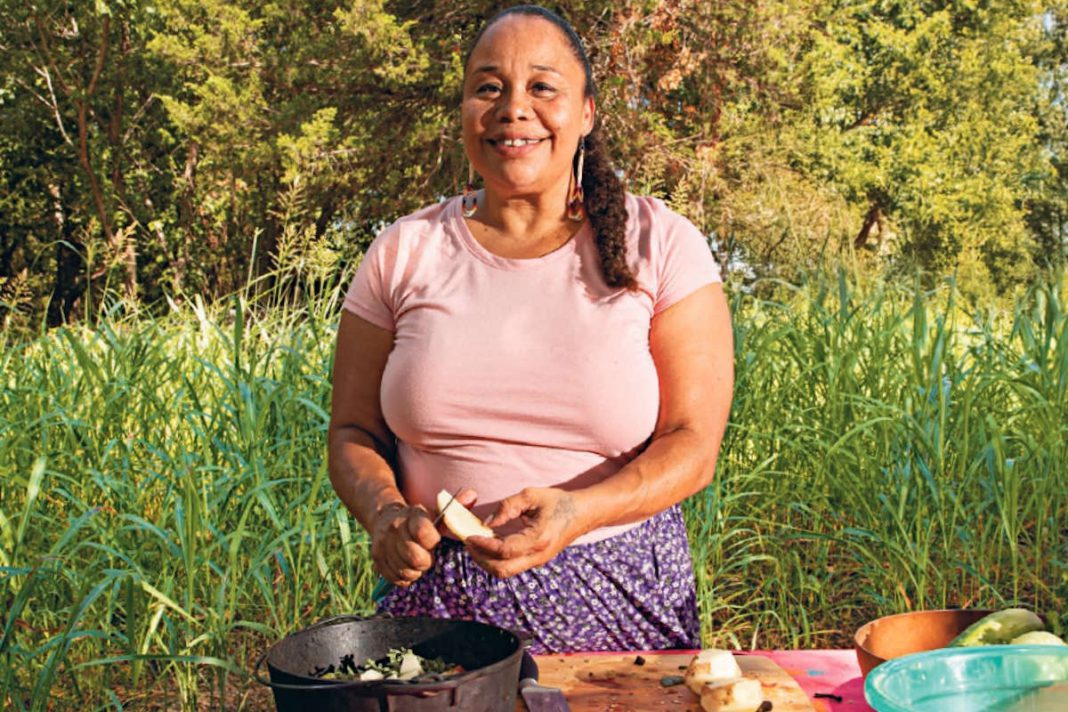
When Crystal Wahpepah opened Wahpepah’s Kitchen five years ago, Native food spaces were, even that recently, still hard to find. When she was a child, Wahpepah told me, she never saw or set foot inside a Native restaurant. Now the chef gets to see her community, young and old, experience a “healing connection” when they walk through the door. “We need to have our foods visible to people when it comes to talking about health and wellness,” Wahpepah said. At the same time, a Native kitchen “uplifts food producers” and the ingredients she cooks with that other chefs don’t.
Earlier this spring Wahpepah, with Amy Paige Condon, published her first cookbook, A Feather and a Fork: 125 Intertribal Dishes from an Indigenous Food Warrior. Wahpepah’s biography provides the backbone of the book. The recipes are all informed by and connected to her life story. She recounts the good memories—foraging for berries, cooking with her auntie Johnella—and contextualizes the more troubling ones within the many destructive government policies directed toward Native Americans.
“I really wanted to share my story, how I became an Indigenous chef,” Wahpepah said. On her current book tour, people are engaging with the recipes as home cooks look for inspiration. But they’re also reading the chef’s anecdotes as a way to connect with “what’s going on in Indian country.” Both the cookbook and her restaurant have provided the chef with a platform to introduce Native cuisine. Her culinary influences reflect the history of a people and their relationship to the land.
Wahpepah’s Kitchen only serves game meat. The chef pointed out that, “These are the meats from this land.” There are recipes in A Feather and a Fork for bison, rabbit, venison, turkey and fish. The chef loves rabbit because she associates it with a childhood memory. “My grandfather would hunt rabbit,” she recalled. “But if you think about what the animal eats—they eat a lot of veggies and greens—rabbit is the cleanest animal, even more than chickens.” Depending on how it’s prepared, whether in tacos or pozole, Wahpepah describes the taste as “really light.”
“We have grown so much when it comes to creating recipes on the menu,” Wahpepah said. In 2021 she wasn’t making acorn crepes, but she since found an acorn provider. The chef also wasn’t offering frybread. Now she serves it with soup, stew and chili. “It’s part of our story, and it’s a part of our resilience,” she said. “And it’s part of when I’m making my grandmother’s sweet corn soup.”
Wahpepah is an enrolled member of the Kickapoo Tribe of Oklahoma. The chef lists each dish on her menu in Kickapoo and in English. In A Feather and a Fork, she includes a Kickapoo glossary right before the first chapter as a way of “reclaiming our voice.” She writes, “By sharing these words, we keep the language alive and show our gratitude for all who came before.”
Chapter one is dedicated to beans, corn and squash, also known as The Three Sisters. “If you come from a bean, corn and squash foundation of a tribe like I do, we have The Three Sisters,” Wahpepah said. She sources blue, white and yellow corn from Bow & Arrow, located on Ute Mountain Reservation land in Southwest Colorado. “They are pretty much one of the biggest providers for Native restaurants,” she said.
Blue corn reminds the chef of her grandmother. She serves it as a corn mush topped with berries, in cornbread and in tortillas. “It has a lot of good healing remedies,” Wahpepah said. “I believe corn can really tell a story. Even though it originated from down South, it’s all throughout North America.”
Some of the produce at the restaurant is grown at Heron Shadow, a farm in Sebastopol. There they grow seven different kinds of squash, beans, corn, chard and greens. “When you come to Wahpepah’s Kitchen, you get a window of seasonality in our menu,” Wahpepa said. But squash is definitely a major player. “Right now I’m looking at these beautiful seeds of squash that have been around for hundreds of years. And we have this opportunity to present it in a really good, tasteful way where people can connect with it.”
Wahpepah’s Kitchen, 3301 E. 12th St., Suite #133, Oakland. Open Wed-Sun, 11am to 2pm. 510.698.4067. wahpepahskitchen.com