
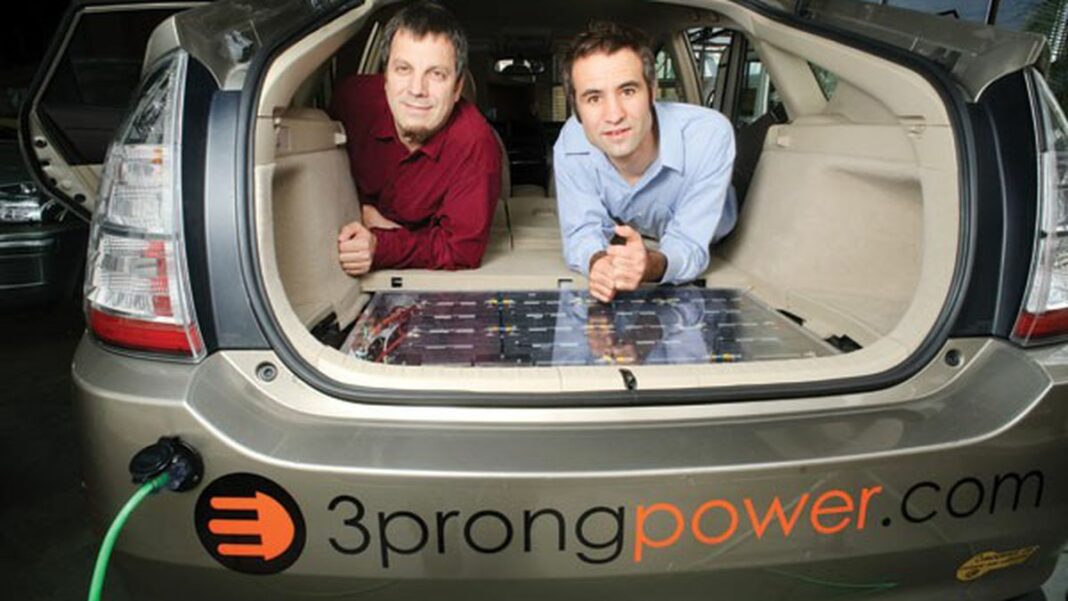
Daniel Sherwood and Paul Guzyk never dreamed they would be accused of harming the planet. After all, the primary goal of their Berkeley startup company, 3Prong Power, is to curb greenhouse gas emissions. They convert Toyota Prius hybrids into mostly electric vehicles that get 100 to 150 miles per gallon. But a powerful state agency is poised to put 3Prong Power out of business and deal a severe blow to a promising new industry.
Next week, the California Air Resources Board is expected to adopt strict new regulations based on the theory that the innovative technology sold by 3Prong Power and other companies may be bad for the environment. Sherwood and Guzyk say that if the board adopts the new rules at its January 22 and 23 meeting, it likely will force them to shutter their business, which just had its grand opening last month at Green Motors on San Pablo Avenue.
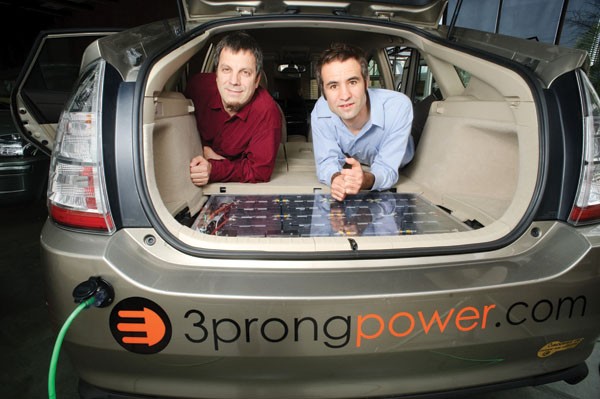
Paul Guzyk and Daniel Sherwood say their company won’t be able to comply with proposed new state regulations. Credits: Chris Duffey 
3Prong Power converts existing Toyota Priuses into plug-in hybrids that can run entirely on electricity. Credits: Chris Duffey
In addition, proponents of the nascent plug-in hybrid industry say the air resources board also may snuff out a key component of what environmentalists believe will be the next generation of eco-friendly cars, thereby hampering our ability to wean ourselves from foreign oil, avoid petroleum wars in the Middle East, and slow the potentially devastating effects of global warming. “It’s simply too early for government regulation of plug-in hybrids,” said Felix Kramer, a leader of CalCars.org, a Palo Alto-based nonprofit that has led the fight for plug-in vehicles. “Acting too soon will shut off innovation and will kill companies that are just getting started.”
Air resources board employees say the new regulations are not designed to squelch technological breakthroughs or bankrupt new businesses. They say they are merely trying to protect consumers’ rights and ensure that the new technology doesn’t roll back their attempts to limit cancer-causing emissions. After all, the board’s main function is to regulate smog — not greenhouse gases such as carbon dioxide.
Indeed, the story of the board’s attempt to regulate plug-in hybrids has turned out to be a battle between an agency whose primary mission is to protect Californians from breathing unhealthy air and a group of environmentalists and engineers who are fighting to slow global warming. The new proposed rules also appear to contradict the board’s own recent attempts to curtail greenhouse gas emissions in the wake of a groundbreaking global warming law signed by the governor in 2006.
And even though the air resources board appears to have some valid concerns about plug-in-hybrid technology, to date it has acted more like an uncompromising bureaucratic agency than a trendsetter committed to saving the earth. In fact, it represents a classic case of not being able to see the forest for the trees.
3Prong Power and similar small companies that have cropped up around California over the past year are threatened by two sets of new regulations proposed by the staff of the air resources agency, also known as CARB. First, the board’s staff wants to force the new startups to put their technology through a series of rigorous and expensive smog tests that could cost between $20,000 and $125,000, depending on how many cars the agency decides must be examined. The board’s staff also wants to require the new companies to provide consumers with warranties for the changes they make to hybrids for up to ten years or 150,000 miles.
But the tests are too costly for the typical small startup to afford and the warranties are unattainable because the electric batteries currently used to power plug-ins don’t last ten years. “For California to be on the cutting edge of green-tech, they need to be more of an enabler than a restrictor,” Guzyk said. “For us, the new regulations, especially the warranty, are a deal breaker.”
3Prong Power and its competitors transform Priuses into plug-in vehicles by putting a large flat battery in the trunk. The battery can be recharged by plugging the car into any electrical socket and allows the Prius to run entirely on electricity for speeds up to 34 miles per hour. Going faster than that triggers the car’s gasoline-powered engine, transforming the vehicle back into a traditional hybrid. The conversion can double or even triple fuel economy, thereby severely limiting carbon dioxide emissions. CO2 from cars does not contribute to smog and is not harmful to human health but it is one of the leading contributors to global warming.
State Assemblywoman Nancy Skinner of Berkeley, an environmentalist and a Prius owner, said she understands the air resources board’s concerns about smog. But she believes the agency needs to balance the regulation of smog and of greenhouse gases and should attempt to reach a compromise that will keep 3Prong Power and other small startups from going belly up. “I’m hopeful that CARB will meet with the companies and really try to partner with them,” said Skinner, who attended 3Prong Power’s grand opening in December and wants to convert her Prius to a plug-in. “These are small companies. They are innovators. There must be a way to share the burden.”
But the proposed regulations are not expected to significantly burden major car manufacturers that are planning to introduce new plug-in hybrids in the next couple of years. General Motors plans to unveil the Chevy Volt, a plug-in hybrid, sometime in 2010, and Toyota may begin selling a plug-in Prius in late 2010 or early 2011. Both cars will be subject to the new CARB rules, but GM and Toyota should have no problem affording the rigorous tests or financing the warranty requirements.
But the new rules could make it virtually impossible for current Prius owners to transform their cars into super-efficient vehicles that get up to 150 mpg. The new regulations will drive up the price of such conversions, putting them out of reach for most Prius owners, and ensuring that the only way to purchase a next generation eco-friendly car will be from one of the world’s two largest auto companies. “They’re suppressing the little guys — the people who work out of their garages, the people who create,” said Robb Protheroe, owner of Plug-In Supply, which provides electric batteries to 3Prong Power and four other small companies around the state. “It’s Who Killed the Electric Car 2.0.”
The award-winning 2006 documentary Who Killed the Electric Car? pinned some of the blame for the death of the electric vehicle in the United States on the California Air Resources Board. In 2003, the board relaxed its landmark support for so-called zero-emission vehicles after being sued by the major car companies and the Bush administration. Automakers and the administration convinced air board members that hydrogen fuel-cell vehicles were a more viable technology than battery-operated cars, despite the fact that fuel-cell vehicles currently cost about $1 million each and are believed to be at least fifteen to thirty years away from mass production.
The board had voted in 1990 to require that at least 10 percent of cars sold in California to be zero-emissions vehicles by 2003. The board’s ambitious goal was to significantly reduce smog in a state with the worst air quality in the nation. To meet the regulations, GM, Toyota, and other automakers began manufacturing electric cars and they quickly gained an underground cult status. But the auto companies hated the CARB rules and never really wanted to sell the cars. They claimed the vehicles weren’t popular with most consumers because the car’s battery had a limited range of 60 to 100 miles before having to be recharged. The documentary showed, however, that the car companies never marketed the electric cars to a mass audience and didn’t make them available to everyone who wanted one.
When the air resources board relaxed its rules in 2003, it allowed car companies to receive credits toward zero-emission standards by building so-called partial-zero-emissions vehicles — super clean cars that produce little or no smog. The board considers Priuses and other hybrids, along with several gasoline-powered cars, to be partial-zero-emissions vehicles, not because they get good gas mileage and limit CO2 emissions, but because they produce very little smog-causing gases.
Over the past few years, many environmentalists have become convinced that plug-in hybrids represent the next generation of super clean cars that will help continue the battle against smog and assist in the fight against global warming. Like hybrids, plug-ins have no range limitations, because when the battery runs out, the hybrid system takes over. That means you can drive around town as an electric car, and then jump on the freeway and head to Los Angeles, without having to recharge the battery. Plug-ins also get far better gas mileage than traditional hybrids — a regular Prius gets 50 to 60 mpg, compared to a plug-in Prius’ 100 to 150 mpg. As a result, the plug-ins burn much less fuel, thereby significantly reducing CO2 emissions. In fact, plug-ins can produce virtually no emissions at all while driving around town, as long as you don’t exceed 34 mph or press the gas pedal past halfway and engage the gasoline-powered engine.
On a recent test drive around Berkeley and onto Interstates 880 and 580 to Richmond, one of Sherwood and Guzyk’s cars drove like any other Prius, except for the incredible gas mileage and the quiet serenity of being in an electric car. According to the car’s dashboard computer, we got 77.7 mpg on what was mostly a freeway excursion. And around town, we were virtually all electric except for a brief stretch in excess of 34 mph on Gilman Street, or when a new driver hit the gas pedal too hard during acceleration. Sherwood said many of their customers pride themselves on making sure they never engage the gas engine and run electric for days, if not weeks, at a time.
It takes 3Prong Power a little more than a day to convert a Prius to a plug-in, and costs customers about $6,700. The price is high, but you can make up for the initial costs by saving money on gas over time, especially if gas prices rise dramatically again. Sherwood said the company has remained busy in recent months despite gas falling from $4 to about $2 a gallon. Before the holidays, they had four cars on their waiting list. Since opening inside of the Green Motors dealership in March of last year, the company has converted a dozen Priuses.
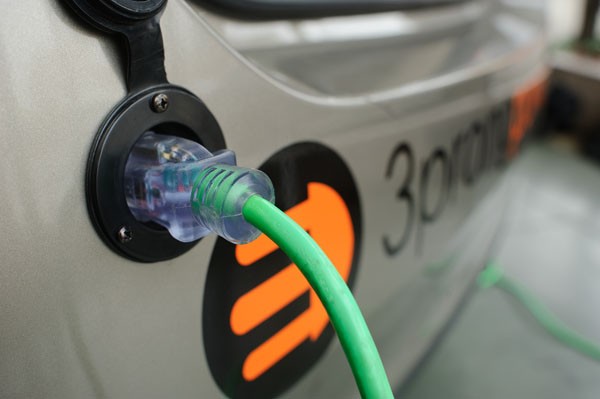
The conversion is simple. Guzyk installs twenty lead-acid batteries packaged together in a suitcase-like steel box that he locates in the trunk just above the spare tire. The batteries essentially take up no trunk space because they go in a hidden compartment that most Prius owners don’t realize they have. In addition, he puts the battery on a hydraulic system to make for easy access to the spare tire. Guzyk then connects the battery to the car’s computer system and instructs it to use the lead-acid batteries only when driving below 34 mph. He then drills a hole in the bumper so that the owner can easily plug-in to a wall socket and recharge the battery at home. It takes four hours to completely recharge a battery that is good for ten to twelve miles of electric-only driving. “When your batteries run out, you just start up the motor and it runs like a regular Prius,” Sherwood explained.
3Prong Power is the only plug-in conversion company in the East Bay. There are two in San Francisco, Luscious Garage and Pat’s Garage, and one on the Peninsula, A+ Japanese Auto Repair in San Carlos. Both 3Prong Power and Luscious Garage use lead-acid batteries, which are recyclable but only last about two to three years, while the others use lithium batteries, which last longer and are significantly more expensive. A conversion system at Pat’s Garage, for example, costs $10,400.
But if the air resources board approves the new regulations next week, those prices could rise dramatically. Or the businesses themselves may simply cease to exist.
So why are plug-in hybrids potentially harmful to the planet? Air resources board officials are concerned about two potential problems that could increase smog emissions in some conversion systems. The first has to do with the car’s catalytic converter. Located underneath the car, between the engine and the tailpipe, the catalytic converter cleans the emissions that spew out of the engine before they’re released into the air. Catalytic converters, along with so-called leak-proof emissions systems, are the primary reason why today’s cars are so much cleaner than those of several decades ago.
But catalytic converters only work well when they’re warm, and they warm up when the engine turns on. Consequently, gasoline-power vehicles pollute the most when the engine is first turned on in the morning after being off for many hours. This high-pollution moment is referred to as a cold start. A regular car or hybrid typically has only one or two cold starts a day. However, it’s possible for plug-in hybrids to have several of these high-pollution moments in a single afternoon of driving. The gasoline engine might click on several different times when driving around town — whenever the car exceeds 34 mph or the driver hits the gas pedal too hard. “The potential exists to significantly increase emissions,” explained John Swanton, an air pollution specialist for the air resources board.
The other potential problem with plug-in hybrids involves unburned gasoline vapors — a real threat to air quality. When gasoline-powered vehicles are turned off, some of the fuel in the gas tank evaporates. These vapors are stored in an adjacent canister built to hold up to three days worth of vapors. If you leave your car’s engine turned off for more than three days, the canister overflows and the vapors leak into the air and cause pollution. But if you turn your car on before the three days are up, the canister vents the vapors through the engine, allowing the catalytic converter to clean the emissions before they come out of the tailpipe.
Most people typically don’t keep their cars turned off for more than three days. But with a plug-in hybrid, it’s possible for the gasoline engine to not turn on for days or even weeks at a time. That’s especially true if drivers never hop on the freeway and don’t otherwise exceed 34 mph. As a result, it’s possible for plug-in hybrids to spew gasoline vapors out of the vapor canister on an almost-constant basis, turning a Prius into a gross polluter.
Consequently, air resources board engineers are recommending that plug-in hybrids undergo extensive cold-start emissions and gasoline-evaporation testing. According to agency documents, the tests likely will cost about $20,000 to $25,000 per vehicle. Swanton said in an interview that the board may only require that one vehicle be tested, but the agency’s own documents state that the board may force companies to submit up to five test vehicles, meaning the total test costs could amount to $100,000 to $125,000.
Such tests would be prohibitively costly for small startups like 3Prong Power. They also appear to be somewhat capricious. Swanton said the agency’s concerns stem in part from testing by at least one major auto manufacturer, which found significant pollution problems in cold-start emissions testing of its own plug-in hybrid prototypes. But the test results “are confidential,” because they’re considered trade secrets, he said. In other words, a state agency is about to adopt new regulations that could cause some companies to go bankrupt based on testing results that allegedly reveal a problem that it won’t reveal publicly. “It’s ridiculous,” said Robb Protheroe, owner of Plug-In Supply. “So you’re going to have a government agency producing regulations based on confidential data? It should be transparent.”
Protheroe also pointed out that California is literally strewn with new and used car lots full of vehicles that don’t get turned on for weeks, or months, at a time. If air resources board engineers are correct, then tens of thousands of these cars are constantly spewing unburned gasoline vapors into the air, doing far more damage than the relatively small number of hybrids that have been converted to plug-ins. “Why don’t they ask the dealers to go out and start their cars every third day?” Protheroe asked.
It turns out, however, that the argument over emissions and evaporative testing is mostly academic. Last year, a Massachusetts-based plug-in hybrid conversion company passed the air resources board tests easily. The company, A123 Systems, which makes the Hymotion lithium battery supplied by Pat’s Garage in San Francisco and A+ Japanese Auto Repair in San Carlos, found a simple solution for the cold starts and unburned gasoline vapors problems. They just make sure the Prius’ gasoline engine turns on when you start your car. That way, the catalytic converter warms up and the evaporation canisters are vented, explained Pat Cadam, owner of Pat’s Garage. It’s counterintuitive, but it works. It turns out that you have to turn on the gasoline engine and burn gasoline in your mostly electric car to make it more eco-friendly.
Because of this breakthrough, Sherwood and Guzyk of 3Prong Power aren’t worried about passing the tests. It’s an easy software adjustment for them to tell the Prius’ gas engine to turn on whenever the car starts. But they say they still can’t afford the expensive testing. Nor can they afford the extensive warranty requirements the board is expected to pass next week.
When the air resources board capitulated to the auto industry and relaxed its landmark zero-emissions rules, General Motors, Toyota, and other carmakers immediately pulled almost all of their electric cars off the road. The companies never actually sold the cars to consumers; they only leased them. But in exchange for the relaxed rules, the air resources board required that the car companies provide extended warranties on the new partial-zero-emissions vehicles, including the Prius. The agency mandated a fifteen-year or 150,000-mile warranty on the car’s emissions system, and ten-year or 150,000-mile warranty on the battery.
The agency adopted these new warranty requirements because it was allowing car manufacturers to replace zero-emission vehicles — the electric car — with autos that are not quite as a clean. Electric cars don’t need extended warranties because they produce no emissions even when they break down. By contrast, a partial-zero-emissions vehicle might become a conventional polluter if one of its key components fails. Consequently, the air resources board engineers reasoned that when a company, such as 3Prong Power, converts a partial-zero emission vehicle to a plug-in, it should provide the same kind of long warranty it requires of the major auto manufacturers.
Under the warranty rules proposed by the agency’s staff, a plug-in conversion company must provide an extended warranty for the Prius parts it alters or affects, along with a warranty for the parts it installs, including the battery it adds. The length of the warranty depends on how old the car is. 3Prong Power only works on Prius model years 2004 to 2009. So if the company converts a 2009 Prius, then it must warranty the Prius emissions parts for ten years or until the car reaches 150,000 miles. It also must warranty the Prius battery for ten years or until the car reaches 150,000. And it must warranty its own battery for ten years or 150,000 miles.
3Prong Power and A123 Systems have no trouble with providing warranties for the Prius parts they alter or affect. Sherwood explained that Priuses are very well-made, built to last, and that converting them to plug-ins doesn’t harm them in any way. But 3Prong Power and A123 Systems object to having to provide a ten-year warranty for their own batteries. After all, the plug-in batteries don’t replace the Prius’ battery, they only supplement them. As a result, if the plug-in battery fails, the car simply reverts to being a regular hybrid. And because the batteries they install don’t last ten years, both 3Prong Power and A123 Systems put in a simple switch for consumers to turn off their battery if they malfunction or die, thereby turning their cars back into regular Priuses.
3Prong Power, A123 Systems, and other plug-in advocates argue that the length of the warranties should be left up to the marketplace. If one company offers a two-year warranty on its battery, and another offers three years, then consumers should decide which company to buy from. “The people who are buying these conversions are grown up and ought to be able to make their own decisions,” said CalCar.org‘s Felix Kramer, who in 2006 became the first non-technical owner of a plug-in hybrid in the nation. “They know what they’re getting and they should be able to get it if they want it.” Sherwood also said they’re completely upfront with their customers, and inform them that the batteries only last two to three years and that replacing one costs about $900.
Swanton said the air resources board may be open to some sort of compromise on the warranty issue. But he noted that investors who have expressed interest in financing plug-in hybrid conversions may balk if there is no warranty requirement. Venture capitalists might not invest in a technology that only lasts two to three years, he argued, noting that there is no guarantee a consumer will replace his or her plug-in battery when it dies. Swanton, however, appeared to indicate that board staff was less willing to allow wiggle-room on the emissions and evaporative testing costs.
He pointed out that under the existing state motor vehicle code, companies such as 3Prong Power are technically operating illegally. The code makes it unlawful to degrade a car’s emissions by adding an after-market part and consequently requires testing of systems such as plug-in conversion kits. In the past, state officials have used this law to target street racers who add turbochargers and other devices to make their cars faster. Swanton acknowledged that enforcing the law against plug-in conversion companies has not been a priority for state officials, because those businesses are attempting to achieve a public good — reducing greenhouse emissions. But that likely will change if the air resources board adopts the new regulations.
Sherwood, 33, said he started 3Prong Power with Guzyk, 43, because he’s been interested for years in getting people “off petroleum.” He also said it never occurred to him that state officials would determine that converting Priuses to plug-in hybrids could potentially worsen a car’s emissions and add pollution to the air. He believes the state agency has failed to see the big picture in its attempt to regulate the field. Clearly, plug-in hybrids are usually cleaner than regular hybrids, he said, because they burn less fuel and run on electricity when driving around town. In addition, the A123 Systems testing proves that a simple fix can address the legitimate concerns of the air resources agency.
Still, the agency’s staff is attempting to regulate with a heavy hand. There is no good reason why it can’t work more closely with small companies such as 3Prong Power and help them finance the costly smog tests or provide them waivers for the time being. After all, Priuses themselves are exempt from smog regulations until 2011. Moreover, if A123 Systems passed the smog tests, then 3Prong Power should be able to as well, since it’s essentially using the same technology.
As for the proposed extended warranty requirements on plug-in batteries, the board should not adopt them. The contention that venture capitalists may not invest in plug-in technology without the warranties is not the board’s concern. Its mission is to clean the air, not make investors rich.
And finally, the board’s attempt to strictly regulate plug-in hybrids flies in the face of the sweeping new regulations it adopted just last month to combat greenhouse gas emissions. Among other things, the new rules will reduce the amount of carbon in motor fuels and require future cars to get better gas mileage. The regulations stemmed from a 2006 landmark law that put California at the forefront in the fight against global warming.
Clearly, the board’s proposed regulations on plug-in hybrids are not in keeping with last month’s vote, nor will they help California maintain its leadership role in combating greenhouse gases. It also makes no sense to snuff out the efforts of green entrepreneurs before they’ve even had a chance to grow.