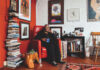

As a longtime peace activist and progressive, Christine Ahn was used to being on the ideological fringe. But even she wasn’t prepared to be red-baited and called a supporter of dictatorship.
It started in 2004. Ahn, then an activist working for Food First, an Oakland nonprofit that looks at the root causes of hunger around the world, was invited to give a speech about North Korea at the Human Rights Commission in South Korea. In her talk, she criticized the American passage of the North Korean Human Rights Act, arguing that increased sanctions against the communist country were choking its people and exacerbating their human-rights crisis. Ahn advocated peace and engagement. She also pointed out US hypocrisy. “I said some provocative things,” she recalled, calling out American human rights violations at Abu Ghraib and Guantanamo, racial biases of the US criminal justice system, and the persistent hunger and poverty of a meaningful segment of the American population.

Christine Ahn of the Korea Policy Institute wants the United States to sign a peace treaty with North Korea. For her opinions, she has been red-baited. Credits: Sonya Revell 
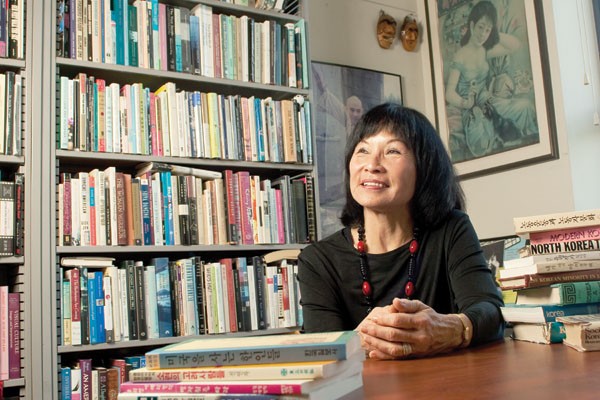
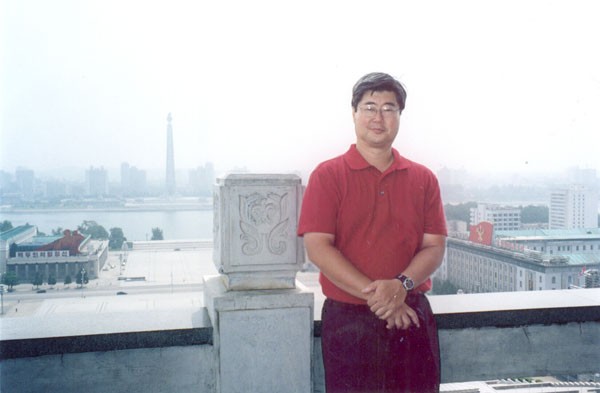
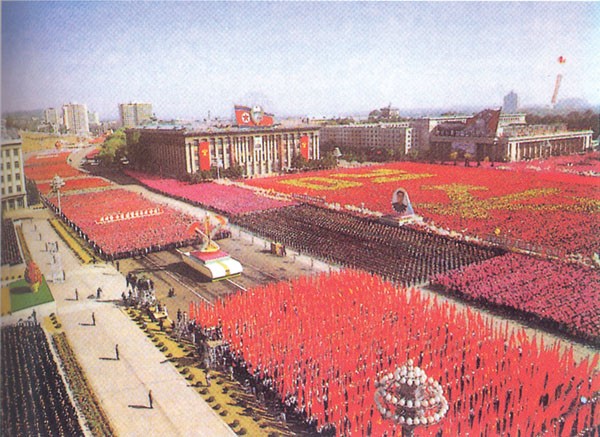
UC Berkeley professor Elaine Kim says there used to be a rumor that she was a North Korean spy. Korean activists are routinely called supporters of dictator Kim Jong Il. Credits: Sonya Revell North Korean leader Kim Jong Il. Korea Policy Institute President Paul Liem, shown in North Korea, says it’s difficult to obtain funding for North Korean issues. Bay Area activists say the military culture of North Korea has to be viewed in light of the fact that the United States has never negotiated a formal end to the Korean War.

The crowd’s response was overwhelming. “My perspective was obviously very fringe and a bit left, but the Korean people loved it,” Ahn said, recalling her surprise. “I was, like, paparazzi’d. …. But it was just like people opened their eyes for a moment here. Okay, let’s just stop for a moment here, all this propaganda about North Korea, and just like think about it here in a more pragmatic way. And, obviously, it had resonance.”
But one month later, she received an e-mail that tempered her excitement. It was a message from a friend, pointing her to a blog called One Free Korea. A post entitled “The Alternative Reality of Christine Ahn” criticized her viewpoint, labeled her a “North Korean apologist,” and detailed facts about her life and her beliefs. Ahn was creeped out. “I mean it was so freaky to have this ten-page article about me,” she said. It was authored by Joshua Stanton, a lawyer with the Department of Homeland Security who currently serves as the department’s deputy chief for tort litigation. In a recent interview via e-mail, Stanton said he blogs as a private citizen, but added, “I think Ms. Ahn is a reprehensible apologist for mass murder, and for the deliberate, discriminatory mass starvation of men, women, and children.”
The incident horrified her. “It freaked me out so much that I was like, ‘Oh, I don’t think I’ll continue doing this peace work,'” said Ahn, who lives in Oakland and is now a fellow at the Korea Policy Institute. But, in fact, she became more vocal, and was interviewed on CNN and talk shows such as the Today Show and KQED’s Forum. Meanwhile, her list of critics grew. The following year, Ahn said one of her colleagues in South Korea received a call from the US embassy demanding to know “Who the hell invited Christine Ahn to speak at the panel?” She’s now listed on DiscoverTheNetworks.org, a web site by conservative author David Horowitz that she describes as an “online database of all these cells, like terror cells of academics, think-tanks, foundations, Hollywood stars.” She’s described as a “Supporter of the Communist dictatorship of North Korea.”
For decades, a small group of East Bay-based scholars and activists such as Ahn have advocated a more contextualized view of North Korea that takes into account the United States’ contribution to and complicity in the situation. While Ahn acknowledges that there is a lot of repression in North Korea, she says that the critique of the country’s human rights is highly politicized. Yet for their efforts they’ve been spied on, red-baited, labeled North Korean sympathizers, fired from jobs, and been the targets of smear campaigns.
Following a series of North Korean nuclear tests and up until its August release of US journalists Laura Ling and Euna Lee, US relations with the country had grown particularly tense. Secretary of State Hillary Clinton called its behavior childish; North Korea countered, saying Clinton “looks like a primary schoolgirl and sometimes a pensioner going shopping.” Hazel Smith of the Korea Policy Institute declared that the United States was effectively “sleepwalking to war.” Yet since former President Clinton — who nearly bombed the country in 1994 — successfully negotiated the journalists’ release, Washington’s tenor has changed markedly. US officials recently held talks with a senior North Korean diplomat, although no formal bilateral talks have been scheduled yet, and sanctions are still in effect. The move also eased the tensions between South and North Korea, which had been strained following the inauguration of the South’s president, Lee Myung Bak, who took a harder-line stance on North Korea than his predecessor.
Now, activists who were once marginalized may have a chance to influence policy after all. About a month ago, Ahn and Paul Liem, the Berkeley-based president of the Korea Policy Institute, arranged a meeting to discuss US-North Korean relations between themselves, ten other activists, and members of the State Department and Congress, including Frank Januzzi, John Kerry’s senior Korea advisor, who also works for the Senate Foreign Relations Committee. They were received much differently than during past visits, Ahn said. “Something about the Bill Clinton trip really changed the dynamics in a very significant way,” she said. “The whole regime-change discourse felt like it was long gone, that was history. It also felt like that they just knew that diplomacy was the way forward and that there had to be some kind of breakthrough with North Korea. It was just a matter of how and when.”
When it comes to North Korea — aka the Democratic People’s Republic of Korea — there’s a lot the American public doesn’t know. For instance, few may know that the majority of North Korean defectors say they fled their country for economic reasons, not because of political or religious persecution. Or that the United States scorched North Korea during the Korean War, dropping more napalm than during the Vietnam War and 420,000 bombs on Pyongyang, whose population numbered about 400,000. In fact, most people don’t even know that the Korean War technically never ended — a peace treaty was never signed, only an armistice — and that approximately 30,000 US troops are still stationed in South Korea. Every year, the militaries of the United States and the Republic of Korea stage a joint exercise, simulating an invasion of the North. This year, that event happened to coincide with the entry into North Korea of journalists Ling and Lee. Knowing that, the public might view their capture somewhat differently.
But lawmakers and the public continue to be uneducated about Korea, due in part to the fact that the mainstream media generally portrays North Korea as a giant gulag run by an evil, unpredictable dictator hell-bent on starving his people, developing nukes, selling arms to hostile states, and obliterating human rights. While there’s undoubtedly a lot of repression and heinous acts committed in North Korea, activists say the situation is far more complex than that. The dominant narrative leaves out historical context that they believe implicates the United States in some of the problems and serves America’s self-interest in maintaining influence in Asia. The ongoing US military occupation of South Korea combined with our punishment of the north via sanctions only stokes the militaristic ambitions of the country and continues to divide families that have been separated for 56 years, they believe. Worst of all, the end result makes life much harder for everyday North Korean citizens and heightens the humanitarian crisis on the Korean peninsula.
“If more and more Americans knew about the kind of diversity of people that are really questioning US involvement, US military occupation, 30,000 troops still on the Korean peninsula, all the kind of crimes committed towards the civilians by the US military … I think they would say, ‘Okay, it’s like the Korean War has got to end,'” said Ahn. “Enough is enough. We need a new kind of way, a new way of moving forward on US-Korea policy.”
Ahn and her cohorts at the Korea Policy Institute are trying to do just that. Formed in 2006, the Los Angeles-based group aims to provide a unified, coherent, and informed voice on US-Korean policy that it hopes will one day lead to the signing of a peace treaty.
A just-released study seems to support the activists’ claim. “North Korea Inside Out: The Case for Economic Engagement,” authored by the Asia Society and the University of California Institute on Global Conflict and Cooperation, advocates for the United States to adopt a long-term policy of economic engagement with North Korea, which would “benefit the North Korean people as a whole and would generate vested interests in continued reform and opening, and a less confrontational foreign policy.” While sanctions have been useful at times, “their long-term effect has been to harden the D.P.R.K.’s resistance to international cooperation.”
Yet alternative information that challenges the narrative that the US role in South Korea has been completely positive typically has been suppressed over the years. Ahn points out that journalist I.F. Stone’s book The Hidden History of the Korean War, which provided a radically different version of events, had trouble getting published in 1952. Crimes committed by the US military during the war were concealed for decades, until 1999, when journalists unearthed the story of the US massacre of hundreds of South Korean civilians, which they published in the book The Bridge at No Gun Ri. (The US military has disputed the exact number killed.) Other historical atrocities are now being investigated by South Korea’s Truth and Reconciliation Commission, established in 2005. So far, there are more than 200 incidents of US soldiers attacking South Korean refugees in 1950 and 1951, according to petitions filed by citizens; a final report is expected to be released next year.
And when it comes to opaque North Korea, there’s even more that we don’t know. “Most people in the United States have no idea how US operations on the Korean peninsula shaped the way North Korea is right now,” said Professor Elaine Kim, coordinator of UC Berkeley’s Asian American Studies Department. Kim noted how the American carpet bombing impacted not only the physical landscape of the North, but also the people’s identity. When she visited North Korea in 1999, she noted that brush paintings sold on the street depicted the one area that had not been bombed. The entire city of Pyongyang looked like it was built in 1955. “So that means that everybody in Pyongyang can be made aware every single day, walking around, that the place was destroyed by somebody aerially,” she said.
Many Americans also may be unaware that North Korea’s economy was doing quite well during the 1960s and 1970s, even surpassing that of its southern neighbor. But a reduction in trade with the Soviet Union, and the impact of the American embargo and sanctions, helped freeze North Korea’s development. “The reason they don’t have energy for all their infrastructure is … the US and its allies who embargo them don’t allow them to trade with anybody the US trades with,” said Kim. As a result, for example, there are streetlights, but no electricity in them. Many North Koreans are extremely slight and seemingly malnourished. “This is a crime,” she noted. “Talk about human rights — this is a crime against humanity that was allowed to happen. And they’re trying to say that it’s because Kim Jong Il is a dictator and wants to keep everybody enthralled, that’s why it’s like that?” she asked, incredulously. “Hello! Let’s have some reality here.”
Learning the whole story would go a long way in contextualizing why North Koreans loathe Americans, Kim continued. She recalled how North Korean sharpshooters, who won gold medals during the 1972 Olympics, said during an interview that they imagined their targets were US bombers. “I think the US was so horrified by them saying that, what they said was immediately squelched,” she said. “That’s an example of the truth being continually squelched.” If Americans understood the extent of the carpet bombing in North Korea, Kim said, that kind of answer might be more understandable. “People do things because there’s a historical context for them. They don’t just do them because they’re nuts. And the way we’re told now is, ‘It’s irrational. Kim Jong Il is irrational and the Korean people are irrational.'”
To understand the activist’s critique of US involvement on the Korean peninsula, it’s important first to understand some history. Although the rabbit-shaped peninsula is rather small (about the size of Utah), it has been coveted because of its natural resources, desirable location (wedged between China and Japan), and the fact that it’s surrounded by water, and thus a strategic port location.
For centuries, Korea was ruled by a succession of dynasties that adhered to a policy of isolation (hence its nickname “The Hermit Kingdom”) — despite invasions by Mongols, the Manchus, and others. But by the late 19th century, the country became increasingly susceptible to geopolitics. Major forces were fighting for control in Korea, starting with the First Sino-Japanese War and continuing through the Russo-Japanese War. Those conflicts resulted in Japan, which was emerging as a superpower, making Korea its protectorate in 1905, then annexing it in 1910.
The end of World War II in 1945 closed the chapter of Japanese colonial rule in Korea. The United States and the Soviet Union occupied the country as a trusteeship, with the idea that it would be temporary. Control was divided roughly in the middle of the country, along the 38th parallel — a boundary that was hastily established by Dean Rusk and Charles Bonesteel of the US State-War Navy Coordinating Committee. The Soviet Union would disarm Japanese troops north of the 38th parallel; the United States would be responsible for the south. But the Cold War was in full swing; the two powers were unable to agree on the terms of Korean independence and ended up establishing two separate governments sympathetic to their own ideologies. In the south, the American military gave many government positions to Koreans who were seen as traitors for collaborating with Japanese rulers, and it didn’t recognize the attempts to set up a provisional government because they viewed it as a communist insurgency. The United States helped install Syngman Rhee, an anticommunist who was exiled in the United States for decades. He became South Korea’s first president in 1948.
As each side jockeyed for full control of Korea, North Korean forces crossed the parallel and invaded South Korea on June 25, 1950, sparking the Korean War. The United States and the UN came to the aid of the South. A counteroffensive pushed North Koreans past the 38th parallel nearly to the Yalu River. Then the People’s Republic of China, which feared US dominance on the peninsula, came to the aid of the North, pushing the United States back down below the 38th parallel. After more pushing by the United States, the fighting ceased with a 1953 armistice that divided the country near the 38th parallel and created the 2.5-mile-wide buffer zone, the so-called Demilitarized Zone. Millions of civilians died during the conflict, and countless families ended up separated. To this day, the war technically continues, with the Demilitarized Zone heavily guarded and watched around the clock by the respective militaries.
Korean immigration to the United States officially started in 1903, when a ship of Koreans landed in Hawaii to work as laborers on sugar plantations. Many also were active in the movement to liberate Korea from Japanese colonial rule, which manifested itself in the Christian churches that had spread in Korea due to the presence of missionaries. Koreans were forbidden from immigrating to the United States under the Immigration Act of 1924, so the population remained relatively constant until 1940.
More immigrants came during the Korean War, mostly wives of US servicemen. But immigration really spiked after the passage of the Immigration Act of 1965, which abolished the quota system that had limited immigration up to that point. According to Census data, the Korean population in the United States jumped from 69,130 in 1970 to 354,593 in 1980 and 798,849 in 1990. Although many had professional degrees, their lack of English skills relegated them to low-paying jobs and many opened their own businesses, such as dry cleaners, markets, and restaurants.
Because of South Korea’s massive campaign to demonize North Koreans after the Korean War and during the 1970s and 1980s, many Koreans who immigrated to the United States subscribed to a pro-US, anticommunist stance. Many are conservative. “There was a kind of effort to instill anticommunism and to instill fear of the authority of the South Korean, pro-US, right-wing military dictatorship and then spread that fear to the US and to the diaspora, I think,” said Kim.
But slowly, that attitude began changing in South Korea. Democracy movements in the South erupted in reaction to postwar military dictators — many of whom were supported by the United States. Many questioned the role of the United States in the Kwangju Massacre of 1980, in which pro-democracy students and activists were killed by the South Korean Army. (The United States had authorized the release some South Korean troops to quell the rebellion, and President Reagan endorsed the actions of then-President Chun Doo-hwan, who was sentenced to death for his role in the event, then later pardoned.) In 2002, two American Army sergeants were acquitted after their tanks crushed two South Korean girls to death, causing widespread outrage. In 2006, US military expansion in Pyongtaek, south of Seoul, evicted farmers from their land and spawned protests and clashes with South Korean military soldiers. “That’s one thing that really I think often gets lost on people, is that democracy flourished in South Korea not because of US intervention, but despite it,” said Christine Hong, a Korea Policy Institute fellow and former UC Berkeley post doc, who recently relocated to UC Santa Cruz where she’s now an assistant professor.
All of this points to a radically different point of view of the United States among South Koreans today. “I remember a few years ago when the people in South Korea said they thought that US was more dangerous than North Korea,” Kim recalled. “So that means that there are many decades of one-sided love affair had come to an end. … Many people had decided that the US was in Korea because of self interest for the US and that things that happened politically in Korea could often be laid at the door of the US and its self interest.”
Activists like Kim, Hong, and Ahn certainly aren’t unique in their advocacy for peace among Korean Americans. The Bay Area doesn’t have a very large population of Koreans, especially compared to Los Angeles and New York, but that fact has perhaps allowed voices here to be particularly strong. “As the community up here is relatively small, it makes for both a certain kind of intimacy and, given the nature of a lot of social activism within the area, it also permits a certain kind of progressive possibility,” said Hong.
The area’s proximity to UC Berkeley has also contributed to a more open-minded atmosphere, says Korea Policy Institute’s Paul Liem. In the 1990s, Berkeley students invited peers from North and South Korea to attend forums at the university. Elaine Kim, who was present during those years, said many students traveled to South Korea and were influenced by its politics. “Even if they’re Christian, they don’t tend to adhere to the old demonizations that used to exist,” said Kim about the students. “It doesn’t mean that they’re not susceptible to stuff like the damsel-in-distress story — I think they probably are — but I think it’s kind of easy to point out what’s wrong with that story to them now, whereas before it really wasn’t. If you said anything at all then rumors would fly that you were a spy and stuff like that. It was really bad in the Korean community.”
While the community has become more accepting to a degree, these activists say they often found themselves targets of suppression. Even the US government got in on the act. Liem said that in the late 1990s, the FBI called him and claimed that somebody had made a threat against a member of the South Korean consulate in San Francisco. “They wanted to go through a list of names with me to find out who these different people were,” Liem recalled. “I essentially said that if he wanted to talk to me about his political views I was happy to talk to him, but I wasn’t going to go through a list with him. And he ended up just saying a lot of derogatory things about my father, how he was un-American because he was very active in the overseas movement for democracy in South Korea. He wrote a lot of articles about US policy. Which surprised me that he knew all that.”
For Kim, it started in the 1960s. Until the 1980s, she said, “if you wanted to express … any interest in North Korea, you were immediately suspected of being a spy for North Korea or something like that; it was very ridiculous.” Kim said she gave a talk in the late 1960s against the normalization of relations with Japan, after which she was approached by some Korean guys who told her, “From now on, you study literature, you talk about literature.” Kim responded by buying a vanity license plate that read “Juche,” the North Korean ideology meaning self-reliance, which spawned a rumor that she was a North Korean spy. She said Korean students at UC Berkeley told her that they were warned by the South Korean consul general in San Francisco to not take her classes “because I was a North Korean spy.”
During the Kwangju Uprising in 1980, which was largely not reported on in the United States, Kim said she ran images of bodies in coffins on “Asians Now,” a monthly Korean bilingual program she hosted on KTVU. Kim said the South Korean consul general immediately went to KTVU and demanded equal airtime to rebuke the images, then offered an all-expenses paid trip for the program’s executive producer and a cameraman to “show how wonderful South Korea is.” After Kim informed the San Francisco Chronicle that there had been an attempted bribe at KTVU, she was fired, she says.
But among the activists, there is a diversity of voices and opinions. While the Korea Policy Institute has generally been viewed as more leftist, others take a different approach. LiNK, or Liberty in North Korea, is a national nonprofit organization with chapters around the country, including UC Berkeley. Jennie Chang, the Berkeley chapter’s external affairs coordinator, says its primary goal is to raise awareness about the North Korean human-rights crisis and to raise funds for LiNK’s various programs, such as the operation of underground shelters. Last month, it screened the documentary Seoul Train, about the plight of North Koreans trying to escape via a network of underground safe houses operated by South Koreans. “It’s really similar to the Nazi concentration camp,” said Chang, describing the humanitarian situation in the North. “All the rights and liberties that we know about are not existent in North Korea. … Eighty-five percent of North Korean women refugees are sex trafficked. It’s not really in the media as it should be.”
However, other activists are critical of LiNK, especially after its former executive director, Adrian Hong, wrote an essay in The New York Times advocating regime change, which they say would require military intervention and thus lead to a massive humanitarian tragedy. “I think he’s kind of a nut,” said Oakland resident John Cha. “He’s sort of hawkish and says stuff like, ‘Oh we have to get rid of Kim Jong Il.’ Well, that’s fine, but how do you do it? He doesn’t have any answers other than, well, ‘I’d love to go in and remove him like we did with Saddam.'”
Cha isn’t affiliated with any organization but, like the fellows at the Korea Policy Institute, he’s been trying to shed light on the US government’s misunderstandings about North Korea. “I think they should learn more about the people over there and try to understand them and figure out what they really want,” he said. “Historically, the people of North Korea, they really hate the Americans and policymakers. Obama and Hillary, they should understand why they really hate the Americans. They learn this from the moment they are born. They paint Americans as true evil. And, on the other hand, we are painting the North Koreans as evil, so where do you go from there?” Cha hopes his current project, a book on Kim Jong Il, will help his cause, but he laments that prospective publishers seem primarily interested in salacious details. One publisher wanted to know more about the Dear Leader’s “wine-drinking habit” and “all those Swedish women,” he said. “They’re asking some wrong questions.”
That’s not surprising because the general US population largely remains in the dark when it comes to Korean politics and moving beyond the polarized perception of the United States and democratic South Korea as good, and communist North Korea as evil. “It’s weird that the US is so far behind South Korea and Korean Americans in terms of critiquing those ideas and they’re still stuck in some kind of old era,” said Kim. “But maybe South Koreans and Korean Americans can change the terms of that discussion. I think they have been.”
Activists and scholars still face attacks and challenges to correct misinformation about North Korea. A few months ago, Christine Hong noticed a statistic cited in several articles in The New York Times and Washington Post, which alleged that there are between 150,000 and 200,000 political prisoners in North Korea’s kwan-li-so penal system. Hong was intrigued where the number came from, and discovered the statistic was sourced from the US State Department. So she contacted their Korea desk, which said that the number came from the paper “The Hidden Gulag,” written by human-rights advocate David Hawk. Hong discovered that Hawk derived the number from one man, a former North Korean prison guard named Ahn Myong Chol.
“I asked the State Department, when they told me where the statistic had come from, if the State Department had attempted to corroborate Mr. Ahn’s testimony with further evidence because it seemed quite flimsy that this statistic would be based upon the testimony of one defector,” she said. In response to her query, Hong said a State Department representative e-mailed her that “‘the State Department does its best to corroborate information” and that “each report goes through a rigorous vetting and editing process. … As you know, North Korea is a special case given our limited diplomatic ties and the restrictive nature of the government.’ In other words, ‘No.'” Even more problematic was the fact that the same prison guard was later quoted saying that North Korea’s political prisoners totaled 900,000. “Now it’s unclear how the statistic, based upon his knowledge as a former prison guard, and he was at four different prisons or something, went from 150,000 to 200,000 to, several years after being out of the country, to almost a million,” Hong continued. “But I would think that any kind of investigator, be it a reporter or the State Department, would really have to take that kind of figure critically.” She noted that defector testimony is often problematic — especially with North Koreans — because South Korean and Japanese journalists pay defectors for their testimonies, “so it becomes a kind of mode, a sort of livelihood to constantly produce ‘intelligence.'”
In some cases, the government is funding the misinformation, according to Ahn. “I feel like maybe even progressives in this country, they don’t really get how much the US government is like spinning propaganda and investing. … They give tons of money,” she said. “If you see that documentary, Kimjongilia, it’s like ‘Thanks to the National Endowment for Democracy’ and these groups, the Citizen Coalition for Human Rights in North Korea. I mean, it’s like there is a lot of, I think, funding that is coming, either from the US government directly or the neocon structures, institutions, that are redirecting money to groups that are part of this spinning this propaganda about North Korea.”
Highlighting these facts could go a long way toward changing public perception about the situation. And yet, there is little funding to support such issues. “Even in progressive circles there’s a tremendous amount of concern about whether or not it makes any sense to support North Korea at all,” acknowledged Liem. “From the left to the right, it’s really difficult to convince somebody to pour money into an issue like this.”
Still, though perceptions vary, many feel that the situation between North Korea and the United States is now hopeful than it’s ever been. The United States said it’s willing to engage in bilateral talks with North Korea if that leads to resuming six-party talks, which North Korea quit some months ago. This time, Ahn believes things will be different — even though she says that the South Korean embassy also tried to preempt their recent Washington visit. “I do think that he genuinely wants diplomacy as the course of action,” she said about President Obama. “The challenge is will the hawks, even among the Democrats, impede him. But I do think that John Kerry, being the chair of the Senate Foreign Relations [Committee], and Frank Januzzi, very affable, very reasonable pragmatic person. From his perspective, he’s like, ‘Yes, we’ll never know, but unless we try, we’ll never know.'”