On a warm sunny Saturday, we are headed for a family birthday party. We’re in Berkeley, the party’s in Benicia, we’re already late, and so we’re warning each other: Not one more delay. But then, crossing Solano Avenue, we see a yard-sale sign. Wordlessly we diverge from our route, arching left to where balloons mark the spot halfway down the block.
It’s a big one, stretching from two blue satin cushions propped against a telephone pole all the way up a driveway and across a lawn strewn with clothes, books, tools, kitchenware, toys. As luck would have it, the sale is ending just as we arrive. From her porch, the seller announces that the sale is over and everything is free.
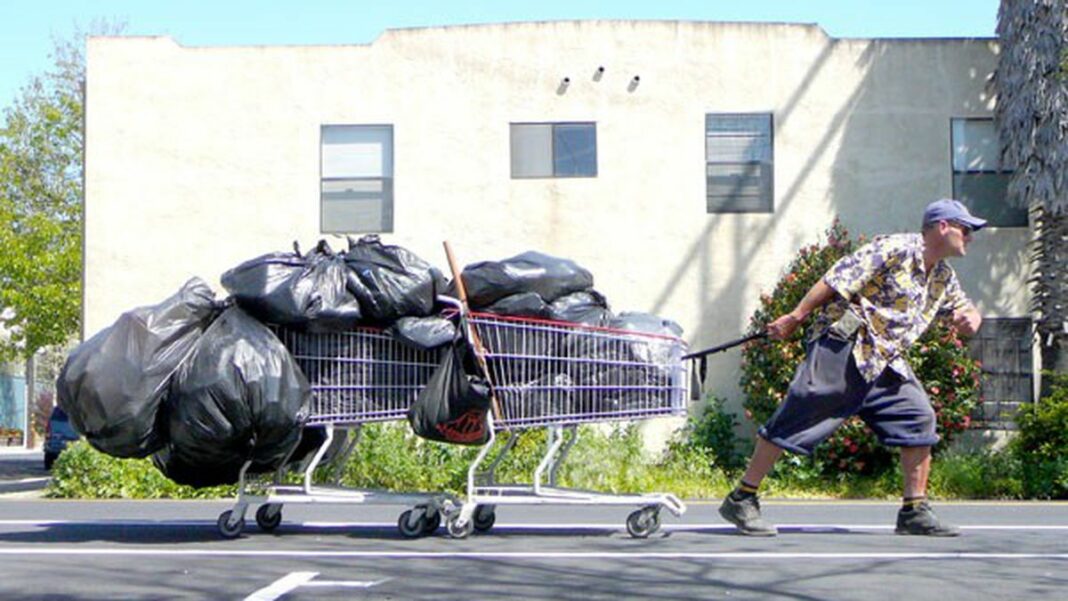
Scavenging makes more sense than ever in the current economy. Credits: Stephen Buel 
Credits: Chris Duffey For the authors, scavenging means never having to say you’re sorry for checking out potential loot. Credits: Ina Lawson


Not all sales end this way. Some folks pack their unsold stuff back up and haul it inside or drive it to Goodwill. Some, though, give it all away. When this happens, the air begins to buzz and everything speeds up. Hands dart. Receptacles are sought to hold the DVDs, the baseball mitt, the vase.
At any free-for-all, you can immediately spot the inexperienced. Gobsmacked and half-embarrassed, they hover over pomanders and clocks but reach for nothing, as if fearing germs or tricks or being called thieves.
And you can spot the scavengers. We glide, our movements purposeful and lithe. Our eyes cut wide arcs, back and forth, as we reach with one hand for shirts — stripes, button-down, okay — and with the other for swim goggles, garden gloves, a blender. Yoink! Into the backpack pops the spoon, the copper horse, the coffeepot. Quick. Competent. Assess each item in a nanosecond. Do I want this? Do I need it? Does my friend?
We will be late to the party. And when we get there and they ask why we were late and we say we were scavenging free clothes and toys and kitchenware from a stranger’s lawn, they laugh. They think we’re joking. When they see we’re not, they scrunch up their noses and ask: But why? Wasn’t it dirty? What if someone bled on those shirts? What if someone cooked meth in that coffeepot? What if the blender’s broken? Can’t you afford gloves?
We hear this all the time.
And: What if that thing doesn’t fit?
What if it’s dented/scratched/stained/faded/ripped?
Wouldn’t you rather just go to a store and buy the exact color/size/style/components you like best?
Well, no.
Because all around the world, a change is afoot. The way in which human beings acquire stuff is shifting. Expanding. Forever. All around the world, millions are salvaging stuff, trading stuff, recycling stuff. This is the end of the shopping monopoly.
All around the world, we are scavenging. Today that doesn’t mean only the squalid ragpicking it used to mean. So many pursuits count as scavenging today. They can no longer be tucked into any easy little category. In our new book The Scavengers’ Manifesto, my coauthor Kristan Lawson and I define scavenging as any legal means of acquiring stuff that does not involve paying full price. That includes everything from thrift shopping to swapping to bartering to coupon clipping to Freecycling to seeking out the sale racks at Macy’s. In the broadest sense, you scavenge just by tracking down a bargain.
But four thousand years of antiscavenger prejudice dies hard.
Pretty much since the dawn of civilization, when hunting and gathering was suddenly seen as primitive, this practice of collecting the lost and discarded, the fallen and unwanted, has been scorned. We see it derided in Leviticus and in modern popular culture, where athletic teams are named after predators and carnivores — and the occasional herbivore, if you count mustangs and bulls. But you never see a sports team named the Hyenas or the Roaches. Scavengers get no respect, even though roaches actually run faster than cheetahs for their sizes and even though all scavengers play crucial roles in ecosystems, working as nature’s cleanup crews, and even though our closest evolutionary cousins are omnivores, which means that chimpanzees and Homo sapiens are all scavengers deep down.
But hey. In times of economic tankage, scavengers know what everyone else now needs to learn, like it (and us) or not.
For a long time now, the very idea of getting stuff by any means outside the standard retail channel and at any speed but warp speed was anathema. A sacrilege. A sin. Not long ago, all of American society pledged loyalty to new-and-improved products. Not shopping was treason. An abomination. But times have changed. Goods and services now circle and circle the world, connecting strangers, without a penny spent.
Well, that took long enough.
My coauthor and I have both scavenged for as long as we can remember. We didn’t know each other when we were kids, but both of us picked up spare change from the street as soon as we could walk. I grew up near a beach and was frequently taken there. Found shells, smooth pebbles, sea glass, driftwood, sand, and dried seaweed turned into countless dollhouse furnishings and early art projects even before the first day of first grade. He grew up in Berkeley, where friendly hippies at neighborhood communes showed him how to construct furniture from scrap wood and pick plums from sidewalk trees. Ten years before we met, both of us bought metal detectors, in both cases going halfies on the purchase with our best friends, and in both cases choosing the cheapest Radio Shack model. Once we met — both, that night, wearing thrift-shop clothes — neither of us ever had to explain or apologize to the other for bending down to pick up pennies or for lifting trash-can lids to peer inside. We have watched (former) friends look on in horror as we do these things.
Sometimes scavenging is the Great Divide.
Some folks scavenge for fun. Some scavenge to save. Money. The world. While millions all around us drown in debt, we scavengers liberate ourselves with every cent we save while liberating tons of would-be garbage. How can we tell typical consumers that every saved penny counts, that saved pennies add up? They call us cheap. They call us poor. No matter how or why you do it, even if you’re just reusing Christmas ribbon or picking fruit in a vacant lot, some will consider you a dangerous radical. Yet the typical consumer carries a four-figure debt. How can we make them understand that they accumulated these debts by paying full price? How can we say: What would you prefer, discount-outlet food and library DVDs and thrift-shop shirts and no debt, or restaurant food, cinema tickets, department-store clothes and debt? Scavengers know that the difference between brand-new, full-price products and their scratched secondhand counterparts is — debt.
Some folks scavenge to recycle. Repurpose. Reduce. Reuse. They know that some 200 million tons of trash is thrown out every year in the United States alone. In New York City, 64,000 tons per week.
Some scavenge to revolt.
Some scavenge to survive.
Some scavenge for the sake of spontaneity. We crave the long-forgotten magic of the random.
Some scavenge for art. Some scavenge for adventure. Some scavenge for self-sufficiency. For some, scavenging is a test. For some, it’s spiritual.
We do not all scavenge for the same reasons, yet we share certain understandings, certain values, certain principles. We share a way of life. A way of looking at the world. Having, each of us, shattered the chains that locked us to consumer culture, we walk free under a clear new sky, scanning a changed terrain studded with buried treasure.
We seek but do not always find. This makes each find a miracle.
Amen.
Admit that you have scavenged anything and expect questions. Misconceptions. Misperceptions. Even accusations. One friend tells me that she cannot even imagine donning a garment that someone else has owned before. The very idea, she says, disgusts her. Another friend buys used clothing, no problem, but avoids my favorite discount food store, Grocery Outlet, because “it’s like shopping in a warehouse.” And if that warehouse stocks organic, fair-trade, and top-brand products just a little closer to their expiration dates than identical merchandise at ordinary supermarkets for half-price or less, what’s not to like? Another friend looks at me pityingly and says, “How can you stand making such sacrifices? I would never want to walk past Starbucks and think, I refuse on principle to buy a Frappucino.”
Silly consumer, that’s no sacrifice. To me, saving four dollars is a victory.
How do we tell them how it is for us? How do we tell them that, for us, old stuff and stuff that has been owned before attains a patina composed of history and mystery, almost a soul? How do we say that a shiny new nickel is just cash to us, but an oxidized greenish 1978 nickel, worn so smooth that Thomas Jefferson lacks eyes, excites us, sets our minds skittering up and down the years, wondering who held this coin, where, when, why. How do we tell standard consumers that new merchandise bores and depresses us? That mass production makes them into drones. How do we tell them we despair for those who spend $65 at the store on the same shirt that costs (or will, within a year) $3 at the thrift shop? How can we explain the size of landfills, the amount of solid waste now littering the earth? Do we describe the ten million pounds of trash now floating on the seas? Do we say that, by scavenging, we make a dent in that?
How do we tell them we appreciate our scavenged goods in ways they cannot possibly appreciate their brand-new full-price purchases? How can we say that every scavenged item reached us in a unique, often unexpected way, so each one adds another story to our lives? How can we say Full-price shopping is easy, but scavenging takes talent, luck, skill, and expertise? Thus every scavenged item is a reward or a miracle. How can we explain that not paying full-price for things gives us the best assessment of true value: We appreciate our scavenged goods not for how much they cost us but for what they have been through and what they are.
We like surprises.
In a processed, paved-over, predictable consumer culture, surprises are rare. That primal, incomparable thrill — Hello, what’s this? — harks back to an age before brands were flags and stores civilizations. Surprise harks back to a natural, spontaneous world in which anything can happen. Good things. Bad things. Things in between. But beyond our control, and all the more awesome for that.
Whether we scavenge nonstop or selectively, it always entails a surprise. When we eschew want-get, we never know what we will get or where or when or how or even if. This sustains sensations in us that standard consumers lost long ago. Uncertainty. Search-and-discovery. The sudden hallelujah.
Standard consumers are numb to these. A thirst for surprise has been doggedly bred out of them. Consumer culture teaches them: Surprise is dangerous.
Sometimes it is.
Sometimes surprises ache. Sometimes they make your day. They are sunbursts and lightning cracks that make you feel totally real because surprises can’t be replicated, can’t be duplicated, can’t be manufactured, can’t be packaged, and can’t be mass-produced.
You can’t predict them. That’s the point.
Surprise is absolutely raw.
By virtue of the magic of the random, most scavenged finds feel like gifts whose meaning — Aha, a Hello Kitty desk lamp! — we will someday grasp. This makes them numinous. If we have any faith, it is in luck. Everyday grails. Some scavengers procure commodities: They barter and resell. For some, scavenging is an ethos, not a source of income but an income extender as Hamburger Helper extends ground beef. The more we find, the less we buy.
Some draw the line at Dumpster food and some do not. We all have our limits.
I haven’t bought new clothes in as long as I can remember. I last bought an umbrella in 1996. Faced with a choice, we always ask: Is there a way to do this/get this/eat this legally for free? It is a reflex. Not scavenging feels unnatural. Just going somewhere, paying full price for something as everyone else does, feels weird.
We live in the land of the (literally) free.
To us, $10 is a lot.
Scavengers touch the ground: not clean, you say. Bacterial spumoni, you say. Who dares finger the sidewalk and street? The scavenger as vector. In actual fact, the ground is not so bad. We ride AC Transit buses and BART and we have seen what respectable-looking people smear on straps and seats and rails. That’s gross.
All scavengers can’t be lumped together. You and me and that goateed guy all reaching at the exact same time for the paperback Lord of the Flies at the rummage sale and those free brownies at the art-gallery reception might never be friends. We might fight over sports or politics or style. We might draw blood. We neither look nor talk alike. We don’t even scavenge alike.
Yet in a lot of ways, we think and feel alike.
The basic order of consumerthink is: want-get. From infancy, typical consumers learn that whatever they want, they get. They must get it. They will. Right now. Whatever it costs. Consumer culture teaches that instant gratification is a basic human right. Consumer culture teaches that waiting is torture. Consumer culture teaches: You are entitled to whatever you desire. Volo, ergo sum. Much of modern identity is shaped by what kind of shopper you are. We are bred, in this culture, to define each other by how much we spend and where, on what.
Scavengers step out of this loop. Because we never know what we will get, where we will get it, or how or when or even if, we cannot be read or defined according to the standards a consumer culture says to use. So in one sense, we are invisible. We are not a demographic. In one sense we do not exist.
The very principle of scavenging makes want-get pretty much impossible. It also makes want-get seem ludicrous. We do not expect to get everything we want.
Thus we want less.
We get — whatever comes our way. Wherever and whenever. We are grateful then. But we do not spend our days driven to satisfy our wants.
We can’t.
For us it is: get-want.
We always get something, sooner or later. But in flipping the equation, scavengers have traded choice for chance.
We like chance. Relish chance. Removing standard shopping from our lives means removing a major source of certainty, i.e. want-get. It is that certainty on which standard consumers base their lives, which they think is a right, and on which they rely. Removing it from our lives is the only fundamental choice scavengers make.
Scavengers choose never to choose.
And by eschewing certainty and choice — by choice — scavengers hold a separate set of values. An exciting, inspiring, invigorating set.
We sing their anthem backward. No wonder we scare them.