
As James Benney approaches the site of what he believes was once a year-round Native American village, he can hardly contain his excitement. He has visited this location in the East Bay hills on more than twenty occasions since 2001, but still recalls with enthusiasm his first trip here.
“I continued on over this way, and then I saw this,” he says. He is pointing toward a two-foot-tall sandstone rock that contains two or three shallow bedrock mortars — softball-size depressions in which natives ground acorns and other foods using stone pestles. Then Benney hikes toward a flat, clear area ten feet across encircled by a partial ring of rocks and more mortars of various depths. “This could’ve been a house pit,” he continues.
James Benney believes that the benefits of increased awareness are too important to be overlooked. Credits: Jenny Pfeiffer 
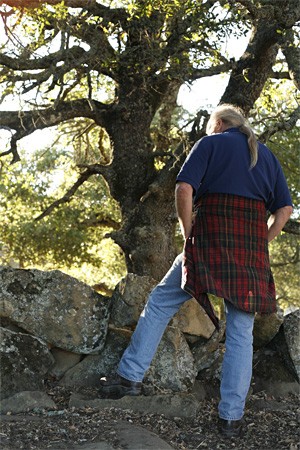
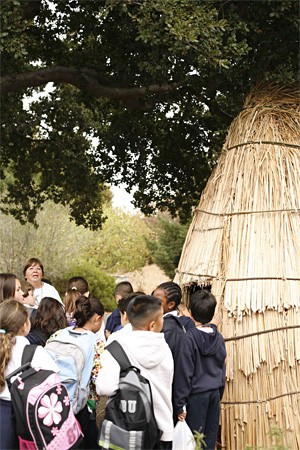
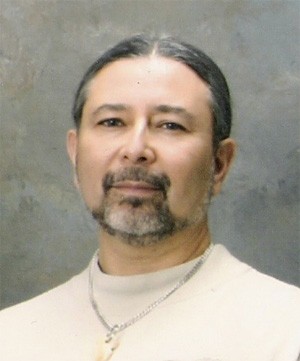
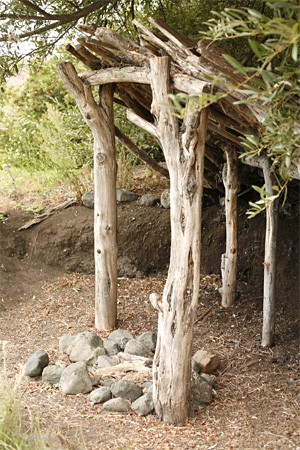
Benney looks at a Native American site. Credits: Jenny Pfeiffer Benney “daylighting” a mortar. Credits: Jenny Pfeiffer Bedrock mortars in the East Bay hills. Credits: Jenny Pfeiffer Benney examines a rock wall he suspects was built centuries ago by Native Americans. Credits: Jenny Pfeiffer Ruth Orta shows schoolchildren a reconstructed Ohlone house in Coyote Hills Regional Park. Credits: Jenny Pfeiffer Gregg Castro in an undated photo. Credits: Courtesy of the Castro family A partly reconstructed Ohlone structure at Coyote Hills Regional Park. Credits: Jenny Pfeiffer Artifacts from an Emeryville shellmound. Credits: Jenny Pfeiffer

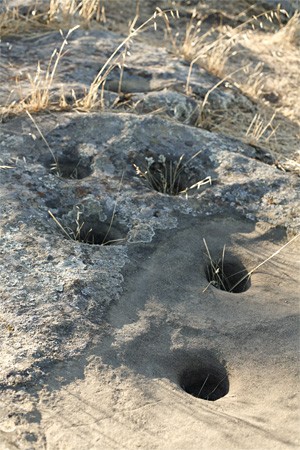

Soon he is standing at the center of a football-field-size plain, nearly surrounded by small sandstone boulders with mortars of myriad sizes and arrangements. Their high concentration suggests to Benney that this must have been an active village site for thousands of years. Though he has no formal training in archaeology or cultural anthropology, he speculates on the location of retreat routes, lookout points, defensive positions, and even a major trading ground nearby. “I still get thrilled by every one of them,” he says with a sense of awe in his voice.
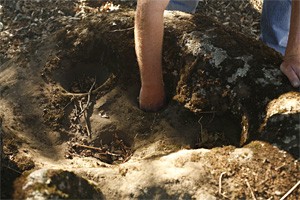
At one large rock, he pauses to demonstrate a practice he calls “daylighting.” Reaching his hand deep into a mortar — enough to fit his outstretched fingers and wrist — he scoops out a handful of accumulated leaves, branches, and dirt. To Benney, merely placing his hands where native peoples once put theirs is an innately spiritual act. He believes it’s important to open up the mortars to the air instead of allowing them to fill with detritus and eventually disappear. He considers daylighting a harmless and imperative part of appreciating these primitive food-preparation areas.
On the contrary, this seemingly innocuous act doesn’t sit well with a host of archaeologists, Native American descendants, and East Bay Regional Parks District employees who consider daylighting a form of vandalism. But in their eyes Benney has also done much, much worse. Five years after discovering this site while wandering from a ranger-led bedrock mortar tour, he self-published a detailed guidebook containing driving and hiking directions to this and some forty other Ohlone, Bay Miwok, and Northern Valley Yokut sites here in the East Bay hills.
Most of those sites sit isolated and unprotected on land owned or managed by the East Bay Regional Parks District, the nation’s largest regional park agency. The parks district is prohibited by state and federal law from publicly disclosing the locations of these and many other anthropological sites, due to their vulnerability. Laws such as the National Historic Preservation Act of 1966 dramatically increased legal protection for such sites by entitling them to certain safeguards, one being nondisclosure by public land stewards. But there’s nothing to stop private citizens from revealing the same information.
No one will debate Benney’s right to be enthralled by the first village site he found. With 630 visible bedrock mortars, it’s one of the most significant Native American sites in the state. Even if it wasn’t actually a permanent settlement, it clearly saw a lot of use, and could hold important clues about how the region’s earliest inhabitants lived. Most remarkably, it’s been virtually untouched for more than two hundred years — since Spanish explorers arrived in the 1770s and began forcing Native Americans away from the East Bay and into missions in San Francisco and Santa Clara. Today, the site sits on land owned by the parks district and the Contra Costa Water District.
What most upsets Benney’s critics is that he provided GPS coordinates for the sites in his book. With portable GPS units available to the public for under a hundred dollars, the sites can now be accessed by virtually anyone who wants to hike out to them. Benney’s book is the first of its kind to reveal this information, and critics believe it could expose the few remaining preserved native sites in the Bay Area to irrevocable damage.
Opponents are worried that Benney’s book could serve as a treasure map for potential looters, or “pothunters,” who have been known to dig up sites in search of artifacts such as arrowheads, pestles, grindstones, and spearpoints. It is illegal to remove them, but they can be stolen and sold to undiscriminating buyers for modest sums. A rare intact arrowhead with a sharp point can fetch hundreds of dollars.
“There are relatively few people doing this, but their impact is absolutely huge,” said Gregg Castro, a Native American descendant with Ohlone ties who has worked for fifteen years to preserve native culture. “The first and only time it happens will totally decimate a site. We know from decades of experience that the more people that know about these sites, the more damage is going to happen, and there’s no getting around that. … We all wish this book didn’t exist. This isn’t the first time this has come up, but it’s probably the most egregious.”
All sides of the issue agree that the sites are incredibly valuable, but lack consensus on the question of if and how they should be opened to the public. Benney believes that the benefits of increased awareness are too important to be overlooked, and should serve as the guiding tenet of site management. Resistance to his vision hinges on a conviction that without adequate protection — which thus far doesn’t exist — the risk of site destruction is simply too great.
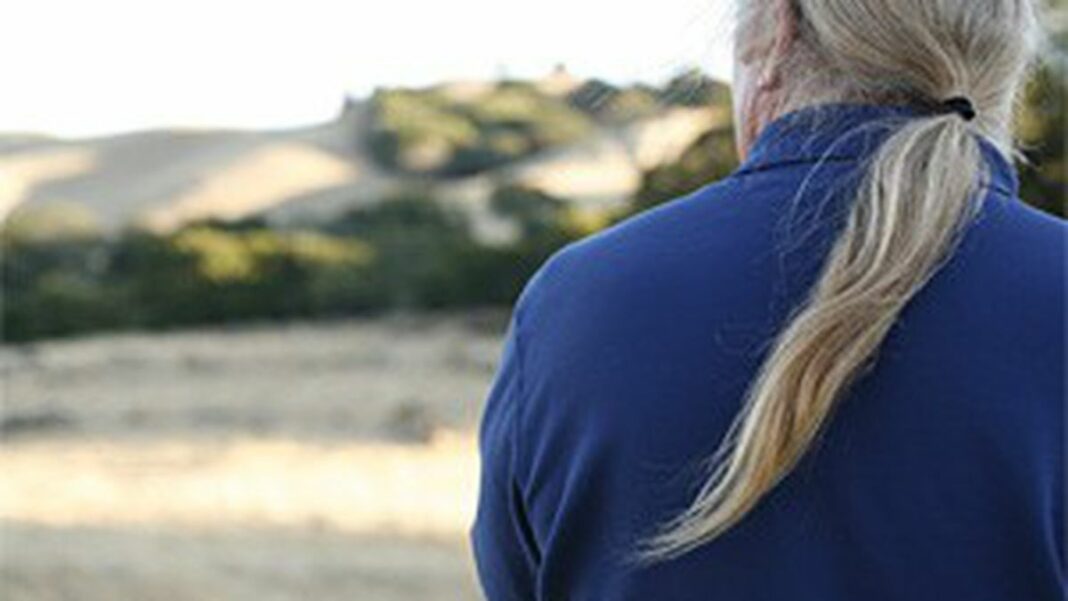
Benney’s guidebook has earned him titles ranging from “idiot” to “vigilante,” but if you ask him or his slowly growing cadre of supporters, he’s just a regular guy with a love for the land. He proudly refers to himself as an old hippie and Contra Costa chauvinist. He’s 57 and lived a block away from Telegraph Avenue in Berkeley in the late ’60s. He grew up in small East Bay towns like Moraga, Orinda, and Lafayette, where he now lives and operates a business painting old homes. His well-worn boots, worker’s jeans, and plain shirt reflect a modest demeanor, while the dirty-blond ponytail reaching the middle of his back flaunts his liberal perspective. Round shoulders droop off his tall, sturdy frame, and his speech is gentle and patient. Yet despite having done nothing illegal, his name is as notorious as a hardened criminal’s among the diverse cast of enemies he has made up and down the state. Indeed, Benney declined to have his face photographed for this article, noting that “I’m already more famous than I want to be.”
Still, Benney is not surprised by all the criticism the book has earned him. It was no accident that he failed to consult with archaeologists, Native Americans, or the parks district before initiating his campaign to publicize the sites. “I knew that they were going to try and stop me,” he explains. “So I went ahead and did it anyway.”
His underlying motivation remains a firm belief that today’s residents of the East Bay have much to gain from increased knowledge of the sites and of the people who once inhabited them. “This native culture has not been adequately recognized or studied for its achievements in adapting peacefully to this land and environment,” he writes in the book’s introduction. Benney feels that by looking back to natives’ plant and animal use, watershed protection, and population control, we will learn to advance our culture without also depleting our land. He refuses to wait for the day when these valuable teaching tools meet the same fate as thousands of Native American sites already sitting under parking lots, golf courses, highways, businesses, and homes in the East Bay.
“I’ve felt that, to me, the message is ‘Don’t let this disappear.’ The first time I was out there, the spirit spoke to me,” Benney said. “I want as many people as possible to know about these sites.” He can’t help but wonder: What good are cultural resources to people who don’t know they exist? His book’s answer reads loud and clear: “The need for increased public awareness and an appreciation of Native American history outweighs the need to hide some sites in order to protect them.”
Recognizing the concerns of those who worry about the sites’ fragility, Benney included the following note: “They should be approached and treated with the utmost reverence. … We do not dig, or even scratch the surface. Nor should you. We’ll leave that to the professional archaeologists and scientists.”
However, he also argues that the looting threat will actually be reduced as the number of people who hike out to the sites increases. Responsible visitors, he says, will discourage criminal and harmful activity in the same way that daylight and busy streets deter some car thieves: “By bringing more conscious people out there, we will know about it.”
Critics such as Castro don’t buy it. “He may see himself as a savior, but to a lot of people he’s no different than a pothunter, because they’re justifying their actions in a way that’s totally self-serving,” he said. “He’s created his own fantasy and ethical world to justify the things that he’s doing.” To Castro, established methods of working with lawmakers, developers, and land management agencies in a reactive capacity are not always effective, but have no viable alternative. “Until it’s shown that public knowledge shows results, this is the way that best protects the site,” he said.
Compounding concerns about physical damage, Castro worries that greater exposure could also threaten the sites’ holistic integrity by compromising their spiritual values. So-called “New Agers” have been known to construct native shelters, build fires, and attempt to practice Indian religion on village sites. An uniformed public stomping about sacred sites could be deemed similarly damaging and disrespectful.
Benney’s book also has been fiercely criticized by archaeologists, who have a vested interest in the resources’ preservation for future study and are bound by law and a professional code of ethics to keep undisclosed sites hidden. “There are circumstances where it’s in the public good to withhold information,” said Michael Newland, staff archaeologist at Sonoma State University’s Anthropological Studies Center. Newland is also the Northern California vice president for the Society for California Archaeology, a nonprofit public organization with a legislative focus, and was put in charge of monitoring the Benney situation.
“He’s convinced he’s doing the right thing, and he’s not,” Newland added. “I respect his desire to save these sites, but the way he’s going about it is all wrong.” Fellow SCA member Gregory White is less forgiving: “Benney didn’t realize the depths he was plumbing here. He has a real narrow perspective on what is right and wrong.”
The uproar clearly suggests to both sides of the debate that the current arrangement for protection of Native American sites is inadequate. Stakeholders have only begun to examine the issue with renewed urgency. And threats from pothunters, vandals, or New Agers are just one part of a bigger problem, as population growth, suburban sprawl, and technological advances raise a host of new issues for cultural resource protection in the 21st century. A solution to the dilemma here, whether public or private, could provide a blueprint for the management of threatened sites nationwide.
Recent archaeological discoveries in California, including human remains found in the Los Vaqueros Reservoir in eastern Contra Costa County, provide hard evidence that Native American occupation of the Bay Area dates back at least ten thousand years. Some experts place this number as high as thirteen thousand years, given that the oldest sites now lie beneath layers of sediment on the bay floor. The native people who most recently called the East Bay home are today considered part of the Bay Miwok, Northern Valley Yokut, and Ohlone tribes. Mission records suggest their population at the time of the arrival of the Spanish was around 4,500, although approximately 80 percent died of European diseases in the missions over the next forty years. Hundreds of their descendants still live in the Bay Area, and as many as five thousand are scattered around the globe.
The Bay Area was once replete with Native American villages, but few have escaped ruin. At least 451 shellmounds — refuse and burial heaps that are today considered rich archaeological sites as well as sacred ground among native descendants — were noted across the Bay Area at the start of the 20th century. Yet most were already gone or heavily damaged by 1910. The village sites’ rich soil, resulting from centuries of decomposing organic matter and human remains, was commonly used as potting soil, road and tennis court fill, yard fertilizer — even chicken feed.
In short, only the last vestiges of Native American history in the East Bay remain untouched, and Benney’s critics complain that he is accelerating their demise. “Now somebody wants to give away the last of what’s left, as if it’s a public curiosity,” objected Beverly Ortiz, who works for the parks district as a naturalist at Coyote Hills Regional Park in Fremont. Through her private work as a cultural anthropologist and passionate protector of Native American culture, Ortiz has led the charge against Benney’s book.
Benney published his sixty-two-page guidebook last March, and thus far has sold a couple hundred of the 2,500 copies pressed, mostly through his Web site and a few boutique bookstores and businesses in the East Bay. Multiple copies also are shelved in two East Bay libraries. There’s no telling who has read the books, but so far no serious incidences of looting or vandalism have been reported.
The sites Benney exposes are spread across the entire East Bay, from Brentwood to Sunol and as far north as Richmond. Some are in plain view in popular public parks; others are located far from established trails. A few are as small as a single mortar, while many contain between ten and twenty. The spots could have been in continuous use for thousands of years, and seemingly look today much as they were left. With wildlife biologist Jim Hale and a few other friends, Benney found all forty — plus another fifty or so not included in the book — simply by exploring. In a few cases he relied on word-of-mouth tips or historical texts with vague mentions of site locations, but for the most part found them through his own initiative.
“We’re just getting out and looking,” he said. Armed with a notebook, camera, and GPS device, Benney and his fellow hikers head out once a week to wherever they feel like going — a process they’ve repeated at least forty days a year for the last six years. In a typical day they cover ten to twelve miles, along the way keeping their eyes peeled for rocks with mortars. These are often located near water sources — usually a small spring or creek — and tend to be found in exactly the sort of places we appreciate most today: those with the best views, most natural beauty, and most wildlife. Eventually, Benney says, he developed a feel for where to look, and more-successful day trips have turned up as many as six sites. While finds like these are certainly a thrill, in the end they’re not the main reason he goes out hiking every week. “We’re not just looking for Indian sites,” he explained. “We like to hike, and the Indian sites are an enhancement.” He hopes his book will inspire in readers the same appreciation of the outdoors.
No matter his motive, his success as an explorer is indisputable. Benney suspects he has made a number of new discoveries, but has no way of knowing for sure — site details are guarded in an archaeological clearinghouse kept off-limits to the public. San Francisco State University archaeologist Jeff Fentress, who is uniquely familiar with the East Bay’s wealth of Native American sites, contends that Benney’s book contains no previously unrecorded sites, although that may not be the case with the fifty unpublished ones. Fentress does confirm that few of them have received any attention beyond a basic site record, and none have undergone archaeological excavation.
As Benney continues to explore, new finds come up almost every week, including another major village site just two weeks ago. Over the last year and a half, he has posted approximately ten of the least sensitive new locations on his Web site. “I’m being a little more cautious,” he said. “I’m trying not to antagonize everybody too much.”
But he hopes not just to make the public aware of the sites, but also to bring his favorite village back to life as a living museum. As part of what he calls his Hundred-Year Plan, Benney proposes that the parks and water districts remove any signs of modernity from the site and its environs — cattle fences, phone lines, dirt roads, cow ponds — then rebuild the village with native materials and institute on-site interpretive programs.
Benney first presented his plan to officials with the East Bay Regional Parks District in 2001, mere months after discovering the site, and has since forwarded it to an additional thirty or so people. His only official response came from the Contra Costa Water District, whose cooperation is essential to Benney’s vision, as the main portion of the site sits on its land. “The District appreciates your understanding of the significance of Native American sites on Los Vaqueros Watershed,” watershed and lands manager William Chilson wrote. But he went on to explain that since the district is prohibited by law from disclosing the site’s location, it cannot develop the area for public visitation. The letter concluded with an appeal to Benney for his cooperation in “keeping the location of identified cultural resource sites on Los Vaqueros Watershed confidential.”
Benney’s plan may look dead in the water, but he won’t admit defeat — after all, he’s already achieved his goal of bringing attention to the site. He remains convinced that this awareness will spark sufficient protective measures and someday result in supervised public access and education.
Not all of the East Bay’s valuable Native American cultural resources are kept secret. The Vasco Regional Preserve is one of the East Bay Regional Parks District’s most sensitive and sheltered areas, with its entire 1,400 acres enclosed by fences. Beyond protecting threatened natural resources — including fragile rock formations and endangered species such as the kit fox, the tiger salamander, and one of the world’s largest populations of golden eagles — the preserve is home to rare Native American pictographs. Still, public access is allowed to a small portion of the preserve via small-group hiking tours led by park naturalists.
This beautiful environment of endless rolling hills and ancient sandstone outcroppings offering views of the Central Valley, the Sierra Nevada, the delta, and Mount Diablo has long been considered an especially sacred place among local tribes. It’s easy to see why. Today many of the area’s hilltops are speckled with giant white wind turbines, but Vasco, which lies directly east of Los Vaqueros Reservoir, feels otherwise locked in time, impervious to the development overrunning nearby communities such as Brentwood, Oakley, and Antioch.
Even so, the pictographs here — native works of art using natural pigments, often red, on rock surfaces — are so sensitive that they are continually degraded by weathering, despite being partially sheltered by the caves in which they were created. They also face an unnatural threat that poses an even greater concern. Ever since the park began offering guided public tours in 2005, vandalism has increased notably. Of the few pictographs shown to visitors, one contains a striking example of what rock art graffiti can look like: Across the face of a series of depictions of the region’s majestic raptors measuring a couple feet across, the words “Gary Was Here” are scrawled into the rock, partially obscuring one bird’s wing. Elsewhere in the park, the word “fuck” is carved near multiple pictographs.
To prevent damage born of ignorance and malevolence, the preserve is patrolled heavily by land and air. A park-owned helicopter surveys the area for trespassers twice a day, while naturalists, rangers, and public safety officers conduct random patrols, even looking for footprints in the dirt. It’s a level of security unique within the park district’s 65 regional parks and 97,000 acres across Alameda and Contra Costa counties. Yet even in conjunction with the public interpretive and educational services the park offers to explain the pictographs’ importance, it’s not enough to keep them safe.
To many observers, the situation is solid evidence of the correlation between public awareness and site damage. Barring 24-hour security, which the district says it doesn’t have the funds to implement, damage is virtually impossible to prevent. And the remote mortar sites in Benney’s book, some argue, could presumably be subject to even more extensive damage.
Benney doesn’t think so. He cites a fundamental difference in sensitivity between pictographs and bedrock mortars. Pictographs can be destroyed in minutes by a single human hand, he admits, but a mortar is a more permanent hole in solid rock. This distinction was enough to convince Benney not to provide GPS coordinates for the two pictograph sites included in his book. One is located in the Vasco territory, and the other is so remote and well hidden that it took Benney and a friend four full days of hiking to find it. “If you stumble upon it, try not to even breathe on it,” he writes above its entry in the book. “Be aware.”
Pictographs aside, Benney believes the pervasive fear of looting is vastly overblown — merely a straw-man argument designed to rally support for the opposing view while painting Benney as a careless fool. Parks employee Beverly Ortiz insists the threat is real, and much more so than Benney will admit. There have been incidents in the East Bay where mortar sites have been dug up, she says, as well as one occasion where a large rock containing mortars was lifted out of the ground and removed altogether.
If anyone is familiar with pothunting in the United States today, it’s Karl Kilguss. He is majority owner and operator of the United States’ largest online Indian artifact marketplace, Cincinnati-based Arrowheads.com. Kilguss recognizes the bad rap that artifact collectors have earned, but insists that all but a dwindling population of rogue traders, who are shunned by the rest of the community, abide by a strict code of ethics. “There’s a history involved that’s not so great,” he said. “But we know better now.”
Kilguss says that pothunting is not as rampant or as attractive these days as some may make it sound. For one, it’s hard work. Potential thieves must not only haul a shovel out to a remote site undetected, but must then dig at least a couple of feet down, sift through large amounts of earth, and haul back whatever they’ve found — if anything. Then they’ll have a hard time making much profit from their efforts. Because of increased supply and access to quality artifacts through sites like Kilguss’, artifacts don’t fetch the kind of money they once did. “The days of people digging artifacts and making a ton of money are over,” he said. “Anyone that’s doing this to make money, they’ve got a long road ahead. It’s a difficult way for a criminal to make money. It’s so much easier to hold up a 7-Eleven.”
According to Kilguss, 90 percent of all arrowheads sell for $25 to $125. The finest, sharpest arrowhead in perfect condition could fetch as much as $1,000, but there are very few of these around — even in the ground. Weathering and cattle grazing cause most buried arrowheads to be chipped or cracked, vastly reducing their value. Still, Kilguss concedes, flea markets and online auction sites — including eBay and unscrupulous artifact-specific sites — often sell illegally obtained pieces and provide a market for artifacts acquired through pothunting. “They won’t hesitate to sell anything they can,” he said. “They don’t care about history. They care about money.”
Although Benney’s opponents vastly outnumber his supporters, his book has managed to generate a small measure of momentum. Marilyn Russell, who retired after 33 years of teaching at Livermore High School, received it as a gift from a friend. As a teacher, she led students on field trips to some of the sites that Benney highlights, including the large village site he wants to develop. “I think it’s really important to realize that there were people here before us who treasured the land and lived in harmony with the landscape,” she said. “I realize it’s a two-edged sword, but I always hope for the best in people.”
Russell is reluctant to let a few bad seeds impede upon everyone else’s freedom. “Those impacts, as destructive as they are … you’re letting the minority, or the criminal, or the dark side, influence the people that are good,” she said. “Educationally, you have to take risks.”
Benney’s most public backer is a friend he’s known since high school. Benney and Bob Bardell grew up in Orinda and attended Miramonte High School together, where one of their favorite activities was roaming the East Bay hills. Many years later, once Benney got Bardell hooked on Native American history, Bardell joined Benney’s band of explorers and the two began to go out frequently in search of sites.
When Benney proposed the idea for his book, Bardell backed him. “I thought it was a great idea,” he said. “The stuff’s on public land, and the public should be out there enjoying it. I’m a taxpayer for the parks and other public entities, and I think they have a stewardship obligation unto the land, but to my mind that doesn’t extend to keeping places secret from people.” Bardell argues that the general public has a right, a duty even, to experience firsthand the East Bay’s shared heritage and rich cultural history.
But some Ohlone descendants aren’t so sure they want to share. “If you want the experience, read the books,” said Jakki Kehl, who lives in the Central Valley town of Patterson and serves with the state as a “Most Likely Descendant,” which means she is called upon to handle Ohlone remains when they are encountered during construction projects. The broader goal of her work is protection of Native American cultural resources, and though she hasn’t read Benney’s book, she’s heard about it. “Publicizing these things is not a respectful thing,” she said. “It is the most disrespectful thing he can do. I really do think of this as a criminal act — if only a criminal act against humanity.”
Bennae Calac, cultural resources director for the Soboba Band of Luiseño Indians in San Jacinto — a small city about eighty miles east of Los Angeles — heard about the book too. But she has problems of her own. About three years ago, a pair of researchers compiled a guide containing the locations of hundreds of Native American sites in the area, then attempted to sell it to the highest bidder. Calac saw this as a blatant attempt to put the book in the hands of graverobbers. Increased foot traffic, vandalism, and minor incidences of looting followed, but Calac can’t say it all came directly from the book — intense development pressures and population sprawl around San Jacinto have also put her tribe’s cultural resources in jeopardy.
“We’re trying so hard to protect what we have,” she said. “These books and the information that people develop is really hurting us. It just causes more people to be out there and taking things. The majority of the people in this world today are not honest, whether we want them to be or not.” While talking, she tries to keep her tone hopeful. After all, preserving these sites has become her personal mission. “I don’t want to have to tell my daughter or my son out of a book, ‘This is where it used to be, and this is where our people traveled.’ Sometimes I feel like it’s a losing battle.”
In the middle of a bayshore marshland east of Fremont and just north of the Dumbarton Bridge sits a model of cultural resource management that comes closest to satisfying all sides of the issue. Coyote Hills Regional Park contains the only actively managed Native American village site in the Bay Area. The two-thousand-year-old Ohlone site is open to the general public through supervised visits led by park employees and a group of ten native Ohlone interpreters, and sees thousands of visitors every year.
As a naturalist based at Coyote Hills, vocal Benney critic Beverly Ortiz oversees much of the park’s extensive Ohlone programming. She’s been with the parks district since 1979, and at Coyote Hills since 1991. She is considered an expert on Native American cultural interpretation and preservation among East Bay parks staff, and has played a pivotal role in guiding the site management style employed at the Coyote Hills village.
Today, the site enjoys around-the-clock protection. It has been fenced off for about forty years, Ortiz says — since around the time the regional park was dedicated to public use in 1967 — and is enclosed by a tall chain-link fence topped with barbed wire. The park road that leads through the marshland and past the village site is closed behind locked gates every evening. Like the sites in Benney’s book, it’s much smaller and easier to monitor than the Vasco Preserve.
Since she’s been at Coyote Hills, Ortiz says she hasn’t been aware of any vandalism of the Ohlone site. Its undeveloped portion — a gently curved shellmound about three hundred feet in diameter and thirteen feet deep — still looks much as it would have when the village was occupied. The developed half of the site, where interpretive programs are now held, contains three small wooden structures designed to give visitors a sense of what native houses looked like.
Ortiz upholds that native descendants living today need a stronger voice in the management and preservation of their culture. She’s shocked that Benney hasn’t ceased his crusade even as native peoples continue to urge him to, since they’re the very people whose culture he claims to honor. “It’s just going to add to what’s already been a very painful history of destruction for them,” she said. “I can’t see any justification for making an existing problem worse.”
While some Ohlone people would prefer that visitors remained outside the fence at her own park, Ortiz counters that the site’s management represents a successful compromise. “For now, we’re doing what many descendants of the people who originally lived on this land feel comfortable with,” she said.
Ultimately, the governance of the Coyote Hills Ohlone village doesn’t look much different from what Benney envisions in his Hundred-Year Plan. Though today it’s one of a kind, the site could provide an archetype for future management of Native American sites in the East Bay.
Rick Parmer, the parks district chief of interpretive and recreational services, says he’s willing to try. “It’s a very valuable thing when you can actually interpret a significant cultural resource on-site, but only under controlled circumstances,” he said. “In order to open things up, you need to have a very solid stewardship and protection plan in place.” Before that can happen, the district — which has traditionally focused more attention on natural resources — needs to direct increased manpower and money toward cultural resources. Then it must determine which sites are the most and least sensitive, and find a way to manage each accordingly. It’s a delicate process that demands a “slow and cautious” approach, Parmer said, and can take years to run its course.
Consequently, although Parmer has some concerns about Benney’s tactics, he isn’t blind to the book’s benefits. “The good news is it’s focusing more attention on the cultural resources,” he said. “These are challenges that we need to face as a society and decide how we’re going to do it. The publication of his book has made the district much more sensitive to the need to do that.”
Other stakeholders have taken Benney’s book as an impetus to pursue a different path. Over the last year, Ortiz moderated two Bay Area panels at which fifteen representatives of concerned parties met to brainstorm solutions to the general challenge of protecting native sites. Titled “Cultural Resources Protection: Strengthening the Law,” the panels examined ways to use existing legislation to impose stricter penalties and expand the legal definition of what constitutes site destruction. They also considered several ideas seemingly at odds with the free press guarantees of the First Amendment, including instituting a permitting process for books such as Benney’s, advancing new legislation to criminalize site disclosure by private individuals, and holding individuals liable for damage that results from such disclosure.
At least for now, the law has no power to stop Benney. Ortiz laments: “The only thing that people can do is appeal to him on an ethical level that this is not right.” But Benney remains undeterred. “It’ll come around,” he says. “This is just the beginning. The sites are way too important to be ignored.”









In a truly California show of ignorance, the “stakeholders” could not be more wrong-headed. Nor have the laws demonstrated such short sighted ignorance of the value of prehistoric cultural knowledge. Were some courageous California Archealogist to examine what is done all over the world to learn about and educate the populace of pre-historic peoples and their cultural heritage he or she would be embarrassed at the backassedness of California. Take five minutes, go on line and see how particularly advanced ancient studies are handled in Great Britain, who look at previous cultures on a multi-thousand year scale. The whole of Great Britain resonates with the joy of learning about the peoples who came before, how they lived, and what they now could teach us. Start with the silly laws which only allow archealogists to earn a living by doing Native American site destruction so that commercial developers can turn the past into parking lots,malls and expansive shopping centers. Wake up stake holders.