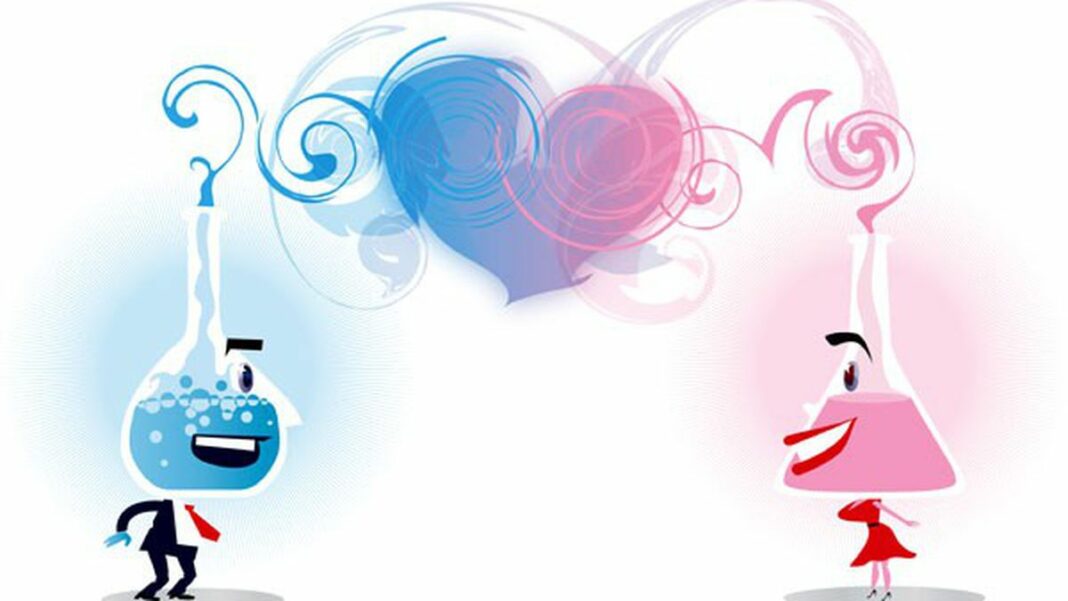
Ah, courtship. A northern harrier hawk repeatedly climbs the sky and then plunges toward the earth, enticing his desired partner to join him in this expression of untrammeled power. The humpback whale casts his mysterious and ever-changing song through miles of pelagic water, hoping it will be heard somewhere in the deep. A teenage boy anoints himself with a potent mix of styrene acrylate copolymer, hydrofluorocarbon, and fragrance — he calls it body spray — before heading to the mall. Humans have the most highly developed brains on the planet. Yet when it comes to sexual attraction and mate seeking, we’re no different from our butt-sniffing animal cousins. Our passions are ruled by the same neurochemicals.
But love — that’s a different story. Fundamentally, we are made for deep, lifelong love for one mate. Humans are among just 3 percent or so of mammals that seem to be hardwired for monogamy. This small set of monogamous mammals — including the prairie vole, the titi monkey, and the fat-tailed dwarf lemur — have a unique receptivity to oxytocin, the brain chemical that enables us to form the deep bond we know as love.
Credits: Norman Dog 
Most male animals mate early and often, with as many partners as possible. This system has reproductive advantage for the male of the species: The more eggs he can fertilize, the better the chances that some of his offspring will live to reproduce, passing along his genes.
There’s a famous and probably apocryphal story about President Calvin Coolidge and his wife, Grace Anna. As the tale goes, the Coolidges visited a farm, where, on separate tours, they were each impressed by the amorous prowess of the top rooster. Mrs. Coolidge and her guide paused by the chicken coop, and she asked him how often the rooster copulated.
“Dozens of times a day,” she was told.
“Well,” she said, “please tell that to Mr. Coolidge.”
Mr. Coolidge was duly told and, after a moment of dismay, he asked, “The same hen every time?”
“Oh, no, Mr. President. A different hen every time.”
“Well,” he said, “you tell that to Mrs. Coolidge.”
Psychologists G. Bermant and D.F. Lott used this anecdote to explain a phenomenon they’d observed: A male rat who’d copulated to exhaustion with one particular female could somehow manage to get it up and begin all over again when presented with a different female rat in heat. The Coolidge effect is reliable not only in rats but also in most other mammals. It’s the reason ranchers need only a single bull to service a herd of cows. But a bull will refuse to copulate again with a cow he’s already mounted, no matter how they try to disguise her. When he’s done, she’s done.
Some women might swear that modern men experience the Coolidge effect. But men are not rats, hamsters, or bulls. While the brains of those creatures impel the males to spread their semen as widely as possible, the brain of the human male, like that of the human female, drives him to pin his desires on one particular woman. Each time he makes love, his orgasm teaches his brain that she, this one particular woman, is the source of pleasure and comfort. He can make love to her day after day after day until their grandkids present them with a gold-plated cookie platter.
Monogamy also has its own adaptive advantages. Instead of expending all their energy seeking mates — and exposing themselves to danger from rivals and predators — monogamous male mammals cohabit with their mates and make a fairly equal contribution to child rearing by gathering food, defending the nest, and making sure the offspring don’t wander away. A man’s investment in the offspring increases the likelihood that babies will grow up and carry on his genes, bettering his reproductive odds just as much as the sperm-scattering approach does. It’s also a better deal for the female; her mate’s protection and help make it more likely that she’ll survive the perils of pregnancy, birth, and nursing.
For years, all of this was theoretical when it came to humans — the province of sociology and anthropology. But recent advances in brain scanning technology have enabled scientists to begin mapping the brain’s circuits for fear, anxiety, and love. Functional magnetic resonance imaging, or fMRI, shows what parts of the brain become active as we do certain tasks. In an fMRI study, the subject may be told to do arithmetic, look at photographs, or think about someone he loves as he lies very still with his head inside the scanner. Patterns of increased activity show as bright spots in the scan; some parts of the brain “light up.”
FMRI studies have identified the areas of the brain that consistently light up when people look at photos of loved ones. These are the same areas that come alive when mothers look at photos of their babies, and when they masturbate or make love. Moreover, when test subjects inhale oxytocin before a brain scan, activation in these areas increases. At the same time, oxytocin decreases activities in the parts of the brain that handle fear or anxiety. In other words, oxytocin increases our receptivity to connecting with others.
This body of research consistently shows that the human brain is wired like those of the monogamous 3 percent. And it shows that oxytocin is the brain chemical not only of bonding and maternal care in humans, too, but also of trust, generosity, and empathy.
Dacher Keltner, a UC Berkeley professor of psychology and director of the Berkeley Social Interaction Laboratory, says that because the bond between mates and their children is crucial for the survival of the species, “the capacity to be kind would be woven into the genetic fabric of this new hominid” during our evolutionary development.
As we evolved into monogamous, familial mammals, differences in the sexes would have been adaptive, allowing the mother and father to protect and nurture their offspring in compatible ways. And while our culture today allows for less rigidly defined gender roles, we’re still working with the sexual chemistries of cave people. Humans aren’t hard-wired for sexual behavior, nor for monogamy; indeed, there’s wide variation among individuals. But understanding how our neurochemistry affects our lives and loves can help us make sense of those mystifying differences between men and women, whether we want to let them play out or escape from them.
Love in the Brain
Whether a species is monogamous seems to depend on a small variation in the distribution of oxytocin and dopamine receptors in the brain. Most mammals, male and female, monogamous or not, have remarkably similar brain structures and neurochemistry. Their brains produce oxytocin, as well as vasopressin, a closely related molecule that seems to stimulate protective behaviors. Dopamine, the chemical messenger responsible for anticipation of pleasure, drives them all to go after the rewards of food and sex.
What’s different about the monogamous minority is the way their brains seem set up to pair the rewarding rush of dopamine with the neurochemical of social connection, oxytocin. The peculiar placement of oxytocin receptors in the brains of humans and the rest of the monogamous 3 percent ties social attachment to the brain’s powerful reward structures. The key to whether a mammal will mate for life or run from one partner to the next seems to be where receptors for those neurotransmitters are located, according to Larry Young of Emory University and Zuoxin Wang, of the University of Florida. In monogamous brains, the reward centers are rich with receptors for not only dopamine but also oxytocin, the molecule of bonding. The same systems involved in addiction to drugs leads humans to form a benign addiction to our mates, families, and friends.
In the nonmonogamous brain, sex feels really good, while in the monogamous brain, the rewards of sex are tied to one particular sex partner, creating a conditioned response that’s not much different from the addicting high of cocaine or methamphetamine. The combined chemical message says, “Sex felt really good with you. Let’s do it some more.”
Evolution may have hijacked the brain’s reward circuits in aid of monogamous love, because raising weak and defenseless human children in pairs provided adaptive advantages. In prehistoric times (and even today) children were more likely to survive to pass on their parents’ genes in a dual-parent family.
But the woman and children’s need for support and defense conflicts with the sexual promiscuity that, in most species, creates reproductive success for the male. Monogamy helps resolve the conflict. A man who lives with his mate and has sex with her frequently is more likely to be the biological father of the offspring he’s investing in. In primitive times, the male half of the pair could protect his woman and children from animal and human predators, and he could provide food when pregnancy, labor, or sickness kept her lying in. Those adaptive advantages seem to remain in our modern times. The largest predictors of divorce in the 20th century were infidelity and infertility, according to a 2000 study by Chris Fraley and Phillip Shaver of UC Davis.
This is not to say that men — or women — are so hardwired for monogamy that infidelity is impossible, or even difficult. Obviously, sex outside of marriage is just a phone call away. We humans, like most monogamous mammals, engage in what biologists call “social monogamy,” defined as living with one partner to whom we’re bonded, sharing the work of maintaining a home and raising children, with the occasional sexual adventure. In fact, there may be no such thing as true sexual monogamy anywhere in the animal kingdom.
Scientists can estimate how often pairs in a monogamous species copulate with other individuals by doing DNA tests on the young. The results show that monogamy is more of a social system than a sexual one. Researchers who’ve examined the DNA of monogamous birds in Europe have found that between 29 and 68 percent of the offspring are the result of “extra-pair copulation.”
We don’t seem to have any comparable stats for human paternity, but anecdotal reports suggest that copulation outside of monogamy is more frequent that people imagine. Surgeons who do organ transplants or bone marrow transfusions typically look first to parents or siblings as donors, because they share genetic material. However, in many more cases than they expect, when they do the DNA test, there turns out not to be a match: The father of the family wasn’t the biological father of a daughter, or the brother and sister are really half siblings. It seems that modern humans are also likely to hedge their genetic bets with some extra-pair copulation.
Men and Women are Different
While oxytocin is the brain chemical of love, trust, and generosity in men and women, there’s a joker in the deck: vasopressin. This somewhat mysterious chemical differs from oxytocin by just two amino acids; both chemicals probably evolved from a single precursor in the days when our ancestors slithered. Researchers haven’t quite figured out what vasopressin’s role is, but it may be the key to some of the most confounding differences in the way that men and women lust and love.
Vasopressin is much harder to study in humans than oxytocin is, for three reasons. First, the level in a person’s bloodstream doesn’t correlate as well with levels in the nervous system, so researchers can’t rely on blood samples to understand what’s going on in the brain. Second, you can’t find people willing to take part in studies where vasopressin, or anything else, is injected into their brains. Third, scientists have identified three different types of vasopressin receptors in humans, the same as in prairie voles.
Studies of rodents, including mice, rats, and voles, indicate that vasopressin may alter a male’s bond with its mate. Scientists used to think that vasopressin regulates male monogamy the same way oxytocin does the female’s. But Karen Bales of UC Davis and Sue Carter of the University of Illinois have done experiments showing that it’s oxytocin that’s key for both male and female bonding. When Bales injected the brains of male prairie voles with a substance to block the effects of vasopressin, it had no effect on their bonds with their mates. After a period of separation, males whose vasopressin had been blocked scurried just as eagerly back to their chosen companions. In another experiment, Bales gave male prairie voles a single dose of an oxytocin blocker soon after they were born. When these males grew up, they failed to bond with a mate. They also displayed a lot less of the parental caring behavior typical of this species: They spent less time “huddling” with the pups, licked and groomed them less, and weren’t as apt to retrieve babies that wandered out of the nest. These experiments show that oxytocin is a critical component of a male’s bonding as well as a female’s.
But vasopressin does play a bigger role in stimulating fatherly behavior in male prairie voles than in females. In prairie voles, and other species of monogamous mammals, males will fight to protect the family and venture out to retrieve wandering pups. In these males, oxytocin is more related to the behavior of huddling up close with mother and pups in the nest, while vasopressin is more related to the “manly” traits of protecting the nest and keeping the kids in line.
One experiment points to the same influence of vasopressin on protective behaviors in humans as in voles: It seemed to put men on aggressive alert. In a study at Bowdoin College, psychologists gave men and women a whiff of vasopressin and then showed them photos of faces with carefully neutral expressions. The men who had sniffed vasopressin frowned more and tended to see the neutral facial expressions in photos of men as unfriendly. When the women in the study looked at photos of other women, on the other hand, their facial muscles moved into friendly expressions and they rated the strange women’s photos as more friendly.
This difference provides a biological explanation for the perplexing mismatch between male and female romantic strategies. In human males, the drive to be the defenders of home and family may be as innate as it is in our mammalian cousins.
Love — His and Hers
Have you ever heard a woman say that she feels love for someone deep in her womb? That could be her uterine oxytocin receptors sending out a message. Her body, primed for childbirth and coursing with estrogen, is extremely susceptible to the bonding influence of oxytocin. This is why she may begin to feel so attached, even before sex. If all it takes is a little canoodling to get the settle-down hormone flowing through her veins, then when she makes love, she feels she’s in the arms of Mr. Right. Oxytocin makes her want to snuggle up for the night — and forever.
The quiet times a woman craves with her man — gazing into each others’ eyes, talking about feelings — are activities that boost oxytocin and make her feel bonded. And romance for a woman tends to involve elements that, really, relate to nesting: dim lighting, flowers, and music — all of which help create the civilized equivalent of a warm, safe place to give birth.
But the man falls more under the influence of vasopressin, so his romantic needs are quite different from hers. Excitement, danger, and the impetus to protect his woman are what make him feel bonded. All the mushy stuff that she needs seems boring and even a bit of a turnoff. The movie cliché where the hero saves a woman from peril, looks into her eyes, and passionately kisses her expresses an evolutionary truth. The testosterone and vasopressin in a man’s system may keep him from turning into a cuddle bug. Instead, he’s more likely to play the role of protector and warrior. That charge of testosterone and vasopressin may be the reason that after sex, while she wants to cuddle, he feels the urge to jump up and fix the car — right after he takes a little nap.
Once he’s mated, vasopressin readies him to respond to challenge by amping up his sympathetic nervous system. In a challenge, vasopressin overrules the effect of oxytocin, turning off trust and friendly behavior. Meanwhile, testosterone increases his energy and self-confidence, and makes him more willing to be aggressive. Also, the man’s tendency to be the disciplinarian of the family may have evolved into a social norm because it’s such a comfortable part of his biology.
That twist that vasopressin gives to the male brain goes a long way toward explaining how differences between mothering and fathering might have come to be. A woman, as the sole provider of milk for babies, needs to be still to let them nurse. They have a better chance of surviving if she stays close to them, even in times of danger. The best defense may be to keep quiet and hope she isn’t seen. Calming oxytocin activates her parasympathetic nervous system and helps her stay put. Once a man has impregnated his mate, he’s more expendable. If he dies or is injured while fighting off a predator, he’s nevertheless given the rest of the family a better shot at survival.
Translate this to modern humans and you get Mommy: warm and nurturing, happy to putter around the house, glad to settle in for a long chat; and Daddy: striding out of the house to work, jumping up in the dark to investigate things that go bump in the night.
At the same time, the mated man’s roaming instincts will be at least somewhat quelled as the sweet influence of oxytocin predominates over the rangy persuasions of testosterone. In fact, Peter Gray of the University of Nevada has found that testosterone levels in married men are actually lower than those of bachelors, making them more committed to the wife and kids. This held true across cultures. Gray’s hypothesis is that this reflects a shift in the man’s reproductive strategy as he moves from sperm-scattering to investing in his family — and the survival of his genes. He and his colleagues have yet to determine whether mated men have lower testosterone levels because they’re in relationships or whether men with lower testosterone levels are more likely to settle down with a family. In either case, the lower levels of testosterone in these family men allows for a fuller flowering of the oxytocin response.
Less testosterone and more oxytocin could make for mellower sex, and the oxytocin effect is probably what makes sex in a long-term relationship so different from those intense encounters during the early days of courtship or marriage. The nucleus accumbens, the brain system that keeps us focused on winning rewards, doesn’t need to go into high gear when that reward is lying in bed next to us every night. Her body and brain, bathed in the calming effects of oxytocin, over time may tend to favor comfort over passion. He, too, is calmer and less excitable, which, overall, is a healthy state for him, even if he’s less of a raging bull when it comes to sex.
If we’re wired for monogamy, how come so many marriages end in divorce? How come some people do just fine in polyamorous relationships? There’s wide variation in individuals, even among animals. Emory’s Young has found that a high percentage of supposedly monogamous male prairie voles never mate — and this is tied to a variation in the vasopressin gene. Nurture also plays a huge role in how strong the oxytocin response is.
You may not choose traditional marriage or sexual monogamy. But we all have an innate need for oxytocin-based relationships that are very different from romantic desire. You may find such a relationship not only with a mate but also with a best friend, a mentor, a parent, or your own child.
And if this sounds like a rationale for a return to gender roles, it’s not. The powerful man and passive woman are stereotypes. The human ability to shape our own fate has created handywomen, hard-charging female executives, and stay-at-home dads who are as good with a spatula as a hammer. Evolution is not destiny. But if you’re a woman wondering why he won’t pick up his socks, or a man tired of being nagged about picking up his socks, it may help to remember that you’re hearing the whispers of eons of evolution — so you should cut the other person some slack.