
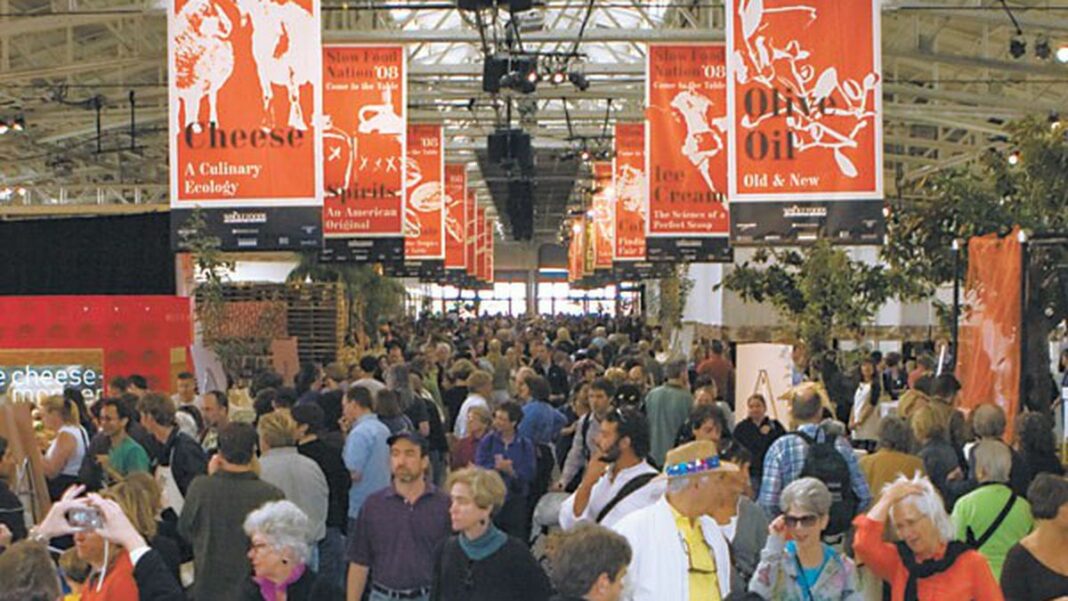
At Slow Food Nation’s massive celebration in San Francisco on Labor Day weekend, about 10,000 people shelled out $45 to $65 each to sample artisanal charcuterie, homestead cheeses, biodynamic wines, craft beers, fresh wild seafood, and other specialty items. Hundreds of well-heeled foodies stood in line at the Fort Mason Center event for the cheeses alone. Elsewhere, others listened to lectures by prominent food leaders like Michael Pollan and Alice Waters on topics ranging from the world food crisis to the philosophy behind the Slow Food movement.
Just a day earlier on August 29, however, another discussion was taking place as part of Slow Food Nation. But the panelists at this lecture, held behind closed doors at the Civic Center as part of “Changemakers Day,” weren’t celebrating. Instead, the activists cogitated on how to bring the health benefits and social enrichment of Slow Food to the neighborhoods that need them the most.
“People like good quality food, and I have nothing against increasing the awareness of quality food,” said Kimi Watkins-Tartt of the Alameda County Public Health Department, who participated in the talk “Reframing the Slow Food Conversation to Support Food Justice.” “But I just don’t want that conversation to drown out more important issues, like the fact that a lot of people have no place to buy a tomato, let alone an organic heirloom.” She wants to see Slow Food Nation connect with the people most affected by diet-related health problems and believes that the San Francisco-based nonprofit subsidiary of Slow Food USA is instead “tinkering around the edges.”
Tartt and other social activists, like Brahm Amadi, director of People’s Grocery in West Oakland, are questioning the Slow Food movement’s relevance in a place as stratified and class-based as the Bay Area. In West Oakland, a near absence of supermarkets makes fresh produce a luxury out of reach for many, and critics assert that the Slow Food movement, in spite of its mantra of “good, clean and fair,” is an exclusive diversion for the upper classes.
The Slow Food movement was founded in Italy by Carlo Petrini in 1986 as an effort to preserve local and regional cooking and eating traditions in the face of the widespread homogenization of food. It has since become a worldwide sensation and one of the most successful campaigns against the fast-food culture that has stricken many Americans with obesity, diabetes, and other ailments. Yet some critics observe that the movement has shifted upward, especially in the US, into an expensive, somewhat irrelevant realm of wine tasting, kitchen islands, artisanal cheese, and heirloom tomatoes at $5 per pound.
“Slow Food needs to slow down, frankly,” said Ahmadi. “Slow Food needs to address the issues that are on the table now in these low-income neighborhoods of color, then bring these people along as [Slow Food] explores more sophisticated avenues in food culture.”
Martha Davis Kipcak of the Kitchen Table Project in Wisconsin also believes that the concept of slow food is not what it once was. “Somewhere, somehow in America, Slow Food has gotten very skewed,” she observed. Kipcak moderated another Changemakers Day discussion panel billed as “Crossing the Divide: Slow Food and Isolated Communities,” in which panelists discussed the inadequate distribution and availability of fresh produce in so-called food deserts. “I think Slow Food should be about celebrating the simplicity of food,” she continued. “I love artisan cheeses, they’re wonderful. But can everyone afford cheese for $23 per pound?”
While Slow Food Nation has been successful in presenting alternatives to industrially produced food and underscoring the virtues of hand-crafted products, it doesn’t know how to bring these things within reach of the people who may want them but have no access to them, says Hank Herrera, project manager of Health for Oakland’s People and Environment. Herrera, who moderated the panel “Slow Food Conversation,” believes Slow Food Nation and Slow Food USA essentially constitute “a very privileged choir preaching to itself.” One point of criticism against Slow Food Nation was the prohibitive $45 to $65 ticket price for admission to the Taste pavilion at Fort Mason.
But a large portion of Slow Food Nation was free and located in the city’s heart — not far from the notoriously underserved Tenderloin. At the Marketplace and Victory Garden, more than 50,000 people passed through to buy produce, try samples, and receive informational brochures about the simplicity of homemade food. Even the ticketed portions of Slow Food Nation — namely the auditorium lectures and the Taste sessions at Fort Mason — were relatively cheap, starting at $10 for students.
In addition, Slow Food Nation held dozens of fund-raising “Slow Dinners” for nonprofits like People’s Grocery, Ahmadi’s market that caters to the underserved of West Oakland. Other organizations that benefitted from the private dining events include the Alameda Point Collaborative, Roots of Change, Save the Bay, and Three Stone Hearth.
Slow Food Nation’s executive director Anya Fernald says the event has taken hugely undeserved flak. “I feel like we’re being held to task,” says Fernald. “What can an event be expected to do? All these issues of food justice are beyond what an event can accomplish. They’re more what a movement can accomplish.”
That is a major goal of Slow Food USA, according to its president Josh Viertel. He says his primary objective is to ensure that healthy food access becomes a right for all — not a privilege of some, as it currently seems to be. One of the major obstacles is a system of government subsidies that make unhealthy food the cheapest on the market. “We’re looking squarely at the fact that poverty is a core cause of the disparity in diet-related disease,” he said. “But this isn’t something that Slow Food can take on on its own.”
Change will require effort at all levels, from the government down to the individual, said Slow Food USA executive director Erika Lesser, and one of the most powerful things an individual can do is also one of the most basic. “We’ve got to learn how to cook again,” she said. “We’re trying to teach that.” Lesser points to their Slow Food in Schools program, which introduces children to gardening and cooking.
Still, amidst all the hype surrounding Slow Food, Ahmadi believes that a casual survey on the streets of West Oakland would probably reveal that a majority of residents there still don’t know what Slow Food even is. “I’m not saying that Slow Food needs to introduce low-income families to artisanal cheeses,” he said. “What I’m saying is that when we can’t get fruits and vegetables, basic dairy products, and healthy meat products within a reasonable proximity of where we live, the idea of talking about anything beyond those staple goods is ridiculous.”