
Berkeley High School is no stranger to controversy, especially when it comes to student achievement. During the 1990s it came under fire for having one of the most integrated school populations in the United States and one of the worst achievement gaps. At that time, a large proportion of white and Asian-American students were getting routed into honors and advanced placement classes, while their African-American and Latino counterparts were overrepresented in special education and remedial classes. It was a stark and painful example of racial inequality right in the middle of progressive, politically correct Berkeley.
In the mid-’90s, outside researchers started exposing these inequities, first in the 1994 PBS documentary School Colors, which showed that kids of different races didn’t even mix during lunchtime, and then in the four-year Diversity Project, led by former Berkeley High teacher Pedro Noguera and a team of UC Berkeley scholars. Their conclusions, published ten years later in the book Unfinished Business: Closing the Racial Achievement Gap in Our Schools, were damning. Well-to-do white kids were getting the lion’s share of the resources, while African-American and Latino kids were falling through the cracks.

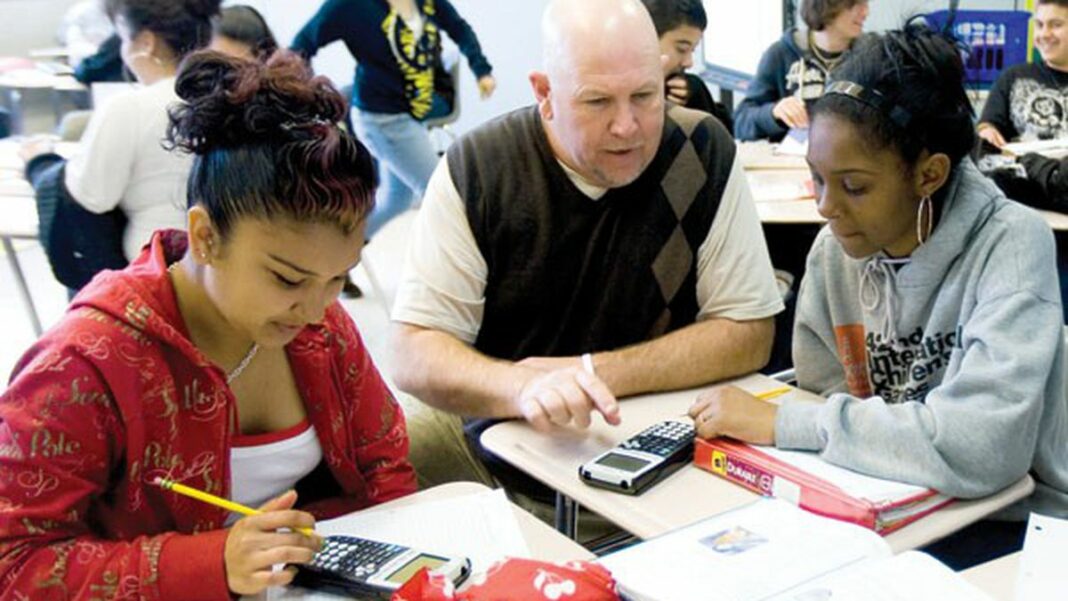
Matt Bremer helps freshmen at Community Partnerships Academy with their integrated math curriculum. Credits: Ali Thanawalla 
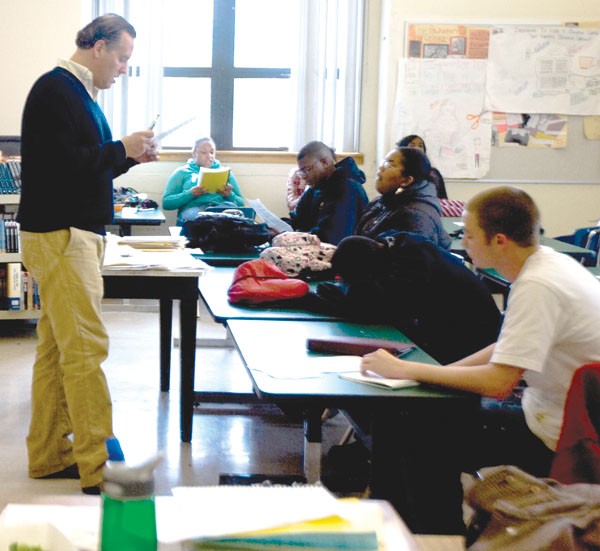
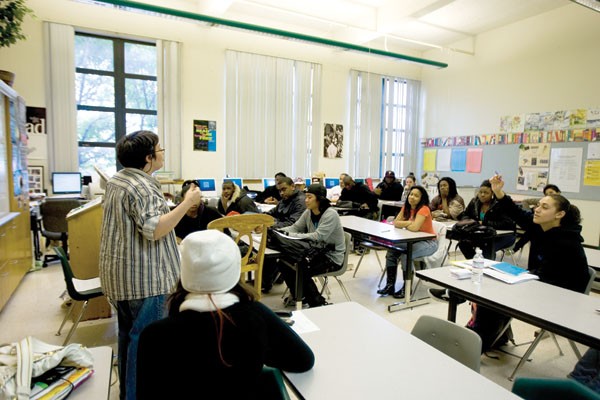
Wyn Skeels’ senior economics class at Community Partnerships Academy. Credits: Ali Thanawalla Susannah Bell and her students rebut the article from the Berkeley High Jacket. Credits: Ali Thanawalla

More than one decade later, Berkeley High is attempting to reverse that pattern by “redesigning” itself in a way that better serves its non-white student population. The school’s leaders think they have found the answer in personalized, theme-based “small learning communities,” which teach a curriculum based on skill mastery, rather than rote memorization.
Small schools were trendy on the East Coast in the ’80s and ’90s. Their nontraditional approach found favor with university scholars and, eventually, Bill Gates, whose foundation ended up financing a lot of them. In the late ’90s, several groups in Berkeley coalesced to form a local small schools movement. They saw small schools as the way to create parity between kids of different races and socioeconomic classes. Their movement gained momentum in 2002, when Oakland’s school system created several autonomous small schools and specialized academies within its existing high schools.
Berkeley High already had two prototypes. In 1990, it launched the Computer Academy, which recruited “at-risk” students from the general population and enrolled them in small classes with a technology focus. That school was later renamed the Community Partnerships Academy and given a focus on technology and internships. Meanwhile, in 1997, English teacher Rick Ayers founded Berkeley High’s first official small learning community, Communication Arts & Sciences, which specialized in arts and media and became a bona fide small school in 2002.
For years, small schools backers pointed to these two programs as a model for converting Berkeley High into wall-to-wall small schools. Then, in 2003, Berkeley High hired Principal Jim Slemp, who had a reputation as Mr. Small School when he came to Berkeley High from Oregon. Berkeley also obtained some seed funding from the Bay Area Coalition for Equitable Schools (BayCES).
In 2003, the once-hesitant school board passed a Small Schools Reform Initiative designed to guarantee, in BayCES’ words — a “personalized preparatory education for every student.” Slemp and former superintendent Michelle Lawrence eventually fashioned a compromise between the folks who wanted wall-to-wall small schools and the traditionalists who wanted to keep Berkeley High as it was. They reconfigured Berkeley High into four theme-based small schools (Arts and Humanities Academy, Community Arts and Sciences, Community Partnerships Academy, and the School of Social Justice and Ecology) and two traditional large schools (Academic Choice and the International High School).
The schools theoretically all had to fit within the larger structure of Berkeley High, following the same rules and using the same standards for testing and grading. But it hasn’t quite worked out that way. While these new small schools were created to level the playing field between students, the evidence suggests that they may be exacerbating the very problem they were supposed to solve.
For one thing, the lottery system used to determine which students went to which school didn’t work. That left Berkeley High’s four small schools about almost twice as African American and half as white as its two large schools. Thus, Berkeley High is now more separate than ever.
But it’s also less equal. Small and large schools use completely different teaching methodologies. They have different grading standards. And Berkeley High has failed to produce the data to show that small schools actually close the achievement gap. If all that were not enough, two weeks ago the Berkeley High Jacket reported that teachers in charge of small schools are pressuring the science departments at Berkeley High to inflate the grades of small school students.
In short, Berkeley High has taken a leap of faith into a giant, piecemeal reform project whose efficacy it can’t prove. Now it is planning the next phase of its redesign at a time when the school district faces up to $9 million in budget cuts. Test scores haven’t budged, the community is highly polarized, and Berkeley has no clear plan for how to bankroll its redesigned vision beyond 2011. Small schools advocates continue to tout the benefits of reduced class size and personalized education. But so far the gains they’ve made are mostly intangible.
In theory, small schools were set up to benefit students like Ronald Pernell. Now in twelfth grade, Berkeley High School’s student body president has spent the last four years at Community Partnerships Academy. Born in Richmond, he moved to Berkeley for middle school, and now the hard-working African-American student holds down a part-time job at Nation’s Giant Burgers while going to school full time at Berkeley High. Pernell once wanted to go into law enforcement and become a police officer, like his mother. But now he wants to study business. His senior economics class and current internship in the Berkeley High student activities office helped change his mind.
Pernell’s chosen campus occupies one corridor on the second floor of Berkeley High’s G building. It has a cluster of classrooms for all four grades, and a separate office for its administrator Annie Johnston (dubbed the school’s “lead teacher”). The idea was to create classrooms with a much lower student-teacher ratio so that students could get more individual attention, and teachers could better monitor each kid’s strengths and weaknesses.
Small schools were given carte blanche to experiment with different teaching methodologies. At Community Partnerships Academy, that means a focus on projects rather than book learning, and a curriculum that’s more to the left of what you’d see in traditional high schools. The seniors in Susannah Bell’s English class read John Berger’s Ways of Seeing and bell hooks’ Where We Stand: Class. At the beginning of the year each kid writes a first-person essay that doubles as his personal statement for college. Meanwhile, math teacher Matt Bremer is showing his freshmen how to find the volume and surface area of prisms for a larger unit about optimizing the structure of a honeycomb — so you get the maximum amount of honey for the minimum amount of wax. Posters adorning the walls of Wyn Skeels’ social studies class show artistic representations of imperialism — students compare it to a Belgian waffle iron, a microwave, and a beauty shop that creates the latest European hair style. Bookshelves in the back off the class contain all the required reading for a social studies class in Berkeley: Howard Zinn’s Declaration of Independence, Ultimate Field Guide to the US Economy, Elihu Rosenblatt’s Criminal Injustice: Confronting the Prison Crisis (the front cover bears a picture of Mumia Abu Jamal).
Small schools enthusiasts cite several reasons why this approach is good for students. Their biggest selling point is “personalization,” a word that pops up immediately in any argument on behalf of small schools. This personalization is based upon a smaller student-to-teacher ratio, a tight-knit classroom community, team teaching, a curriculum designed to meet students’ individual needs, and parent-teacher conferences where the parent — not the teacher — is the expert.
The students at Community Partnerships Academy seem to like their classes, or at least think their classrooms are a fun place to hang out. After all, most of them get to be with the same group of students for four years. Pernell certainly loves his school and champions it unequivocally. “I’ve been with same students for four years,” he said. “They help me get through the day. If I don’t go to school, or I miss class, they get my homework. If I have to go to work or I get busy, they’ll be like, ‘You have to go to work, we’ll take care of it.'” He already advised his younger sister to pick Community Partnerships Academy as her first choice when she enrolls in Berkeley High next year.
His comments suggest that Berkeley may have succeeded in its goal of using smaller classes to create a sense of camaraderie between students so they’d have a collective will to succeed. Indeed, many small schools teachers give group exams or have students write papers as a group in class, rather than at home.
And small schools backers say they’ve done wonders for student retention. According to Dave Stevens, a teacher at Berkeley High, the Arts and Humanities Academy had a 98 percent graduation rate last year, while the Community Arts and Sciences program had a 95 percent graduation rate. Community Partnerships Academy had a 91 percent graduation rate and 55 out of 57 graduates went on to two- and four-year universities. “That’s a really a good number when you compare the population demographics versus the population at large,” Stevens said.
But schools such as Community Partnerships Academy are not without their detractors. Such critics believe education should be a meritocracy in which everyone faces the same course material, the same grading standards, and the same requirements to graduate. Many parents criticize the curriculum at the four small schools for being completely Berkeleyfied, and not preparing students for state-mandated standardized tests, let alone college. “CPA kids can’t take English or History APs, and the courses offered in place seem to suffer ‘the soft bigotry of low expectation.’ Easier courses, with gut finals and higher grades than outside CPA,” wrote one anonymous parent on the Berkeley Parents’ Network web site.
Critics also complain about the philosophical underpinnings of small schools, which they say have caused academics to erode at Berkeley High. Small schools certainly reject many of the old standards of academic performance, tend to favor group projects in which one person can do all the work while everyone else pretends to understand, and allow for a chummy relationship between small school teachers and their students.
“I had problems with that because I didn’t want to be their friend, I wanted to be their teacher,” said Evy Kavaler, who chairs the science department at Berkeley High and used to teach at Community Arts and Sciences, but now works at the big school exclusively. “The kids run it and they know it. They’re very much a block. If they decide that they don’t want to do something, they don’t do it. … If they didn’t like what you were saying, they swore at you.” Kavaler said that while she liked a lot of her small schools students, she didn’t cotton well to the alterna-curriculum, or the utopian “personalized” setup.
In the wake of recent controversies over these issues, the opponents of small schools are on the war path, e-mailing up a storm, using online discussion boards and petitions, and generally trying to curb Berkeley’s embrace of the movement by any means necessary. Chief among their arguments is that standardized test scores show that small schools have not boosted academic performance or even leveled the playing field at Berkeley High.
In fact, the test scores at Berkeley High have been moving in the wrong direction. At a January 14 board meeting, the school district’s evaluation and assessment director, Rebecca Cheung, presented similarly stark data based on California exit exam results for all Berkeley High tenth graders, broken down by race. In 2008, only 40 percent of African-American tenth graders passed the California math exit exam on their first attempt, as opposed to 50 percent in 2006. Only 92 percent of white tenth graders passed in 2008, versus 95 percent in 2006. Only 78 percent of Asian students passed in 2008, versus 84 percent in 2006. Just Latino students improved their scores: 68 percent in 2008 versus 65 percent in 2006. The trends were somewhat better for the language arts exit exam. In 2008, only 55 percent of African-American tenth graders passed on their first attempt, versus 62 percent in 2006. About 95 percent of white tenth graders passed in both years. However, 75 percent of Asian tenth graders passed in 2008 versus 72 percent in 2006. And Latino students again showed marked improvement: 69 percent in 2008, versus 62 percent in 2002.
Testing data also shows a huge performance disparity between small and large schools. Last month, small schools critic Priscilla Myrick took Berkeley High’s recent data from the mandatory California Standards Test and sorted it by school. The discrepancies were staggering. In 2008, 31.5 percent of large school students tested “proficient” in math, which was a lot higher than the four small schools: Arts and Humanities Academy had 20 percent proficiency, versus 11 percent at the School of Social Justice and Ecology, 5 percent at Communication Arts and Sciences, and 2 percent at Community Partnerships Academy. For language arts, the large schools averaged 60 percent proficiency in 2008, which was, again, much more than the small schools: Arts and Humanities Academy had 42 percent proficiency, versus 41 percent at the School of Social Justice and Ecology, 25 percent at Communication Arts and Sciences, and 23 percent at Community Partnerships Academy. The breakdown was roughly the same in 2007 and 2006.
In fact, small school supporters deemphasize test scores and all but admit that their campuses won’t succeed according to this traditional measurement of academic performance. “No, you’re not gonna see a huge gain in that perspective,” conceded Victor Cary, current program director at BayCES and one of the main architects of Berkeley High’s redesign. “We have some things, but if the test score is the primary thing then we’ll lose.”
Most small schools supporters say test scores don’t even matter. “The state values one thing, which is test scores — that’s hard-wired into the state and federal accountability system,” said Steve Jubb, the former executive director of BayCES. “Kids, teachers, and families to a large degree value something else. … There are lots of reasons why test scores go up or down. Whether you’re teaching them what’s on the test is one reason, whether the kids got fed that day, or speak another language, or are emotionally distraught is another reason.”
Berkeley has long been wary of standardized tests. Since 2004 it hasn’t even tested the correct number of students to get an Academic Performance Index ranking from the California Department of Education. Not to mention that college entrance exams are voluntary in Berkeley, and small school students tend not to take them. But critics note that if the rest of the academic world uses standardized tests to measure success and Berkeley High doesn’t, then it isn’t really preparing its students for college. Test scores do matter, and at one point BayCES admitted as much. In its 2008 federal grant proposal, it stated: “Anticipated project outcomes include improved standardized test scores and college preparedness for African-American and Latino students.”
Moreover, Berkeley High appears to be giving small schools students the perception that they’re doing better than they really are. Disparities between the students at small schools and big schools have long been evident among the student population at Berkeley High, said Noah Teller, a junior in the International Baccalaureate Program who started a Facebook group opposing Berkeley High’s redesign. “If you get in one of the big schools, you’ll do well if you try hard,” Teller explained. “If you’re in one of the small schools, you’ll be told you’re doing well, and be failing.”
But not actually failing. A few months ago, two Berkeley High science teachers — Kavaler and Amy Hansen — noticed something was fishy. They were teaching a vocational class at Berkeley High called Biotech Academy, which helps prepare kids for jobs in science and technology. Normally, said Kavaler, kids’ lab skills reflected whatever grades they were getting on their report cards. A students would do pretty well, while C or D students would need extra help. But last semester, Kavaler noticed a change: Small schools kids were coming in with stellar GPAs, but no skills. In fact, the skills of A students from small schools were on par with those of students who were failing in the big schools. It didn’t make sense, she said. “Kids from Academic Choice were getting straight Ds, kids from [Community Partnerships Academy] were getting straight As. And they were at the same level.”
Kavaler shrugged it off at first. Having taught at small schools herself, she knew they operated in a parallel universe. Over the summer she had worked with several biology teachers to come up with a standardized final that everyone had agreed to use — mostly to see who did the best job of teaching evolution. At the end of the semester, none of the small schools gave the final. “We all know why,” she said. “They didn’t cover the same material, and they didn’t cover it in the same way.”
But Hansen was furious, and wanted to investigate the matter. The two began looking at student transcripts, and soon concluded that small schools students were, in fact, earning grades that exceeded their actual skill level. Moreover, they saw that students could fail a class and get credit for it anyway. “We found out kids in [Community Partnerships Academy] were in a chemistry class, failing it, and ended up getting credit for a physical science,” Kavaler said. “So if you look at their transcript it says a C in physical science.”
Hansen and Kavaler were mortified. On January 18, they and a third science teacher, Matt McHugh, wrote a letter that outlined their criticisms. They said that some small schools had a special class called “senior diploma seminar” that allowed kids to get credit for a lab science class they had failed. Unlike summer school, such seminars are taught during the year, usually by teachers who are not credentialed in the subject area. The kids who take them get independent study credit, which goes against school policy, according to the three teachers. Moreover, they said, small schools are mixing different classes together in the same room — human anatomy with integrated science, chemistry with physical chemistry, biology with advanced biology — so students can enroll in one course and get credit for another.
Finally, and most damningly, they said the teachers at small schools were pressuring teachers at big schools to change students’ grades. Kavaler said it’s happened to her more than twice. “Small schools administrators admit it’s happening and they have no qualms about it,” she said.
The teachers e-mailed their critique in January to Principal Slemp and Superintendent William Huyett, hoping that it would create some kind of stir. When their complaints were largely ignored, they sent a letter to the campus newspaper, the Berkeley High Jacket. Hansen had wanted the letter to run January 24, in time for the February 11 school board vote on Berkeley High’s redesign plans for next year. But Jacket editors Megan Winkelman and Natalie Orenstein held off until February 27, so they could write an accompanying story and invite small schools teachers to write a rebuttal.
Lead teacher Phil Halpern of the Community Arts and Sciences campus responded with his own letter, which also ran in the February 27 Jacket. He said the science teachers’ claims were “unsubstantiated.” But Halpern failed to undermine the claims. Rather, he spent a few paragraphs carping about the dangers of “turning on one another in an adversarial, confrontational, and public way.” In the interest of making everyone just get along, Halpern proposed a series of lunchtime dialogues about improving teacher relations at Berkeley High. Halpern would co-host them with Hansen. But after the first dialogue on March 2, Halpern rescinded his offer. About twenty people attended, he said, and he and Hansen could not, in fact, get along. She kept steering the conversation toward morality and ethics, he said.
“As of today I’ve divorced myself from her,” Halpern said. “I thought it was worth a try. I thought we could do better. But she’s just not into it. … Just because something is true doesn’t mean it deserves front-page coverage.”
The debate did indeed get front-page coverage from the Jacket, in the form of a fairly comprehensive article by Winkelman and Orenstein. It provided substantive evidence for the science teachers’ accusations. Small schools teachers made no bones about holding multiple classes together in the same room during the same period. They didn’t protest the charges of grade inflation. Confronted a few days later, lead teacher Annie Johnston of the Community Partnerships Academy said the rightness or wrongness of the accusations depended on which belief system you embraced. “Those people, their philosophy is that it’s inviolate — ‘You did the class, stamp, D student,'” she said. “It’s a different philosophy about what the grade means.”
Grading is evidently more relative at Berkeley’s four small schools.
Last Thursday’s project in Susannah Bell’s senior English class at Community Partnerships Academy was to rebut the article in the Berkeley High Jacket. Editor Winkelman had invited the class to write a response that she would run in the next issue, provided they could hand it in by Friday.
“I will be the first to admit that I’ve done it one time,” said Bell, Berkeley High School’s new Distinguished Educator of the Year. “In my twenty-year career, I have asked a teacher to change a student’s grade one time. She had an 89.9 percent, and I asked if there was anything she could do to change the 89.9 percent to an A. He said no. I said, ‘Okay, I hope I didn’t offend you.'”
“He’s a jerk,” someone shouted from the back of the room.
“Pressure,” Bell continued, “That’s a loaded term. … One of the main overarching things here is that small schools are preparing you for the application process, making sure your transcript looks good, and not helping you once you get there. Heavy on claim, light on evidence — right?”
In the back of the room students jeered. A student named Prentice said that the letter made blanket statements about small schools. Bell began scribbling on the whiteboard in red pen: “Blanket statements — Prentice.” Then another student, Chelsa, raised her hand and pointed out that everyone had to take the same exit exam, SATs, and standards test, so how could testing be different at small schools?
“What does that mean, that we cheated on that too?” demanded a girl in the second row.
“Illegal, corrupt, pressure,” Bell said. “All loaded terms. Anything else we want to add to this?”
“Hi haters,” said a girl in the front row.
“I think a really big reason why they’re saying all this is that they’re focused on us being rowdy,” said a girl in the back. “Most kids in AP classes are from Academic Choice,” she added.
Someone pointed out that Hansen, who wrote the letter, is known for making students cry.
“Damn,” said Prentice. “I wish I had her class. I would have made Ms. Hansen cry.”
Berkeley keeps plowing ahead with new reforms. This February the district unveiled the next phase of its redesign. Beginning next fall, Berkeley High will launch a spate of new educational reforms, including staff diversity training and student advisors, wherein every staff member gets assigned twenty students to monitor. In the 2010-2011 academic year, the high school will convert to blocked scheduling, meaning that each class will meet less frequently, but for longer periods.
These proposed changes ignited a new battle royale in Berkeley. Hundreds of parents (279 to date) petitioned against the proposed scheduling changes. Students launched their own Facebook group against the redesign. School board meetings became a site of heated debate over competing educational philosophies. But the board voted four-to-one in favor of the redesign on February 11, with only Shirley Issel in opposition.
District spokesman Mark Coplan — an adherent of the small schools movement along with current superintendent Huyett and PTA president Mark van Krieken — said the redesign will go on. “We’ve really raised the bar across the board,” he said.
But roughly a decade and more than $2 million dollars since small schools launched at Berkeley High, their future looks uncertain. First of all, there’s no more money coming in from the Gates Foundation. Bill Gates recently changed his mind and decided to stop throwing money at small schools. His sudden shift created a crisis in all the districts whose reformation programs he’d bankrolled, including Oakland and Berkeley.
“I think they had unreasonable expectations and were uninformed about the nature of the beast they were trying to tame,” said Jubb, the former executive director of BayCES. “You had people who had just gotten their small schools up and running. In their first year of implementation someone who’s always been a thorn in their side waltzes in with a piece of paper and says, ‘See, even Bill Gates doesn’t like what you’re doing.'”
Spokesman Coplan thinks the system will be sustainable by 2011, but his reasoning isn’t clear. In fact, the small school system costs a lot more. Money has to go toward paying a stipend whenever a teacher gets promoted to administrate over a small school. It has to go toward creating a new program and buying new materials. More personnel have to be hired in order to retain a counseling staff for each school and keep the reduced student-teacher ratio. And administrators at Berkeley High want to add another school next year — one based on ecology and the green economy — which will add to their projected expenses.
Meanwhile, the small schools set unrealistic equity goals that all but require teachers to inflate grades and doctor students’ transcripts. At Community Partnerships Academy, for example, teachers agreed that 70 percent of the tenth graders who started out with basic or below eighth grade scores on the California Standards Test should be UC or California State University eligible by the end of the school year, as long as their grades don’t decline in the second semester. In essence, this means that teachers have given themselves the near-impossible task of making up for two years of school work in less than one year — with an experimental curriculum and an alternative way of teaching it. Even if the accusations in Hansen, McHugh, and Kavaler’s letter were are false, the mere fact that five Community Partnerships Academy seniors could not pass the state exit exam last year — despite having enough credits to graduate — suggests that some type of social promotion is going on.
Lowering the standards by which kids are measured doesn’t help them in the long run, even if small schools teachers think it’s a great way to boost their self-esteem (and perhaps get them into college) in the short run. For one thing, they aren’t really learning the material. “This year, I had a small schools girl who’s a senior,” said Kavaler. “I looked at her transcript. She’s in AP calculus, she’s getting an A. But she can’t solve 2x + 5 = 20. She couldn’t solve for x. Yet she’s getting an A in AP calculus.” She continued: “The small schools are saying, ‘Look at us, we’re so great. Look at our students, they’ve got such good GPAs.’ But their GPAs aren’t reflective of what they can do. … They’re grade inflating, and they send these kids out into the real world and then they have GPAs that are way inflated, and then they’re getting into places like Cal and they’re getting slammed.”
And finally there’s the issue of race, and whether or not small schools are actually redressing social problems or just making them worse. Berkeley’s small schools movement was well-intentioned at its genesis, and the goal of academic parity is honorable. But at this point, small schools reformers are using race in an opportunistic way. Perhaps some of them genuinely believe that African-American and Latino students are better served if you put them in a segregated system, give them an unconventional curriculum, inflate their grades, and then lie to them about how well they’re doing. But with so many stakeholders involved, it may get harder for Berkeley to extricate itself from a system that appears not to be working. The supporters of small schools want to meet their equity goals so their programs look viable. Principal Slemp wants to keep his reputation as a reformer. BayCES wants to keep Berkley High on the reform track so it can keep its organization in business. Evidence suggests that the improvements to date are dubious, at best. If New York University professor Pedro Noguera were to come back to Berkeley High and conduct another Diversity Project, he’d get the same results today.