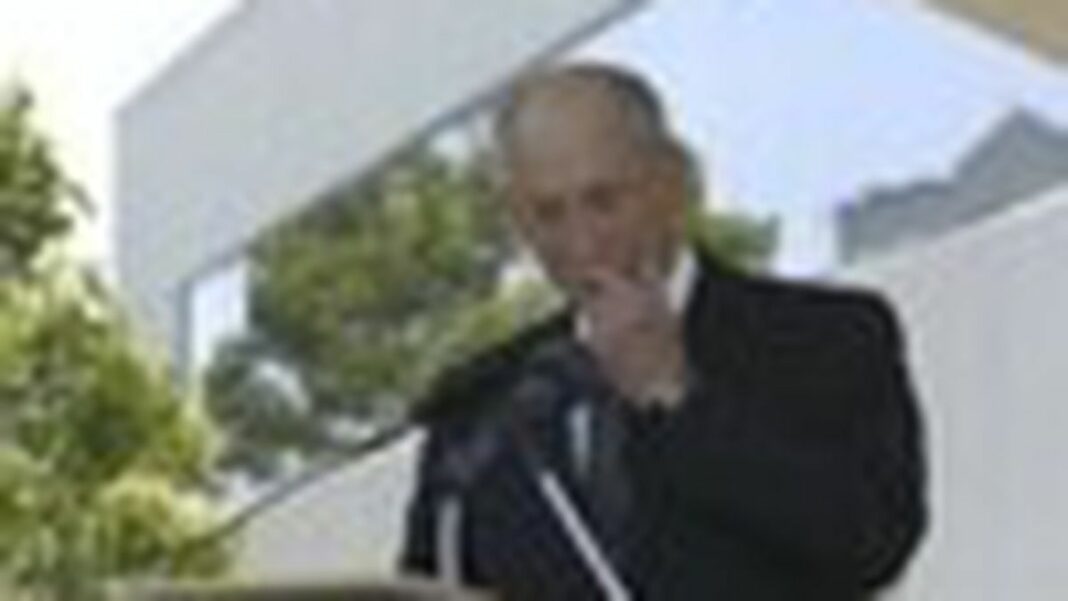
Ron Cowan wiped away his tears, but they wouldn’t stop flowing. The flashy developer who once crashed his helicopter into San Francisco Bay held his breath and muttered “Goddammit” as he stepped up to the microphone. It was June 11, 2004, and many of his longtime friends were on hand to sing his praises and name a road after him. He had helped put most of them in office.
But Cowan knew something many of those in the sizable audience did not: He’d paid a steep price to get his road, the Ron Cowan Parkway. The man had gambled everything for this 1.4-mile stretch of pavement connecting his flagging Alameda business park to the Oakland International Airport.
Credits: E. Scherle

Cowan’s dedication.
Credits: L. Cheung

Credits: Justin Page

flagging business park.
Credits: Chris Duffey
Cowan started out as a nobody, a high-school dropout, and rose to become one of the most influential developers in the Bay Area. Among his close friends are former San Francisco Mayor Willie Brown, former state Senate president John Burton, Attorney General Bill Lockyer, and, most recently, state Senate boss Don Perata, the second most powerful man in California. “I’m blessed with a vivid imagination,” said Cowan, who was decked out in an exquisitely tailored suit for the occasion. “My supporters would call it ‘visionary’ and my detractors would call it … ‘He’s full of fantasies.'”
Over the last four decades, the 71-year-old has had more than his share of success and failure. In the good times, his spending was legendary: He once owned a $12 million Tiburon villa with 24-carat-gold sinks, and rented Mel Gibson’s Malibu estate to throw parties for his rich friends and politicians. In the quest to get his road built, though, he went bankrupt and defaulted on millions of dollars’ worth of loans.
But none of that was mentioned on the day of the dedication. One by one, Citizen Cowan’s powerful pals took up the microphone to extol his tenacity and marvel at his “vision.” Among them were Lockyer, Oakland City Council President Ignacio De La Fuente, Alameda County Supervisor Nate Miley, and Alameda Mayor Beverly Johnson. Governor Arnold Schwarzenegger even sent a personal envoy to speak on his behalf.
Perata was master of ceremonies. Dressed in a dark pinstriped suit and wearing sunglasses on this cloudless day on Alameda’s Bay Farm Island, the politician declared, “Ron Cowan, I’m proud to be your friend and to represent you anywhere I go.”
But being friends with Don Perata is a double-edged sword. One year later, Cowan and his beloved roadway became ensnarled in Perata’s legal troubles when the FBI subpoenaed the developer in its public corruption probe of the senator, the Express has learned. The FBI has been investigating whether Perata has pocketed illegal kickbacks, and now federal investigators are scrutinizing his role in steering a lucrative deal to a Beltway lobbyist to ensure the Ron Cowan Parkway would get built.
At least two dozen interviews and hundreds of pages of documents reviewed for this story raise serious questions as to whether the lobbyist, former Georgia Congressman Dawson Mathis, accomplished anything for the $135,000 he received in public funds from three East Bay agencies. They also shed light on how taxpayers ended up footing an estimated bill of $40 million for a road that was essentially designed to benefit one man — and in the end didn’t even do that.
A Long, Hard Road
An understanding of how Cowan’s roadway came to pass is worth a trip back to the beginning. In the early 1960s, after a stint owning a men’s clothing store failed to satisfy his ambitions, the Alameda businessman launched a real-estate company called Doric Development. Throughout the decade, Doric built small- and medium-size housing complexes. By the early ’70s, the company’s prowess had earned Cowan a partnership with Utah International, which owned nearly one thousand acres of San Francisco Bay wetlands on Bay Farm Island, adjacent to Oakland International Airport. Cowan and Utah had big ideas for the land — they wanted to fill in the wetlands and erect a densely populated city of nearly 10,000 homes for 21,000 new residents.
But Cowan’s plan sparked a strong backlash. Among his harshest critics was Perata, then an Alameda schoolteacher. In 1975, Perata ran for mayor of Alameda, railing against Cowan’s plans; he lost the race by the slimmest of margins. Public opinion had clearly turned against Cowan. The city forced him to downsize his development, which he named Harbor Bay Isle, to 3,000 homes for 10,000 people.
Before he could break ground, Cowan had to overcome another adversary — the Port of Oakland, whose officials believed his development would interfere with their own desires to expand the airport. At one point, an angry Cowan claimed to the Oakland Tribune that delays from his years-long legal fight with the port was costing him $5 million annually. So Cowan used his political savvy to get what he wanted. He started a local ballot drive to eviscerate the port’s independence and turned to then-state Senator Bill Lockyer for legislation to curb airport noise. Lockyer admitted to the Tribune that the genesis of the resulting bill was Cowan’s Sacramento lobbyist. In the end, the port got the message and settled with Cowan, allowing his plans to move forward.
The homes Doric built amid the lagoons of Harbor Bay sold briskly, and Cowan spent his profits freely. He reportedly poured $12 million into his 20,000-square-foot Tiburon villa, a hidden hilltop mansion known as the Roundhill Estate. It featured eleven bathrooms, nine bedrooms, seven fireplaces, waterfalls, pools, spas, a twenty-seat Art Deco movie theater, and panoramic bay views. Understated it wasn’t. According to a 1996 San Francisco Chronicle story, Roundhill also boasted Dutch gold-leaf ceilings, alabaster fixtures, and Honduran mahogany doors.
But where Cowan’s residential development succeeded, his 350-acre office park, the Harbor Bay Business Park, was struggling. Corporations viewed it as too remote, despite its proximity to the airport. Recognizing this problem early on, Cowan launched campaigns both to run a ferry service from Harbor Bay to San Francisco and to build a road from his business park to the airport. “I’ve been planning for that since the late 1970s,” he said in a phone interview last month. It took the 1989 Loma Prieta earthquake and the resulting Bay Bridge collapse to jumpstart his ferry service plan. And when the roadway project later steered off course, Cowan’s onetime enemy Don Perata, whom he had since befriended, jumped in to save it.
Let the Voters Pay
By the mid-1980s, Interstate 880 between Oakland and Fremont was viewed widely as one of the worst, if not the worst, commutes in the Bay Area. Nicknamed the Nasty Nimitz, the freeway rivaled some of Los Angeles’ most horrific traffic. It was choked with so many cars and big rigs each day that politicians believed Alameda County voters would happily tax themselves to widen it.
That would have brought some relief to Cowan, but not enough to support his high-flying lifestyle and inject life into his half-filled business park. What he really needed was a direct roadway from Harbor Bay to the airport. That way, his business tenants wouldn’t have to take the circuitous two-lane Doolittle Drive from Bay Farm Island. “A new roadway was extremely important for Harbor Bay Business Park, and it was extremely important for Ron Cowan because he was the primary owner,” said Bill Withrow, former mayor of Alameda.
It was also extremely important that county taxpayers pay for the road, because Cowan couldn’t afford it. In 1986, he teamed up with other local developers, road builders, business leaders, and local politicians on an ingenious plan. They decided to put a ballot measure before voters that would combine the popular idea of widening the freeway with their own individual pet transportation projects. This became Measure B, a countywide half-cent sales tax, which was packaged and sold to voters as the solution to the I-880 nightmare even though there were ten other transportation projects included in the measure’s fine print.
To ensure his road was among them, Cowan persuaded his pal, Alameda County Supervisor Robert Knox, to place a Cowan employee on the task force charged with recommending the Measure B projects. Cowan’s airport connection also was combined with the widening of 98th Avenue between I-880 and the airport, which made the package more palatable to county voters.
The Measure B campaign, to which Cowan was one of the largest donors, advertised the costly public project as a way to relieve airport traffic jams, which was partly true. The 98th Avenue widening and a third component — the overhaul of the Doolittle Drive interchange — have proved their worth (see map). But the airport connector, a major part of the overall project, was designed largely to benefit Cowan’s corporate tenants and make him money.
The scheme paid off at the ballot box, but even with voter approval, it would take nearly two decades to build Cowan’s road, then known as the Cross Airport Roadway. For starters, the project required environmental studies and additional fund-raising — the ballot measure provided only $60 million of the overall project’s estimated $77 million price tag. Cowan also needed cooperation from the port, which had become the project’s sponsor. But the developer angered some port officials in 1989, according to news accounts, when he campaigned to become the master developer of all port property along the Oakland Estuary.
As the 1990s began with no Ron Cowan Parkway on the immediate horizon, Harbor Bay Business Park was hemorrhaging money. According to public records, it nearly went bankrupt before Cowan, reportedly with Willie Brown’s help, secured $22 million in loans from the pension funds of two powerful labor unions — the Northern California Carpenters Union and Local 3 of the Operating Engineers Union.
Armed with fresh cash and the promise of his roadway getting built sometime during the decade, Cowan launched one of the most ambitious campaigns of his career: He attempted to transform his business park into a biotech mecca and tried — without success — to persuade UC San Francisco to construct a new medical school campus at Harbor Bay.
Rocked by this very public failure, Cowan’s finances nearly hit bottom. In 1996, his development company, Harbor Bay Isle Associates, filed for Chapter 11 bankruptcy when it became clear it couldn’t repay the union pension loans. That same year Cowan was forced to sell Roundhill for $9 million, property records show. He then bought a smaller $1.9 million Belvedere house with three bedrooms, three and a half bathrooms, and no theater.
The Cross Airport Roadway Project, meanwhile, sputtered to a stop; it was tied up in litigation initiated by the cities of Alameda and San Leandro, and environmental groups that wanted to block the airport expansion.
As the decade drew to a close, Cowan was down but not out. He emerged from bankruptcy after obtaining two loans totaling $34 million from Lehman Brothers, the investment bank. The loans were secured against much of his remaining property in Harbor Bay Business Park, property records show. He got another break in 1999, when the Port of Oakland and the city of Alameda agreed to remove the roadway project from their litigation over the larger airport expansion — Alameda, too, was anxious to get the roadway built, in the hope that it would relieve congestion on Alameda Island proper. That June, the Port Commission selected a contracting firm owned by local businessman Ed DeSilva, one of Perata’s closest friends and biggest campaign contributors, to build the entire Cross Airport Roadway Project, the cost of which had ballooned to $104 million.
It looked as though Cowan would get his road after all.
Enter the Lobbyist
Just as it seemed things were finally a go, the construction plan hit a bureaucratic snag that left backers fearing their project would go even more over budget, or not get built at all. The roadway needed environmental clearance from the Federal Aviation Administration, which was sitting on the plans. Local officials wanted the FAA to act by year’s end. Otherwise, they claimed, they risked losing a time-sensitive $5 million state construction grant. With the future Ron Cowan Parkway hanging in the balance, Don Perata intervened with the plan that later piqued the FBI’s interest.
On July 12, 2000, the state senator presided over a meeting with officials from the three agencies funding the roadway — the port, the Alameda County Transportation Authority, and the city of Alameda. Perata outlined a plan to light a fire under the FAA: They would ask the federal agency to fast-track the Cross Airport Roadway Project by separating it from the larger airport expansion plan. The roadway project was just a small facet of the proposed $1.4 billion expansion, which called for a dozen additional gates, a new 6,000-car parking garage, and extra space for the two passenger terminals.
“At the urging of Senator Perata,” all present at the meeting agreed to hire a lobbyist to get the job done, according to a memo written after the meeting by Matt Naclerio, Alameda’s public works director. Naclerio’s handwritten notes show that the lobbyist’s name was Dawson Mathis.
Mathis, a Democrat, served in the House of Representatives from 1971 to 1981. After he left Congress, he did what many Washington politicians do: He returned to Capitol Hill as a hired gun. How he fits into Don Perata’s universe is unclear. Mathis had never been publicly associated with the senator before. Campaign finance records from 1998 to the present indicate that the lobbyist hasn’t given Perata a dime during that period. In its corruption probe of the state senator, the FBI almost exclusively has subpoenaed Perata’s former staffers, friends, and family members — profiles that don’t apply to Mathis.
One common connection between the two men is John Burton, whom Perata succeeded as leader of the state Senate. Perata has adopted as his own consultant at least one former Burton aide, Sandra Polka, whose name has appeared in other FBI subpoenas. Mathis and Burton, meanwhile, became tight friends when they served together in the House of Representatives. Mathis even drove Burton to rehab when Burton’s cocaine addiction spiraled out of control, according to a December 2004 article in the Orange County Register.
Burton didn’t return phone calls for this story, and Mathis, who is no longer working as a Beltway lobbyist, declined to comment, citing the pending FBI investigation. In an interview, Cowan said he didn’t know Mathis. But like many people interviewed for this story, Cowan had fuzzy recollections. He also was good friends with then-state Senate boss Burton, and it was more likely he would have talked to Burton than Perata about roadway delays, he said. Cowan speculated it was Burton who’d recommended Mathis, and added that he never asked Perata to intervene on his behalf.
Money talks in politics, however, and Cowan’s cash flowed freely into Perata’s coffers. Since 1998, campaign finance records show, Cowan has contributed at least $198,300 to Perata’s various campaigns and to political action committees that were either run by the state senator or closely associated with him. Last year alone, Cowan wrote five separate $10,000 checks to Perata’s legal defense fund — making him the fund’s largest benefactor.
Cowan wasn’t Perata’s only pal losing money on the road project delays, however. Over the years, contractor Ed DeSilva has been the state senator’s single biggest contributor, and as long as the FAA kept him from breaking ground, DeSilva wasn’t getting any of the tens of millions of dollars his company stood to receive.
Alameda and port officials say it wasn’t unusual for Perata to call meetings and mediate disputes between public agencies in his district. Perata spokesman Jason Kinney did not answer questions about the senator’s connection to Mathis. Instead Kinney provided a short written response saying that the senator got involved because he has “long been an outspoken and passionate champion of vital transportation and infrastructure improvements. … When bureaucratic inertia threatened to jeopardize a project vital to the entire region and derail nearly twenty years of regional collaboration, Senator Perata joined many others in helping to keep the project on track.”
Neither the FBI nor the US Attorney’s Office comment on pending investigations and thus won’t reveal why agents have taken an interest in Mathis. But two sources close to the investigation have said investigators in the federal Perata probe are generally seeking evidence as to whether the state senator took illegal kickbacks.
While the Express found no proof of any illicit connection between Mathis and Perata, it did uncover a deal in which Mathis was paid lavishly despite questions over whether he was needed or effective. Furthermore, the lobbyist collected his fees in the absence of a written contract with any of the three public agencies that hired him. In fact, at least two of the three local officials involved in the hiring of Dawson Mathis have never met the man, or even talked with him by phone.
The Senator Is Outraged
Contrary to the memo that claimed all the players at the July meeting had agreed to Perata’s plan to hire Mathis, public records and interviews show that not everyone was fully on board.
Christine Monsen, head of the county transportation authority established by Measure B, apparently complained about Mathis’ high fee. The original estimate cited during the meeting with Perata was $175,000, which included a $15,000 retainer. In the end, Mathis charged $135,000 — absent any contracts, it’s unclear how he arrived at that figure. In an e-mail, Alameda’s public works chief noted at the time that Monsen “unofficially told me that they are reluctant to fund the lobbyist because the costs are so high (they can fund two lobbyists for this price tag).”
Indeed, the transportation authority could have hired at least two lobbyists for its $45,000 share of the fee Mathis charged for perhaps a few months of work. Records show that the authority paid its regular lobbyist, Simon and Company, just under $25,000 for all of 2000. Monsen told the Express that she vaguely recalled objecting to Mathis’ fee. “We had a federal lobbyist,” she said. “I would have preferred to use that lobbyist, but there was agreement … that we needed to use someone who was specialized and connected.”
Chuck Foster, the port’s executive director at the time, would dispute that. In a recent interview, he insisted that he never agreed to hire Perata’s man. He didn’t see why he should hire another lobbyist when the port was already under contract with Patton Boggs, one of Washington’s most powerful firms, which was paid $120,000 by the port for all of 2000, records show. “There was no need from our perspective to bring in Dawson Mathis,” Foster recalled.
That interview with Foster and documents obtained by the Express in fact suggest it was the port director — not Mathis — who convinced the FAA to get on the ball. In July 2000, just two weeks after the meeting at which Perata urged officials to hire the pricey lobbyist, Foster flew to DC, e-mail records show. In defiance of the state senator’s wishes, Foster met with FAA managers and urged them not to “decouple” the roadway from the larger airport development. Word of Foster’s trip apparently got back to Perata. “The senator is outraged,” Alameda’s public works director wrote in an e-mail.
Foster feared that separating out the roadway project would remove the port’s only leverage for dealing with the city of Alameda, which was still suing the port over other aspects of the airport expansion. He said he asked the FAA to hurry up and greenlight the expansion as a whole. The official he met with, Foster recalled, assured him that he would get his approval by the end of that year.
Sure enough, in December 2000, the FAA issued a so-called “finding of no significant impact” for the entire expansion, the roadway project included, which meant that the federal agency had specifically rejected the proposal Perata had directed Mathis to push through.
That Mathis’ services were perhaps unnecessary wasn’t the only dubious aspect of the arrangement. The lobbyist also appears to have had little, if any, oversight by the agencies paying the bills. Shortly after the meeting with Perata, Alameda’s public works chief complained in an e-mail about receiving a bill from Mathis, who had already begun work “without any authorization.” And when the county transportation authority got its $45,000 bill from Mathis in January 2001, apparently no one could decipher what he had done to earn his money. Christine Monsen, the transportation authority boss, recalls that her agency had to ask Mathis for more information before it would pay him.
In response, Mathis supplied a July 27, 2000, letter to then-FAA administrator Jane Garvey that he’d had signed by two influential congressmen on the House transportation subcommittee. The letter urged Garvey to expedite approval for what is repeatedly misidentified as the “Port Roadway Project” and once as the “Port Railway Project.” In a note to Monsen, Mathis said he also had coordinated with Perata and worked closely with Congresswoman Barbara Lee, who wrote Garvey as well.
Foster also received a $45,000 bill from Mathis for “professional services rendered” on the “Oakland Airport Roadway Project.” That’s all it said. Foster said the port — like the other payees — had never laid out the price and terms of Mathis’ services. Foster strenuously objected to paying Mathis at first, he said, but ultimately left the decision to the seven-member Port Commission, which included several Perata allies.
Foster’s displeasure comes through in a terse but carefully worded note accompanying the lobbyist’s payment in March 2001. In it, the port director reminded Mathis that the “port did not support efforts” to separate the roadway from the rest of the project, “so the port was very pleased that the [FAA] approved the entire Airport Development Program.” Three months later, Foster surprised the East Bay political establishment when he abruptly announced his retirement at age 61.
Cowan paid for some of Mathis’ fee, at least indirectly — Alameda cut Mathis a $45,000 check from its Harbor Bay Assessment District fund. At the time, Cowan’s companies owned most of the properties in the assessment district, city records show. Stephen Brimhall, chief financial officer of Harbor Bay Associates and Cowan’s majordomo, confirmed he was contacted by the FBI, but refused to say what investigators asked about. “I don’t think it’s any of your business,” Brimhall said.
The Road to Nowhere
The questions surrounding the Mathis arrangement and what the lobbyist did — or didn’t do — to justify $135,000 in fees don’t necessarily add up to evidence of corruption. They could simply be evidence of sloppy government, or the confused byproduct of involving three public agencies, each with its own agenda. While Foster didn’t like the idea of hiring or paying Mathis, for instance, the transportation authority’s Christine Monsen credited the lobbyist with helping to speed up the process and thus safeguard the $5 million state grant. “It turned out to be effective,” she says of Mathis’ work.
It’s also unclear whether the FBI has found any evidence of wrongdoing by Don Perata. Nearly eighteen months after the FBI began issuing subpoenas in the case, it has yet to produce any indictments. Jason Kinney, a Perata spokesman, has described the sprawling investigation as “a mile wide and an inch deep.”
Perata certainly has been proactive. Last year he shelled out $742,389 for his legal defense, according to spending reports filed with the California secretary of state. Much of that was probably spent to determine exactly what sort of case the FBI is building, legal experts say. Indeed, a private investigator working for Don Perata’s lawyer approached Alameda County last October, seeking copies of any FBI subpoenas mentioning the senator, Dawson Mathis, the roadway, the Doric Group, Doric Development, and/or Harbor Bay — in other words, Ron Cowan. The Express learned of the PI’s inquiries and the FBI subpoenas through a routine review of county records.
Cowan confirmed that the FBI subpoenaed him and his companies, and that they gave the feds “a boxload of documents.” But the developer wouldn’t discuss specifics, saying he believed the FBI had requested that he not talk about it.
He was, however, willing to discuss the parkway named in his honor. Waiting for the roadway all those years had simply cost him too much, Cowan acknowledged. “Had the Cross Airport Roadway been built in the ’80s, it would have made a difference — no question about it,” he said.
But in 2002, with the parkway still two years from completion, the businessman’s finances tanked for the last time. He defaulted on the Lehman Brothers loans, which had grown to $43.1 million, including interest, property records show. The investment bank and SRM Associates, its property management partner, promptly seized much of what Cowan still owned at Harbor Bay Business Park. His companies now own only about twelve acres of the 350-acre park, Cowan said.
That was just one of many ironies in the air at the June 2004 dedication of the parkway. Another was that it was named after Cowan at all, since he had feuded with the port for the better part of three decades. Still, the Port Commission voted unanimously on the name, over the objections of some port staffers. “I was absolutely amazed,” said ex-Mayor Withrow, who was on hand for the ceremony. “It was obviously politically driven.”
Cowan, too, said he was “shocked” at the honor. He credits a heartfelt letter to the Port Commission on his behalf from late Alameda mayor Ralph Appezzato — another Perata ally. But it was neither the naming of the roadway nor the loss of the business park, Cowan says, that made him cry. “It was the end of that phase of my life,” he explained. “I was forced to realize that this stage of my life was over.”
Scott Newman, a partner in SRM, said the business park is finally on the rebound. “The roadway went a long way to solving the problem,” he said. Among the park’s new occupants is Peet’s, which is opening a roasting facility there. Despite Newman’s cheery assessment, few people, other than those driving to and from the Harbor Bay Business Park, appear to be using the landscaped airport connector.
While the other portions of the project have helped ease traffic congestion, the Ron Cowan Parkway remains a lonely place indeed. Neither the port nor the city of Alameda has conducted a traffic study of the four-lane road, but four recent day trips by this newspaper failed to find many cars using it. During one weekday midafternoon visit, more than one hundred cars were counted meandering along nearby Doolittle Drive. The total for Ron Cowan’s namesake: zero.
Editor’s note: Appended below are two sidebars that ran with this feature in print: “On the Senator’s Trail” is a timeline in the FBI’s probe of Don Perata’s activities, and ‘Can’t Get from There to Here” examines the dearth of useful road signs on the Ron Cowan Parkway. Also see “Commuter Glitch” in this week’s Water Cooler, wherein we ponder how this pricey road ended up on online map sites such as Google and Yahoo Maps as “Ron Cohen” Parkway.
CAN’T GET FROM THERE TO HERE
Thanks for the $40 million shortcut. Now how about some useful road signs?
If you don’t know who Ron Cowan is, and you’ve never heard of Harbor Bay or its ferry service to San Francisco, you probably have no idea there’s a new $40 million shortcut from Oakland airport to Alameda. How much of a shortcut? Well, so few people are now using the four-lane parkway, you’ll likely cut your drive time in half.
Why don’t you know this? Probably because there are no road signs to guide you. When you come off I-880 at 98th Avenue, either from the north or south, a few smallish green signs point to “Ron Cowan Pkwy,” “Harbor Bay,” or “Ferry to SF.” But there’s no indication that the new Ron Cowan Parkway actually gets you to Alameda. “It doesn’t make sense; there are no signs that say ŒAlameda,'” said Bill Withrow, the city’s former mayor, who had nothing to do with the signage.
In fact, the only signs that direct motorists from the airport to Alameda point them to Doolittle Drive — the two-lane, overcrowded route that’s been around forever.
No local officials seemed to know how this came to be. Alameda officials directed a reporter to the Port of Oakland. Steve Grossman, director of the airport, which is owned by the port, said the port approved the signs, but he was surprised that none mentioned Alameda when directing people to the Ron Cowan Parkway.
Could this be because the road was built to benefit Cowan, his ferry service, and his business park, and the decision makers didn’t want Alameda residents or commuters tying up the park’s corporate occupants? We may never know the answer, but we can still enjoy the drive. — Robert Gammon
ON THE SENATOR’S TRAIL
A timeline in the FBI probe of Don Perata.
September 2003
Following a nasty breakup, Frank Wishom, former boyfriend of Oakland powerhouse lobbyist Lily Hu, contacts the FBI and accuses Hu of accepting kickbacks from her clients. Hu is a former staffer of state Senate boss Don Perata who maintained a close relationship with the senator. Her clients include some of Perata’s close friends and major campaign donors.
October 2004
The FBI searches Hu’s home in Oakland’s upscale Crocker Highlands neighborhood. Sources said the FBI was also looking for evidence as to whether Perata ever received kickbacks via Hu. … The US Attorney’s Office empanels a grand jury with Perata as the main target of the probe.
November 2004
Federal subpoenas are served on several private firms associated with Hu and/or Perata, including some of his biggest campaign contributors. BART also receives a federal subpoena demanding all documents and payment records for Perata and Hu; companies owned by Perata’s son Nick and daughter Rebecca Perata-Rosati; consultant Sandra Polka; and Timothy Staples, Perata’s college roommate and business partner. Perata and the others named in the subpoenas deny any wrongdoing. The Express breaks the story of the investigation.
December 15, 2004
The FBI searches the homes of Perata and his son Nick. Federal agents, including some from the IRS, carry away boxes of documents and two computers from the younger Perata’s house. Oakland political insiders have quietly speculated for years as to whether Don Perata may have laundered campaign contributions through his son. Nick Perata and his companies, Exit Strategies and NRP Productions, have raked in nearly $1 million since 1998 for ill-defined consulting work on his father’s campaigns and committees associated with him.
February 2005
The grand jury subpoenas Caltrans, demanding documents related to Perata, Polka, and Ezra Rapport, a longtime Perata ally and former aide. The Oakland Tribune cites sources who believed the feds were investigating a 2003 Perata transportation bill that was approved by voters the following year, authorizing a $1 toll increase on Bay Area bridges. Both Polka, a former aide to former state Senator John Burton, and Rapport, a former Oakland deputy city manager, worked on the bridge toll measure.
April 2005
The San Francisco Chronicle reports that “The FBI has expanded its investigation of state Senate leader Don Perata in recent weeks, interviewing current and former members of his staff as well as lawyers and lobbyists for Bay Area card clubs that hired Perata’s business partner [Timothy Staples] at the senator’s suggestion.”
May 2005
The Sacramento Bee reports that the FBI has demanded “copies of all e-mails sent by the Oakland Democrat and eight legislative staffers during his first six years in the upper house.”
June 2005
The feds send subpoenas to the Port of Oakland, the city of Alameda, and the Alameda County Transportation Authority demanding records pertaining to payments made years earlier to Dawson Mathis, a Washington lobbyist. Records obtained by the Express show that Perata steered lucrative work to Mathis to fast-track federal approval of what would later become the Ron Cowan Parkway. Some time after the subpoenas are issued, FBI agents contact several of the players involved, including Ron Cowan, a prominent Alameda developer and major campaign contributor to Don Perata. — Will Harper