

The video begins with a long shot of a cement-gray apartment building. The sun is out, and a slight breeze sways the trees. Jerkily, the camera zooms in on a view of the thirty-unit North Oakland structure. The scene is a summertime yard sale, yet the blue skies and communal appearance are deceiving. Residents are selling their possessions, but not because they want to. People look tense, and as they’re interviewed we learn they’re angry too. One woman says she had to leave the Bay Area to find new housing. Another shakes his head at having to search for an apartment after thirty years in the same building.
Meet the tenants of 138 Monte Cresta Avenue. What are they so upset about? In two words: Dennis Cox. Shortly after buying their apartment in May of 2007, Cox notified them that he was increasing their rent by $381 a month. He probably didn’t suspect he was about to unleash a storm likely to shape rental policies for the whole city.

Lyta, Renee Dyer’s dog, stands by a sign made by tenants of 138 Monte Cresta. The new owner banned all dogs from the building Credits: Jared Gruenwald 
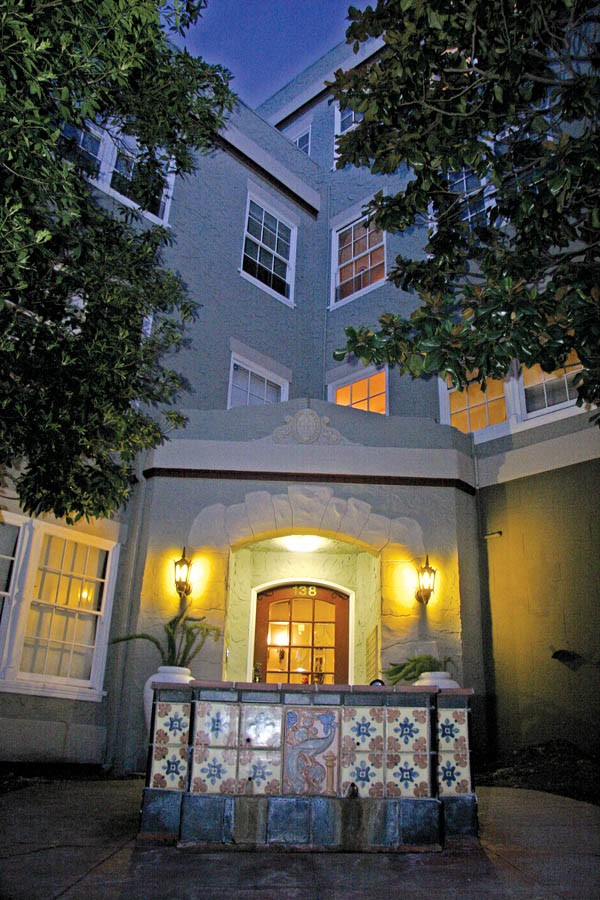
Landlord Dennis Cox Credits: Jared Gruenwald 138 Monte Cresta Avenue Credits: Jared Greunwald Renee Dyer Credits: Jared Gruenwald Tenants Amy Pierre and Laura O’Rourke Credits: Jared Gruenwald Swami, a tenant of 138 Monte Cresta Credits: Jared Gruenwald Marilyn Kolakowswki Credits: Courtesy of Marilyn Kolakowswki The front lawn more closely resembles a construction site than an apartment building. Credits: Jared Gruenwald Building owner Dennis Cox (front left) and tenants from 138 Monte Cresta listen to testimony by tenants attorney Marty Greenman. Credits: Jared Gruenwald Tenant and lawyer Martin Greenman. Credits: Jared Gruenwald Landlord representative Greg McConnell speaks on behalf of Dennis Cox during the February 21 hearing of the Oakland Housing, Residential Rent and Relocation Board. Credits: Jared Gruenwald









Many residents of 138 Monte Cresta had lived there for decades, and enjoyed rents well below market rate. The videotaped interviews barely scratch the surface of their outrage. “My home is threatened by a landlord who’s scheming to get people out,” says tenant Amy Pierre, who chose to stay and fight for her $699-a-month rent. “It’s extremely, extremely upsetting and unsettling.”
Pierre and her neighbors are irate about many things. Most view the building’s massive renovation as part of a sinister plan to drive them out. They also complained that Cox failed to promptly repair a leaking sewer. Others griped about the dismissal of the apartment’s on-site manager. Some disliked the building’s new ban on dogs. But the rent increase dominated their complaints.
Oakland’s rent-control regulations say that landlords can raise rents to cover maintenance expenses plus 95 percent of the debt service on their mortgage. However, Cox took out an unconventional mortgage, and that’s where the controversy began. As such loans have become more common in the tightening real estate market, there have been at least 58 separate disputes before Oakland’s rent board.
Cox eventually told the rent board that he was unable to obtain a conventional loan because of the very low rents paid by tenants of 138 Monte Cresta. Based on the existing rents, his longtime banker would only loan him half the building’s value. To purchase the apartment with such a loan, Cox would have needed to make a 50 percent down payment.
So instead, he chose instead to obtain an unconventional mortgage — an interest-only loan with a high 10.5 percent rate and a short, two-year repayment period. Cox put down a quarter of the purchase price, and his private lender demanded additional collateral beyond the building itself. So he secured the loan with a second piece of property, which some tenants would later cite as proof that he was trying to cheat them.
When Cox notified those tenants that he was increasing their rent to cover his borrowing costs, they balked. Residents took their complaints before a hearing officer of Oakland’s Housing, Residential Rent and Relocation Board. In a showdown on September 19, 2007, the tenants’ were represented by one of their own, lawyer Martin Greenman, a resident of 138 Monte Cresta. Cox was represented by Gregory McConnell, who is notorious among tenants-rights activists for his role in sculpting the anti-rent control Costa-Hawkins Rental Housing Act of 1995.
The tenants said their landlord’s costly loan was an intentional effort to undermine Oakland’s rent controls. They implied that Cox had taken out a larger loan than necessary to provide the legal justification to raise their rents by more than the city’s 3.3 percent rent cap. “He wouldn’t have been entitled under a regular principal-and-interest loan to any increase in rent at all,” Greenman said in an interview.
When the hearing officer handed down her ruling in November, the tenants scored a huge victory. In what James Vann of the Oakland Tenants Union called “a watershed decision,” the hearing officer concluded that Cox’ loan was not “commercially reasonable” and froze building rents at their existing levels.
“It would be against the spirit and intent of the ordinance to allow an owner to simply pass on all debt-service costs without considering whether the transaction is a commercially reasonable loan,” wrote hearing officer Barbara Kong-Brown. “It would allow an owner to engage in unfettered self dealing and structure any financing arrangement.”
In essence, she argued that Cox had found a loophole that he and other landlords were using to skirt the city’s rent controls. “It appears the owner’s intent was to purchase the subject property for speculation purposes, raise the rents … and to refinance the property after two years at a much lower interest rate, after the tenants have left or paid the new rents,” she wrote. “This scenario evades the Rent Ordinance.”
But despite the ruling, the dispute is far from resolved. Cox has appealed the decision to the full rent board, and it could well end up in court. In the meantime, reverberation from the case, and dozen of others like it, has prompted the board to reconsider rent increases of this type. Observers expect the matter to come before the Oakland city council this summer.
Welcome to 138 Monte Cresta, where the conflict between angry tenants, frustrated landlords, and confused regulators captures many of the passions of Oakland’s raging gentrification debate.
Tony Lufrano amassed a sizable collection of Bay Area properties over the years. From 1965 to 2007, 138 Monte Cresta was one of them.
In 1965, Lufrano’s longtime insurance agent sold him the apartment, which is two blocks east of Piedmont Avenue and was built in the mid-1920s. “It was in a good neighborhood; it had very few vacancies; it was well maintained; we knew the owner,” Lufrano said. “It just made a lot of sense.”
The 79-year-old painter recalls his relationship with tenants being good. “I always tried to be honest and sympathetic with tenants,” he said. Lufrano remembers only occasional, minor conflicts. “Periodically, someone wanted security gates and I would say, ‘That’s fine with me, but I’ll have to raise the rents so many dollars a month to pay this,'” he said. “But nobody wanted that.”
Longtime tenant Bob Fearman has less-charitable memories of Lufrano’s maintenance record. “Only basic repairs were done as needed, not regular maintenance such as painting the building, upgrading rotting window frames and so on,” Fearman said. “So there were defective conditions throughout the place.”
But Lufrano counters that it’s hard for landlords to afford maintenance under Oakland’s rent-control system. “You can’t do the proper maintenance you need to do because you can’t raise the rents you need to do it,” he complained. “You can’t pass those costs onto the consumer. And we had no turnover. It wouldn’t be so bad if people were moving and you could let new people come in at a higher rent.”
Indeed, many of the tenants at 138 Monte Cresta had been living in the building for decades. So under Oakland’s rent-control system, their rents were significantly below the market rate. The average tenancy of the 21 residents who contested Cox’ rent increases was almost sixteen years, and their average monthly rent was just $747, with nine rents below $700 and one as low as $326. An appraiser hired by Cox later concluded that the rents were “substantially below market.”
Lufrano hasn’t ever met Cox and has no idea what the current conflict is about. But he is familiar with Oakland’s rent board, and he’s no fan. Lufrano said the board gives undo power to “unreasonable people” — the kind one normally wouldn’t choose to heed. As an example, he cited one tenant who persistently complained that the hallway outside her room was not 70 degrees. “Meanwhile, you look up at her apartment and her windows were wide open,” he recalled. “But somehow you had to get that hallway to 70 degrees.”
Although Lufrano said the idea of rent control sounds good in principle, he isn’t fond of it in practice. “Once people get hired for the rent board, they have to make sure there’s enough work on their desk, so they can keep their job,” he griped. “Which means that even the smallest things get attention.”
So why did Lufrano sell Monte Cresta to Cox? At first he said he grew tired of “trivial” matters getting dragged in front of the rent board. Later, he insisted that he just wanted to diversify his investments.
In late May 2007, Dennis Cox, a slender man of average height with white hair and sunken cheeks, bought 138 Monte Cresta for $3,900,000. He narrowly outbid a competitor. Lufrano said Cox and another businessman were both very interested in the building. When Lufrano’s accountant told him that his asking price was too low, he jacked it up a few hundred thousand dollars. Both bidders continued to pursue the property, and Cox prevailed.
If Lufrano had been hesitant to invest in the building, its new owner had other plans. “The previous owner owned the building for 42 years,” Cox told the Oakland Tribune in 2007. “His operating style was to run it cheaply and keep the rent low.” Cox described himself in letters to tenants as “a nice guy” who wanted to restore 138 Monte Cresta to “its former luster.” The Tribune said he planned to improve the building’s exterior and interior, and upgrade the plumbing, carpets, and paint job.
Cox acknowledged he was doing a lot of work on the building, and said the only way to recover his costs was via a rent increase. “I understand it can impact certain budgets,” he told the Tribune. “It was on the market and if I didn’t buy it, someone would have.” Charging tenants more money “is not part of the job I enjoy” he told the paper, but he added that sometimes rent hikes just come with the territory. “The truth is, even with this increase that I’m passing on, most of these rents are still not above market rate,” he told the Tribune.
The Alameda-based landlord briefly responded to a few questions for this story but he and his spokesman both declined to sit for a detailed interview. “I would be happy to discuss these issues with you after this matter is concluded, but I decline now,” he wrote in an e-mail following the ruling against him. “I am not going to litigate it in the press.” When pressed to respond further to various tenant complaints, Cox wrote that he hoped the press would not “turn this into some cause celebre.” Almost as an afterthought, he added, “I’m not comfortable talking about myself.”
Renee Dyer signed her first rental agreement at 138 Monte Cresta in May 1980. Until February, she had lived there ever since — in a one-bedroom apartment for which she was paying $793. “College friends introduced me to this neighborhood,” Dyer said. “The location was better than my college address in East Oakland, and the trees generously planted in this neighborhood made me feel more at home.” Dyer said the apartment reminded her of a less-urban setting. “The building manifested itself as a small town, a community,” she said. “There have been deaths, births, divorces, graduations, and marriages. Many tenants chose to stay at Monte Cresta … just as one would choose to stay in a small town.”
When Cox hiked everyone’s rent, Dyer felt betrayed, as if her “village” had been ransacked. Even worse, her Jack Russell Terrier was threatened with eviction by Cox’ new “No Dogs” policy.
Meanwhile, Dyer said all the activity made her feel like she was living in a construction zone. “The unit next to me has been a construction storage shed for months,” she said. “The workers lunch and take bathroom breaks in the unit next to my bedroom wall. I am awakened most mornings by hammering in the endless remodeling of unit 309, as if the unannounced sound is being dealt deliberately. I can’t say I’m used to all the errant and unpredictable nuisance, like the debris truck coming and going, but it has become a known sound. … I have been brutalized from the beginning. I had fine art glass bouncing off my shelves, to which Cox responded ‘Oh, my bad.'”
Ultimately, the burden was too much for her. Dyer moved out.
“The financial burden has been pronounced,” she said. “Attempting to live in fair regard to the landlord’s renovations has not been conducive to a constructive work schedule, or personal home life privacy and confidence of comfort. Many times since May, a downright threatening and hostile environment has existed in our community.”
Dyer believes the dispute between Cox and the tenants goes to the heart of a larger struggle playing out across Oakland. “The Oakland City Council may have some grand scheme to make everything east of MacArthur Boulevard a huge gated community,” she said. “There are fewer artists, less local color, more wealthy, young people, single and with families.”
She views herself as another victim of Bay Area housing costs and feels that she and her neighbors have been driven out. “When planning a move, it’s so much healthier to want to move or need to move but to have to move because the new ownership is unreasonable and focused on a business plan and not a community … it is incredibly bittersweet to have to yield my home to a business venture.”
Dyer won’t say where she moved — simply “a different city and county.”
Marilyn Kolakowski came to 138 Monte Cresta in 1986. Her sister had lived in the building in the 1970s, and Kolakowski remembered it when she started apartment hunting. Having been robbed at knife-point in Rockridge, safety factored into her decision. “I felt safe here as a single woman in her twenties,” she said. “I liked the location, too.”
As a freelance graphic designer, the artistic foment of Oakland was another important draw. “During the mid-1980s, everyone wanted to live in San Francisco and Oakland was not known to be a very desirable place to live,” she recalled. “Oakland, in general, was populated with more creative types and non-rat race people. Oakland and this neighborhood was funky and down-home.”
And despite the landlord’s public denials, Kolakowski said she wasn’t convinced that Cox doesn’t ultimately plan to convert the apartment into condos. “I think he is the worst kind of landlord — one that looks good on paper but shows little regard for the effect his actions have on the lives of his tenants,” she said. “His thinking seems to be: If the $381 rent increase doesn’t get everyone out, then maybe his upgrades, remodeling, and construction projects being carried out in such an aggressive manner will.”
She was elated about the tenants’ triumph before the rent board hearing officer. “I’m glad we were able to stand up to him and prevail at our hearing,” she said. “Even if our efforts in the long run may prove to not help our own fight with Cox, we wanted to work to change public policy on this issue.”
However, the dispute was even more stressful for Kolakowski. In September 2003, she had been diagnosed with cervical cancer. Surgery later revealed ovarian cancer. Seven chemotherapy treatments later, in April 2004, her cancer went into to remission. But last November a CT scan showed fluid in her lungs and pelvis, and by January 2007 the cancer had roared back to life and she was hospitalized. In the following months, she drifted from chemo to chemo, undergoing several surgeries for infections. Three days after returning from one of these hospital visits, she got the letter informing her of the rent increase.
In a phone conversation with Cox in June 2007, Kolakowski said she “begged” for some kind of leniency in her case. Cox gave her an extra month to find a new place to live, she said, but told her that after that she’d be responsible for the rent increase.
The stresses took their toll on her, both physically and emotionally. “It’s hard to describe having to be home because of ill health and to daily tolerate pounding, drilling, strange workers roaming the halls, while trying to recover between hospitalizations and chemo treatments,” she said. She described how the building’s intercom system was replaced with one that didn’t work. For weeks when her nurse came to change her surgical bandages, she had to yell up to her apartment. Then Kolakowski had to hobble down the stairs and let her in. “Without question, this has been the roughest year of my life.”
By mid-December 2007, Kolakowski moved into a quieter environment. “I need to focus on healing and getting my health stabilized and the environment created in the building since Cox took over does not lend itself to peace and restfulness,” she said in a January interview. On March 29, she succumbed to her cancer.
Bob Fearman remembers when the average meal along Piedmont Avenue cost five bucks. It was 1987, the year the 59-year-old registered nurse moved into his apartment. Ever since then, Fearman has noticed the slow creep of gentrification in his neighborhood. Mom-and-pop outfits have been priced out by rising rents, he said. “It’s getting younger and more up-scale by the looks of Piedmont Avenue,” he said. “It’s keeping up with the young monied.”
Fearman was attracted to 138 Monte Cresta by former property manager Joe Oberg — a man he described as “the salt of the earth.” Fearman ran into Oberg while apartment hunting and instantly liked him and his building. Oberg — who traded services for his rent and had to relocate because he can’t afford the rent today — was a real people person, Fearman said. He was always on the tenants’ side, and would speak his mind to Tony Lufrano when he had to.
While fond of the former property manager, Fearman had nothing but disdain for both of his landlords. “Tony had his arrogant side,” he said. “He wanted things the way he wanted them. He was slick and would sidestep issues as long as he didn’t have to get too involved.” Fearman said Cox is more sophisticated. “He doesn’t seem to care about the people side of what he is doing,” he said. “It’s a business venture for him, to physically improve 138, and the lives in there only seem incidental.”
Fearman was shocked by the rent increase for his $812 one-bedroom apartment. But Cox’ methods were even worse, he complained. “He hires crews for whatever job he wants done, painting, landscaping — tearing out nearly all the vegetation around the place that has grown in the last thirty to forty years — and has them do whatever he wants,” he said. “He doesn’t ask for tenant input about what we care, feel, or think about what is done; it’s his fiefdom, and he’s the lord and master, beholden to no one. It doesn’t matter that many of us have lived our lives here for up to 35 or more years.”
The landlord’s practices encouraged Fearman and other tenants to organize. Last fall and early winter, they held weekly strategy meetings for four months. One started a Yahoo group for building tenants. At the “yard sale,” tenants gathered signatures for a petition they submitted to Mayor Ronald Dellums calling for city regulations to prevent such rent increases. They spoke with Councilwoman Jane Brunner, did interviews on KPFA, and sought press coverage in the Tribune. “We were very active,” Fearman said.
It is that activism that paved their way to moderate success. Although Fearman said the victory over Cox before the city was “the big one,” there were earlier successes as well. “We had inspectors come out during various phases when we thought he was doing work on the cheap,” Fearman said. “They made him put up netting during the painting phase when all sorts of crap, suspected of containing lead, was falling on the ground when they scraped the building.” Still, Fearman was hesitant to speak of victory. “We’ve delayed his progress,” he said. “We’ve made it more costly for him. He hasn’t gotten the first six months of his rent increase, and may not get any this year.”
Still, Fearman admitted with despair that he found it necessary to move to Jack London Square. “I lost my home and community of twenty years to get away from the near-daily disturbances I was experiencing,” he said. “I’m living as a stranger in a new environment that is nice but doesn’t have that warm, familiar feeling that comes from shaping your environment over the course of years.” Fearman is not sure he has made the right decision. “I’ve told people ‘Ask me in two years if I made the right choice’.”
He continues to hope the tenants will prevail upon appeal. The struggle is really about one simple thing, he said. “The Oakland rent ordinance is gutless if a new owner can pass on whatever costs he wants to tenants.”
Amy Pierre moved into 138 Monte Cresta in 1996, but even after more than a decade, she remained one of the newer tenants. “Some people have been here most of their lives,” she noted. Her original attraction to the place was aesthetic. “I liked the fact that it’s an older building with old style built-in cabinets and detailing,” she said.
Although Pierre he loves 138 Monte Cresta, she hasn’t ever had much love for its owners. Lufrano, she said, was “slippery” and did only “the bare minimum of work needed to keep the place going.” For instance, she said, “When the apartment above me had a toilet that overflowed and leaked gross toilet water into my closet, ruining some of my things, he didn’t want to reimburse me for anything. Actually, he never did.” In general, she said, his attention to the business side of things trumped all other concerns. “He seemed condescending and seemed to avoid dealing with us whenever possible.”
Still, whatever she felt about Lufrano hardly compares to her outrage toward Cox. “He got an expensive loan that wasn’t at fair market value with the intent of passing the cost onto the tenants,” Pierre said. “I feel that the debt-service ordinance is questionable in the first place, but he completely abused the idea of it and tried to use it to his advantage.”
Although she was ecstatic about the tenants’ victory at the rent board, she noted that the rent increase nonetheless scared off a number of tenants. “It has not felt like a home from the minute Cox bought the building, and some people felt that leaving was a better way for them to handle things than staying and fighting for their rights,” Pierre said. After all, everyone who stayed and fought will be responsible for $381 a month in unpaid back rent through August 2007 if Cox ultimately prevails.
Like most tenants, Pierre doesn’t think their battle is unique to 138 Monte Cresta. “There is an increase of apartment buildings being turned into condos and other instances where tenants are being turned out of their homes due to the debt-service increase.” But Pierre doesn’t plan to be a pushover: “Although this is a very, very difficult situation I will continue to stand up for my rights as a tenant,” she said. “I am not going to give up because I believe what Cox is doing is wrong, and hopefully our efforts will help others in this situation in Oakland.”
In their appeal to the full seven-member rent board, representatives for Cox argued that the ruling in which the hearing officer denied his rent increase was rife with legal errors. They said it denied Cox a fair return on his investment and put him in a “financially ruinous position.” Their appeal correctly noted that city rent regulations neither include any requirement that a loan be “commercially reasonable” nor define what would constitute an “unreasonable” loan.
“The only thing Mr. Cox is ‘guilty’ of is complying with the letter of the law,” the appeal said. “He read the debt-service regulation, took it at face value, relied on it in purchasing the property, and followed its plain and unequivocal terms afterward. To say that Mr. Cox, who followed the law, did so to evade the law, is nonsense. … Mr. Cox was literally ambushed with new standards imposed after the fact.”
Tenant Martin Greenman’s brief on behalf of tenants urged the board to “make policy” that would prevent Cox and other landlords from undermining the intent of city rent controls. “Mr. Cox had choices about how to spend his money,” Greenman wrote. “He made those choices. Instead of putting down 50 percent to buy the building, he found a 25 percent lender.” In essence, Greenman argued that Cox should not be allowed to pass his debt-service costs on to tenants when he could have avoided a rent increase by making a higher down payment instead of buying another building in Pleasant Hill.
Other passages of Greenman’s appeal seethed with the same contempt that the lawyer’s clients had for their new landlord. The appeal accused Cox of lying during his earlier testimony, and essentially implied that he was also trying to charge residents of Monte Cresta for that building in Pleasant Hill. “Mr. Cox comes before the rent board with unclean hands, having committed perjury in an attempt to subvert the fact-finding in the hearing in this case,” Greenman wrote.
At the February 21 hearing of the full Oakland rent board, Chairman Stephen Sanger, who was reappointed to the board by Mayor Dellums, admonished the tenants and their representative to keep such rhetoric in check. “I’ve never ever had more hyperbole or rhetoric in briefs,” Sanger said. The chairman added that Greenman’s allegations of perjury were not within the board’s purview nor relevant to its hearing.
Landlord representative Gregory McConnell walked the board through the same points that he and a lawyer had made in their written appeal. He rejected Greenman’s implication that Cox was trying to charge the residents of Monte Cresta for any other building, stating for the record that all the money Cox borrowed was used to purchase 138 Monte Cresta. In addition, he noted that Cox was investing more than one million dollars in renovations at 138 Monte Cresta. He warned the board to head off a lawsuit by reversing the hearing officer’s decision. “You can’t just ignore the fact that there’s debt on this property because that won’t be sustained in court.”
After testimony from both sides, the board discussed the rent increases at 138 Monte Cresta in the context of several other cases in which landlords have sought outsized rent increases based on nonconventional financing. Board member Shelby Anguiano, another Dellums appointee, rejected Greenman’s challenge to the propriety of the loan Cox obtained. “I don’t think you can call this a bogus loan,” she said. “We don’t know what’s appropriate for the time that we’re in right now. We’re seeing all kinds of new financing.”
Alan Flatt, a landlord appointee to the board whose sympathies nonetheless lay with tenants at this hearing, suggested there should be a limit on the interest rate landlords are allowed to pass on to tenants. “Would a 15 percent loan be OK?” he asked. “Thirty percent? Fifty percent? If you’re not going to read something like that into the law, where do we stop? … This is why we need to have a cap on rents.”
Consensus emerged that the board needed to devise a policy for dealing with such unconventional loans. The case of 138 Monte Cresta was sent back to the hearing officer for reconsideration once the board devised a new policy on such rent increases.
Oakland’s rules allowing landlords to recover the costs of buying a building have been controversial ever since the first introduction of rent control in Oakland in 1980. The rules have changed several times, although the current scheme has been in place since 1994. The rent board’s staff recommended disallowing this type of rent increase in 2004, but the board did not heed its advice.
On May 1, a three-member rent board committee met to consider a new policy for the city. The committee received a consultant’s report that proposed changes that would probably preclude rent increase like the one Cox hopes to implement. Dave Kadlecek of the Oakland Tenants Union endorsed this approach.
Landlord representative Steve Edrington, executive director of the Rental Housing Association of Northern Alameda County, urged the board not to make changes that would depress the value of rental property in Oakland. Citing 138 Monte Cresta as an example, Edrington said it would be unfair to rental housing values to current rents. “If a landlord gives a tenant a deal because they’re being a nice guy, should that landlord be punished later, when they go to sell that property?”
The committee discussed solutions ranging from a maximum annual cap on rent increases to eliminating such rent increases altogether. City Rent Adjustment Program Manager Rick Nemcik-Cruz said an outright ban on such rent increases would “seriously interfere with the sale of rent-controlled properties in Oakland.”
The committee is likely to recommend changes to city policy at its May 29 meeting. “This was an issue before I came on the board, and people are kind of waiting for us to come up with a policy,” said board member Anguiano.
And by summer — just as voters state-wide are grappling with rent control in Proposition 98 — the issues exemplified by the case of 138 Monte Cresta are likely to face the Oakland City Council.









One of the best posts I’ve read in a while. Keep them coming.