At first glance, you’d never know that little Elizabeth Nettleton is Pagan. The vivacious four-year-old cuddles in her mother’s lap, floppy blond bangs dangling in her eyes as she clutches her green stuffed alligator and a red teddy-bear blanket. Then the girl reaches underneath her pink sweater and pulls out a long silver chain bearing a dime-size pentacle.
“Why do you wear the pentacle?” asks Tina, who would pass as a typical San Leandro mom were it not for the tiny silver stud in her nose.

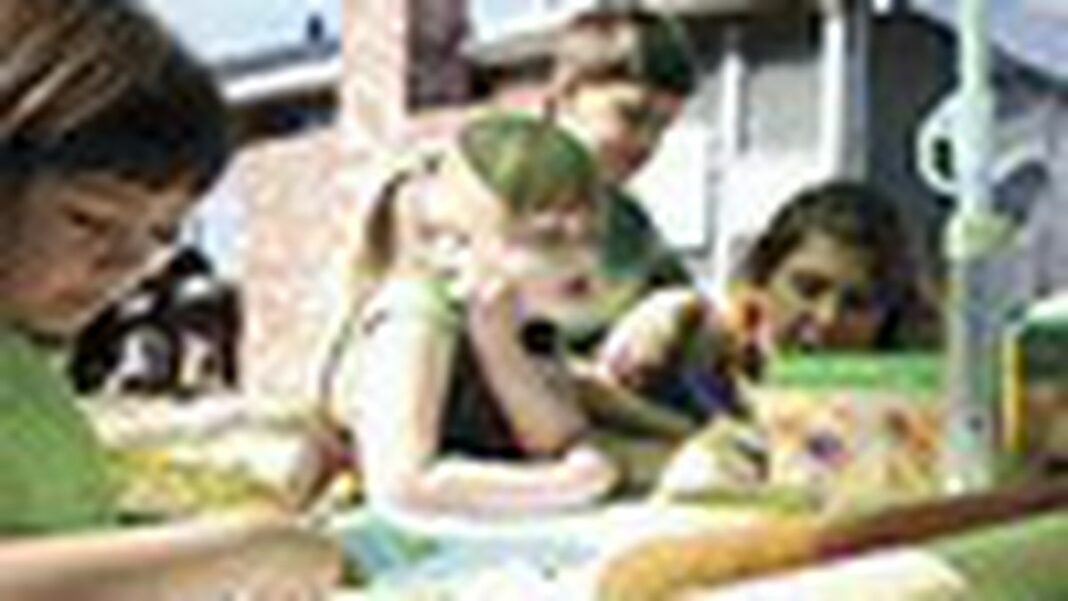
Playtime at the inaugural meeting of SpiralScouts. Credits: Jen Siska JoHanna Coash launched the local SpiralScouts group. Credits: Jen Siska The Nettletons: Tina, Chris, Elizabeth and Sean. Credits: Jen Siska Angela Weilert and Anais Fernandez color at the SpiralScout meeting. Credits: Jen Siska

“Because mommy wears hers!” Lizzie exclaims.
“Do you remember what the pentacle stands for?” Tina, 37, asks tenderly.
Sean, her brown-haired six-year-old, sits playing with dominoes at a small table nearby. “The earth, the air, the fire, and the water,” he rattles off, neglecting “spirit,” the star’s fifth point.
Last summer, Tina, a Wiccan, bought pentacle pendants for her children. Sean had been pestering her for months, ever since she started wearing hers. But after only a couple of weeks, just before he was due to start kindergarten, he took his off.
According to his mom, Sean doesn’t like to stand out, while Elizabeth is the “free thinker” and “wild girl” who proudly declares that her mother is a Witch. But Sean’s apprehension to display his Pagan side also has to do with his father.
Chris, 38, is Catholic. Since his wife began practicing Wicca two years ago, he has been largely supportive of his wife’s newfound religion, even if there are some things he doesn’t agree with. For her initiation — which she likens to a Catholic confirmation — he bought her a besom, a ceremonial witch’s broom. There are several altars around their San Leandro home, including one in the living room by the front door. Bold bumper stickers adorn their refrigerator, such as “Born Again Pagan” and “Where there’s a Witch, there’s a way.”
But navigating their religious differences has become trickier as the children have grown. Chris is worried the kids will face discrimination. “I had a discussion with him saying, ‘Well, some people might not understand,'” he recalls telling Sean. “‘And if you don’t feel comfortable you don’t have to talk about anything. But if you do feel comfortable we’ll back you up.’
“I think that kind of backfired,” Chris adds. “I think he kind of said, ‘Well, people won’t like me.'”
At just six, Sean is already highly aware of his dual religious identity — even more so since he started attending Catholic school. He now calls himself a “Catholic Witch” and says he doesn’t agree with all Catholic or all Wicca beliefs. The boy says he believes in one God and one Goddess, and that Jesus was “a great person.”
His pentacle chain now also carries a cross — a gift from his mom — but Sean still won’t wear it. It’s hanging on a shelf in his bedroom.
Out of the Broom Closet
By many accounts, Paganism has grown tremendously in the United States over the last several decades, which means a lot more kids are being raised Pagan. The old religion reemerged during the 1960s after England repealed its anti-witchcraft laws, and began taking off in the mid-1980s. Once-secretive Pagan societies here and in Europe emerged from what they called the “broom closet.” New books on Paganism were published, and small groups of devotees known as covens or “circles” began to multiply.
By far the biggest Pagan subgroup is Wicca, which itself has numerous subgroups with varying practices and beliefs. Generally speaking, Wiccans worship the sacred as existing in nature, are polytheistic, and can choose Gods or Goddesses from any pantheon, such as Egyptian or Norse — Tina favors Tara, a popular Buddhist deity, whom she describes as “the all.” Many Wiccans trace their roots to medieval pre-Christian European traditions.
“It’s grown from being obscure to becoming one of the top four faith groups in the United States,” said Reverend Patrick McCollum, a longtime Wiccan chaplain, activist, and instructor for Cherry Hill Seminary, an online Pagan religious school based in Vermont. Wicca has no central authority, and therefore nobody’s membership estimates are definitive. McCollum, who lives in Moraga, cites estimates that range between 300,000 and 1.2 million in the United States — he thinks the latter is most accurate. Some Pagan organizations boast upward of fifty thousand members, and the online WitchSchool.com claims nearly 180,000 registered students.
The biggest factor in Wicca’s growth, according to McCollum, is that it encourages its adherents to participate in their own spirituality and connect with the divine in their own way. McCollum had his first divine connection in 1965 following a near-fatal motorcycle crash — he encountered God, who was female. He details the experience in his book, Courting the Lady: A Wiccan Journey, Book One: The Sacred Path, which was published last year.
The recent Paganism boom has brought about a wave of second-generation Pagan children, which has in turn spawned Web sites such as Witchvox.com and PaganParenting.com. Books, groups, and Web discussion boards have cropped up to address everything from kid-friendly rituals to how to find good Pagan daycare.
The increasing presence of children is transforming a community that has historically practiced behind closed doors. “Twenty-five years ago when the first Pagan children were coming out, there was no place for them in the Pagan community,” says McCollum, who has raised three children. “Now every major event you have for Pagans, they have playgrounds and directors that oversee children’s programs.”
That’s a dramatic departure from Pagan parenting of the past. “It was dangerous to participate in Pagan events, and if you take your children, you might have someone come up and firebomb you,” McCollum says of the 1960s and ’70s. Parents who did involve their children faced the possibility of having them taken away, he notes. Many Pagan events still require parents to sign a waiver.
Vibra Willow remembers having to warn her two kids — the eldest is now 27 — against disclosing their identity as part of the East Bay’s Reclaiming community. Reclaiming is a form of feminist, modern Witchcraft that includes kids in its rituals. “I know that was traumatic and unhealthy for them, having feelings about growing up different and weird,” she says.
Now, perhaps for the first time, Willow’s children can be open about their religion. “Paganism now is no longer a shocking or scary thing to mainstream culture, and as a consequence, children can identify themselves as Pagan or Wiccan,” she notes. “The words ‘Pagan’ and ‘Witch’ — you have to imagine a time when those were frightening, pejorative words. And it’s been a long, slow struggle to change that.”
Alt-Scouting
Despite the newfound openness, many Pagans are still cautious, even here in the East Bay. On a rainy Saturday afternoon in February, about two dozen kids and their parents make a circle inside the back porch of a San Leandro home. Tranquil New Age music emanates from a boombox. Strings of shiny foil shamrocks dangle in the window. In the middle of the carpeted room, crayons and Pagan-themed coloring books cover a round table. One of the group’s two leaders is 25-year-old JoHanna Coash, who requests that the location not be disclosed. For safety reasons, she explains.
It’s the first meeting for the Bay Area chapter of the SpiralScouts, a Pagan alternative to Boy and Girl Scouts. SpiralScouts was launched in 1999 by the Michigan-based Aquarian Tabernacle Church, which calls itself “the first Wiccan church with full legal status and recognition by the governments of three nations,” including the United States. The alt-scouting organization now has more than 130 “circles” — or “hearths” for smaller ones — in the United States, Canada, and Europe. The fledgling chapter, designated #171 Earth Heart Circle, is the only one in the Bay Area.
It was Coash, a Pagan Alliance member majoring in art and education at New College of California, who launched the local scout circle. The very first day she posted ads on Craigslist, Tribe.net, and Pagan message boards, she received e-mails on behalf of sixteen interested children. “There’s a huge demand for it,” she says. In all, 27 kids from nineteen families are participating. They range in age from three to fifteen and come from as far away as San Jose, Benicia, and Clayton.
Although developed on Pagan beliefs, SpiralScouts is open to children of all faiths. Each coed group is led by one man and one woman. Like mainstream scouts, they learn camping and wilderness skills, but also traditional woodland lore, ancient mythologies, life strategies, and skills for teens. The kids earn badges based on the four elements (earth, air, fire, water), which they plan to affix to sashes they will sew.
In true Pagan fashion, though, SpiralScouts has no rigid structure. Coash wants a consensus-based group, hence today’s “Intention Circle,” where each parent and child can express what they’d like to get out of their scouting experience.
Lizzie Nettleton has crafts in mind. “We could make stars and moons,” she pipes. “We could make leaves. We can make some Goddesses.”
The group listens to the ideas as Coash jots down notes. She’s good at encouraging the shy kids, no doubt because of her own childlike demeanor.
“For a craft, we could use paper to make our own witch hats,” suggests Sean Nettleton, who wears a brown hooded sweatshirt adorned with Thumper the rabbit.
Tina learned of SpiralScouts at PantheaCon, a three-day Pagan conference that drew thousands of people to San Jose in February. She tells the circle she was looking for a fun place where her kids could express themselves, and learn some skills.
Many of the new SpiralScouts parents took part in traditional scouting as children, and hope their kids will have a similar experience, only in a more Pagan-friendly environment. Nicky, a single mom, says she grew up as a solitary Witch and wants a magical community for her son. One boy says he and his younger brother got hurt a lot in the Boy Scouts because the kids were too wild. Another boy says he wants to make friends and go fishing.
Sue McCollough based her decision to bring nine-year-old Alec (fourteen-year-old Kenton was sick) on the fact that the Boy Scouts discriminate against gays, and this group doesn’t discriminate against anyone. “One of the nice things is we can be open about our Paganism,” she says. “In traditional Boy Scouts, we might have run into parents who are not open to Paganism.” She would like the group to go camping and hiking, do crafts, garden, and learn to sew. Alec wants to take camping and field trips, and help grow a Faerie Garden.
“These are all Pagans in training,” notes James Bianchi, a Druid and legal adviser for the Pagan Alliance, which sponsors the local scouts circle and organizes Berkeley’s annual Pagan Festival and Parade each May. This year’s parade focuses on children and young adults, and the SpiralScouts will lead the community ritual that accompanies it.
Bianchi trained as a tracker and wants to be able to pass along his survival skills. He sees Paganism as a way to combat environmental problems such as global warming and overconsumption. “One person at a time, we want to teach people how to live with the natural order,” he says in a later interview. “Over time, they influence other children who influence other children, and then it becomes critical mass.”
As the circle drags on, the kids get impatient. They start to trickle outside, even though it’s cold and drizzling, to play tag in the backyard. Coash joins them later, striking up a conversation with one of the moms, as they watch the children with delight. “This is just tag, but these kids are coming from the same background,” Coash says. “They’re already pairing off. Isn’t that great?”
The scout leader stand a petite five-foot-one, with multicolored dreadlocks and a warm presence. She calls herself an eclectic Pagan and the epitome of a Faerie. Coash is a devotee of Eris Dischordia, the Greek goddess of Chaos. She also “works with” Dionysus, and Egyptian God Horus and Goddess Ma’at. Her long-term goal is to open a private K-12 school that combines Pagan spirituality with rigorous academics. “I really want to be able to give positive influence in order to provide a safe space for Pagan kids to be themselves,” she says. “Because most of them don’t have one.”
Coash was one such kid. Raised in Vacaville by a Lakota father and a white Protestant mother, she took an early interest in world religions, and by age eleven began self-identifying as a Witch. Her beliefs made her an easy target. “This is all about Faeries and Faerie meditation and shamanism and using animal totems,” she says. “I had no idea that would lead to people saying that I worship Satan and that I killed animals.”
At one point a rumor surfaced among the kids that she had murdered her parents and that they were buried in her backyard. “People were really scared of me,” she recalls. “I used to come home crying so much.”
Such experiences are not uncommon. It’s one reason the Pagan Alliance aims to educate the public. “When we remain hidden, other people define who you are,” Bianchi says.
Pottermania and the Bible
Pagan parents have reason to be concerned. The words are right there in Exodus: Thou shalt not suffer a witch to live. The verse has many translations, but the King James version is the one Pagans usually hear quoted.
While the mainstream has become more accepting, Pagans still face discrimination, especially from some Christians who justify their attacks with Bible passages such as the Exodus verse. Another often-cited passage in Deuteronomy states: There shall not be found among you any one … that useth divination, or an observer of times, or an enchanter or a witch. Or a charmer, or a consulter with familiar spirits, or a wizard, or a necromancer.
If the popularity of the Harry Potter series has led many people to think fondly of witches, it has also sparked a resurgence in anti-Pagan writings, which range from sensational to subtle. Christian author Steve Wohlberg, while dispelling notions that Wiccans are Satan worshippers, nonetheless condemns the religion in Hour of the Witch: Harry Potter, Wicca Witchcraft and the Bible, one of numerous recent books to sound an alarm over Pottermania. Wohlberg argues that the nation’s “growing fascination with witches” will make Paganism the third-largest religion in the United States by 2012.
Such attitudes extend beyond the realm of Christian literature. In custody proceedings, even in the Bay Area, according to McCollum, it’s not unheard of for an ill-informed judge to revoke custody of a child based on a parent’s practices. “There isn’t a month that goes by that I don’t get a call from some Pagan parents who are potentially losing their children because they are Pagan,” he says.
Some Pagans view their religion as a sort of last frontier for human rights. “As you go down the line you get people who gradually get rights,” McCollum says. “First the blacks, Irish, Catholics, and they keep going down the list. If you look at human history, kind of the bottom of the barrel is the Pagans. If they throw out the misnomer that Pagans are evil people that worship Satan and want to destroy the world, there aren’t too many people to hang your problems on.”
Path to the Goddess
Tina Nettleton distinctly remembers the feeling she got when she walked into an outdoor church while attending Catholic Youth Organization camp. She was about nine years old. At the end of a dirt path, the church was cut out from a large grove of enveloping redwood trees with benches and an altar made from rustic lumber. “I walked in and I felt the sense of spirituality in this setting,” she remembers.
The young girl sitting next to her didn’t share that sentiment. “This girl was incensed, just incensed,” Tina says. “And she’s like, ‘This isn’t church!’ I’m like, ‘What?’ She goes, ‘You’re not supposed to have fun in church!’ And that was a defining moment for me. Because I thought, ‘The heck you’re not supposed to have fun in church,’ you know?”
Tina and Chris both grew up Catholic. The high-school sweethearts were actively involved in their youth group at Saint Leander’s Church in San Leandro. Tina was particularly drawn to its expressive, open liturgy — then under the musical direction of famed composer Bob Hurd — which included things like liturgical dancing.
But over time, Saint Leander’s changed. It became more conservative, and Tina found it less and less interesting. In college she began to explore women’s studies and was exposed to ideas about Paganism, but never pursued them. She majored in psychology, married Chris, and got her master’s degree in clinical psychology. Eventually she changed careers, became a teacher, and focused on raising her children. But Tina never again found a Catholic church she connected with.
What most turned her off about Catholicism, besides its observatory style of worship, was its description of a male God. “I feel like spirituality should empower you,” Tina says. “And Catholicism has never empowered me.”
When she became a mother, she resolved to empower her children. It was also something she sought for herself after feeling limited to a world of diapers and nursing. So a couple of years ago, she made a trip to the now-defunct women’s bookstore Change Makers in Oakland. As she perused the shelves, she came across a flier for a Goddess circle. One Sunday, she decided to attend.
The circle of about eight women was held in a patio area at the bookstore. Being in their company brought back a familiar feeling. “It was a moment like when I had walked into the grove of trees at camp,” Tina said. “Almost like my spirit could settle down and find a place to be and express itself.”
Chris remembers the day. “She came back really enthusiastic and really enjoyed it and it felt like she was in the right spot,” he said. “That was neat to see.”
Yet Chris had some deep reservations about his wife’s new spiritual pursuit becoming a way of life. Like most Catholics, he’d grown up with false notions of Pagans as devil worshippers. “I was a little freaked out and weirded out by it and was not happy,” he said.
Tina’s husband did not share her alienation with the Catholic Church. A one-time altar boy, youth group counselor, and Eucharistic minister, Chris grew up entrenched in Catholicism. Although he doesn’t consider himself devout, or even attend church regularly, he views his experience as positive. He credits the church with having instilled in him a sense of social responsibility and an openness about world religions. It was what inspired him to become a social worker. It’s these values he hopes his children will gain from growing up Catholic.
Now the kids will be growing up Wiccan, too, and the father’s struggle to understand what that means has prompted him to question his own beliefs. Chris wonders if there’s a difference between polytheism and monotheism, and why Wicca is considered such an evil religion. With his wife’s help, he’s also learning about connections between Catholicism and Paganism — which are the subject of considerable controversy. “St. Brigid, a Catholic saint in Ireland, was actually a Celtic God that the Catholic Church couldn’t seem to get rid of, so they made her a saint,” he says. “So you start reading about these things and you go, wow.
“It’s really made me try to define what I really believe in, because I think sometimes we go through the motions,” Chris continues. “Do you really think through every single thing the Catholic Church has taught and say, well, where did that come from? And it’s making me do that. So in some ways, it’s been an interesting journey.”
Yet much as Chris tries to be accepting of his wife’s religion, he has to deal with parents who are dead set against it. In fact, they’re downright afraid for the kids. “They’re very opposed to it,” he said. “They don’t understand it; they think Tina’s weird and out of her tree, like clinical diagnosis. … That’s a real source of conflict.”
A Religion of Converts
The Nettletons are far from the only Pagan family struggling with religious identity. Because modern Paganism emerged from the movements of recent decades, most Pagans, like Tina, were raised in religiously conventional households. “We’re almost exclusively a religion of converts,” says M. Macha Nightmare, a Priestess, Witch, author, and de facto historian of Bay Area Paganism. “I think the trickier part is somehow not blending, but adapting primarily Christian or secular holidays with who we are and what we do.”
If adapting is an issue, it’s one that thirteen-year-old Miriam Isler has perfected. The seventh grader, who aspires to be a fashion designer, identifies as Pagan, Christian, and Jewish. Her mother, Donna Isler, grew up attending Berkeley’s First Congregational Church, while her father, David Isler, was raised Jewish in upstate New York.
David and Donna became attracted to Paganism in the early 1980s. Donna liked the emphasis on personal transformation, and she’d always had a hard time believing that the Bible is the word of God.
But when it came time to raise their kids, Miriam and ten-year-old Joe, the Islers decided to teach them all three religions. “I felt that Christianity and Judaism were part of their heritage,” said Donna, sitting in a rocker at the family’s North Berkeley home. “I feel it’s important to know about where you come from. And also because Christianity is the dominant religion in our culture, I wanted them to know about it. I think there’s a lot of value in the stories.”
Donna views her kids’ multidimensional faith as enriching. Every year, Miriam participates in a Christmas pageant at the house of Donna’s sister, who is Mormon. They occasionally attend services at First Congregational (Miriam goes to Sunday school) and participate in a Jewish circle. The girl likes Judaism because it has “good food” and “good music,” though she was hard-pressed to come up with reasons she liked Christianity. Paganism is her favorite by far. “It’s less sitting down,” she says. “And it’s not really hugely strict, so you can be in as one particular circle but maybe not worship this one deity that that circle worships and they’re, like, fine with it.”
But what Miriam seems to enjoy most is all the holidays. “I celebrate Christian holidays, I celebrate Chanukah, sometimes Purim, and I celebrate Pagan holidays,” she said. “So … I don’t go, ‘I am just one thing.'”
The Berkeley-raised teenager has seldom encountered negative reactions to her being openly Pagan. Most of her peers respond with awe. But once in the fifth grade, a Christian girl told her she was a witch and was going to hell. “I really took that negatively,” Miriam recalls. “Now I’m kind of, like, Yes, I’m a Witch. I don’t care what you say, I’m a Witch.”
Fear of the ‘Dark Side’
On a recent evening, Sean and Elizabeth Nettleton are prancing around their parents’ bedroom shaking sistrums, Y-shaped percussive instruments with coin-like rattles on a thin metal crossbar. Tina made them for the kids, although she typically would use them in rituals to rattle away negative energy.
In the corner is a small altar flanked by two large drums. A ceramic Goddess statue with arms outstretched sits in the middle. Tina explains that the objects on the table symbolize the four elements, directions, and male and female energy. A small feather represents air; a red candle, miniature cauldron, and an incense burner represent fire; an acorn, garnet stone, and a stick represent the Earth; and a dish of water and a dolphin figurine represent water. A gold-colored chalice represents female energy.
Tina carefully pulls out a small double-sided blade kept underneath the altar. It’s an athame, a ritual knife that represents male energy and is used by most Wiccans. Its handle is a womanly figure with a spiral design on its tummy representing creation, and a little butt on the back (Tina thinks it’s cute). While the knife is used strictly for “cutting” sacred space during rituals, it freaked Chris out, Tina says.
It’s not the only aspect of her religion that makes him uneasy. “I’m still weirded out by the whole going to the dark side,” he says, “and that’s okay, I’m uncomfortable with that.”
“Like Darth Vader?” asks Sean, who is listening in.
“Yeah, like Darth Vader,” Chris says. “I see God as a really benevolent thing, kind of like in the traditional Christian or Buddhist [theology], and I don’t think Wicca sees it necessarily that way. I think they kind of embrace both, more like the Hindus do with Kali and there’s destruction. So that’s really difficult for me.”
That “dark side” debate began in February when Tina excitedly told Chris about a PantheaCon workshop that addressed the “crossroads.” She describes it as a place where “the living world and the spirit world meet.” According to Tina, going to this in-between place involves meditating — “looking at what I connect to in the world below, what I connect to in the world above, what I connect to in this world. And how that can make me the best person I can be.”
Her husband’s fears, she says, have to do with his Christianized view of heaven and hell, which don’t exist in the Pagan worldview. “We’re talking apples to oranges,” she said.
Chris may grasp that intellectually, but when Tina holds informal ritual circles at their home, he doesn’t want anyone invoking dangerous Gods or Goddesses. “Maybe it’s my Catholic upbringing and watching The Exorcist one too many times,” he says. “I joke, but there’s some seriousness because I think there are like evil energies and entities out there. I’m concerned that if she opens herself up to those kinds of things that there is a potential of …” He drifts off. “So I have to trust that she’s going to take every means necessary to keep us safe.”
Such topics have become more common in the Nettleton household as of late, especially with Sean asking about things he learns in Catholic school. When differences arise, Tina and Chris try to reach an understanding. Recently, Chris taught Sean to say, “In the name of the Father, the Son, and the Holy Goddess” instead of “Holy Spirit.” When they can’t agree, Chris explains what he believes in, and that Tina might believe something different.
The Nettletons are still working out what they believe and how to teach it to their kids, but they are determined. Both parents want the children to have a sense of spirituality, whatever path they take to get there. “What we do is present to them, at their level, ‘Well, Mommy thinks this,’ and Chris will say, ‘And Daddy thinks this a little differently,'” Tina says. “And you get to decide when you’re grown up. That’s the point.”
“I think it’s hard that he gets one concept from school and then we may give him one a little bit different, and that’s tough because he has to think about it,” Chris added. “He can’t just absorb and say, ‘Oh, that’s the way it is.’ So I think that’s it’s probably richer and it’s probably harder.”
While Lizzie is still too young to really comprehend the subject, Sean is starting to join the conversations. “Sometimes I get kinda mad, like, can’t you just talk about this another day?” he says of his parents’ religious debates. He doesn’t go so far as to say he wants them to believe the same thing. Even at six, he seems okay with their differences. “Because I get to pick,” the boy says.
Spoken like a true Pagan.