
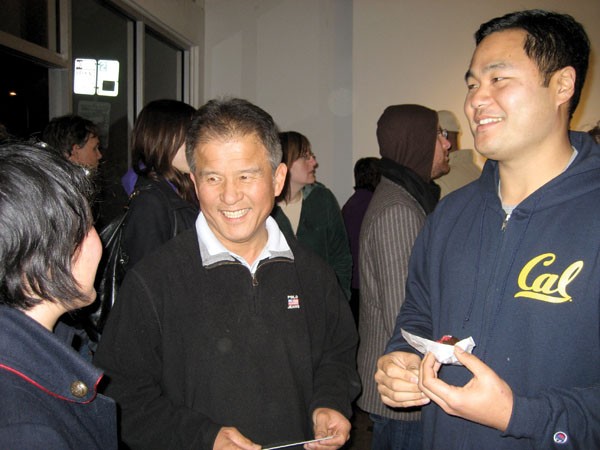
Keun Bae Yoo stands in front of a large splotchy painting resembling
a Rorschach inkblot. It’s the evening after New Year’s Day during the
monthly Art Murmur, when Oakland art galleries collectively open their
doors to the public. Yoo, a Korean-American real estate investor
dressed in a Polo pullover sweater, slacks, and dress shoes, looks just
a tad out of place among the twenty- and thirtysomething hipsters
milling about the gallery Johansson Projects.
After a moment of quizzical inspection, he asks, “What is this?”
Credits: Ali Thanawalla
Credits: Kathleen Richards
Credits: Ali Thanawalla

Credits: Ali Thanawalla

Credits: Ali Thanawalla

Credits: Ali Thanawalla

Credits: Ali Thanawalla
Credits: Ali Thanawalla
Credits: Ali Thanawalla

Credits: Ali Thanawalla
Credits: Ali Thanawalla

A young woman standing nearby, watching over the artwork, looks
puzzled.
“Excuse me, what is it?” asks Yoo’s associate, Ben Schweng, trying
to be a little less blunt. At 34, wearing a Cal sweatshirt, jeans, and
roughed-up boots, Schweng looks slightly less conspicuous than Yoo.
“What is the material?” the woman asks, trying to clarify the
question.
“No. What is the picture?” Yoo asks again in his heavily accented
English.
“I dunno,” she replies, unsure of how to respond. “It’s supposed to
be abstract. What do you think it is?”
“I think it’s a lake,” Yoo states, and then walks on.
The Korean-American community and the art crowd may occupy the same
Telegraph Avenue neighborhood — the same block, even — but
they don’t often interact. So when they do, it can be a bit awkward.
But tonight, Yoo, at the suggestion of Schweng, is here to breach that
boundary. Both are board members of the Koreatown Northgate Community
Benefit District, a newly formed organization made up mostly of
property owners whose goal it is to “promote and improve the area.”
They’ve come to Art Murmur to recruit folks to help plan their upcoming
Koreatown street festival in the fall.
It’s not the kind of outreach one might expect to see in an ethnic
neighborhood. But then again, this isn’t your typical enclave. Unlike
other ethnic neighborhoods, Oakland’s Koreatown isn’t majority Korean
— or even residentially Korean. It didn’t arise organically. Nor
was it the result of a wave of Korean immigrants settling in the same
neighborhood, with mom-and-pop businesses sprouting up to cater to
them. This Koreatown was planned out — largely by one man.
About fourteen years ago, real estate developer Alex Hahn decided he
wanted to create a Koreatown in Northern California. Today, after years
of owning businesses, buying and selling property, and making money,
Hahn is finally seeing his vision come to fruition. Last year, property
owners of Telegraph Avenue — stretching from 20th to 35th streets
and including about 150 Korean-owned businesses — agreed to
increase their taxes to form the community benefit district. The
district has allowed them to increase security and street cleaning.
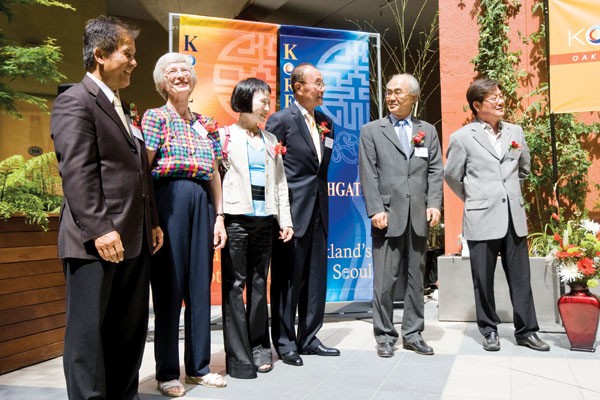
Earlier this month, they unveiled new banners to demarcate Koreatown,
with the slogan “Oakland’s Got Seoul.” Besides the upcoming street
festival, other plans include starting a farmers’ market and attracting
a Korean hotel.
Some believe the changes have helped improve a neighborhood that for
years has been characterized by homelessness and crime. “From 1991 to
2009, it’s a three-sixty — in a good way,” said Alex Jones, the
Arab-American manager of Telegraph Quality Market, who grew up in the
area. “It was terrifying out here. … I see a lot of improvement,
cleaning. Got a lot more patrol since the taxes went up.” Wayne Harris,
the African-American owner of Telegraph Cleaners, thinks Koreatown will
be successful. “Hopefully it’ll be an increase in business and a
decrease in crime and people who hang around,” he said.
Yet, as with any new ethnic enclave — especially one in which
the ethnic community is still very much in the minority — not
everyone has been so receptive. Some businesses are upset with the name
“Koreatown,” and say the community benefit district doesn’t embrace the
neighborhood’s diversity, which includes Muslims, African Americans,
artists, homeless people, and industries such as social services,
health care, and auto repair.
Led by Hahn, the board of the Koreatown Northgate Community Benefit
District — whose members are about half Korean — insists
they’re trying to improve the community for everyone, but that the
naming and branding of Koreatown is necessary to attract more Korean
businesses, investors, and residents. Yet they also believe that in
order to succeed — and to avoid the fractionalized atmosphere
that erupted in Los Angeles’ Koreatown during the riots in 1992 —
they have to proactively embrace the whole community. Which is why,
among other reasons, they’ve hired an African-American “street
ambassador” to help spread the word — and keep the peace.
The story of how Oakland’s Koreatown came to be starts with Hahn,
who has the kind of immigrant success story that’s almost
cliché. He arrived in the United States in 1966 as a member of
the South Korean Olympic fencing team with just $50 in his pocket. Now
he lives in the affluent community of Blackhawk.
The tall, sprightly Korean American was ambitious and enterprising
from the get-go. When his Olympic dream failed to materialize, Hahn
started a wig business in Los Angeles. But that didn’t work out either,
so he relocated to the Bay Area and earned a degree in hotel restaurant
management at City College of San Francisco.
In the decades following, he operated a string of businesses,
including a restaurant and grocery market. “You name it, so many,” said
Hahn, whose first language was Korean and who still retains a thick
accent. “Sometimes fails, sometimes big success.” Most all of his
businesses were in predominately black neighborhoods in Oakland, where
he learned to reconcile cultural differences with mutual respect and
“street smarts.”
Being the owner of a small business involved long hours and little
pay. So about fifteen years ago, Hahn entered the fray of real estate
development. “I realized I have to be involved in real estate because
when I have a lease from the landlord, oh, I’m paying so much money.
Looks like I’m working hard, fourteen hours a day, and landlord, they
don’t work. I work for him. Why don’t I be landlord, that’s the best
business.”
He started slowly buying up properties — a shopping center,
the I. Magnin building — when prices were still reasonable in
Oakland. “I have a vision, actually — real estate booming. Nobody
believed it at that time, fourteen years ago.”
His instincts were right — Hahn made quite a bit of money. But
he wasn’t satisfied just making a profit; he wanted to do something for
the Korean-American community, too. “I liked to create Koreatown for
the next generation,” said Hahn. “Also, the Korean community trying to
organize something … just like Chinatown. We try to build up our own
dreams.”
He set his sights on Oakland as the perfect location for a
Koreatown. Using LA’s thriving Koreatown as a model, he decided San
Jose was too big and San Francisco didn’t have a large enough Korean
population. Telegraph Avenue, he reasoned, was centrally located, close
to transportation, and had ample parking.
First, he bought property on Telegraph at 27th Street, which was
then the old Sears tire center. He developed the property, leasing it
to the restaurant Samwon BBQ House and a Korean pool hall, and then
sold it. Next, his Koreatown needed a Korean grocery store, so he lured
Kyopo Market from San Jose. The owner sold it to the current owner of
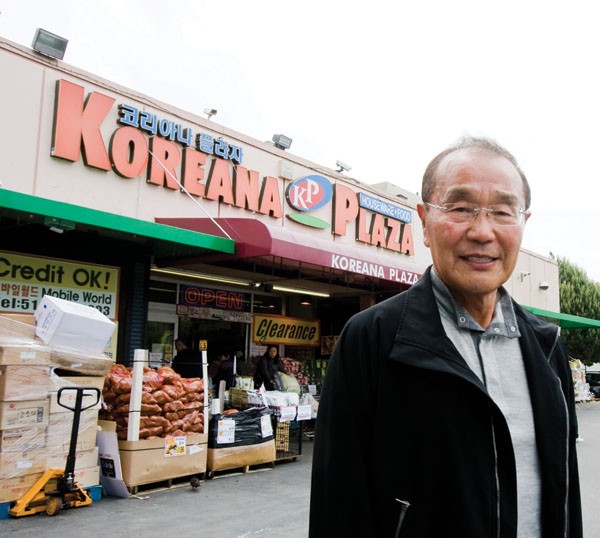
what is now the hugely popular Koreana Plaza. Hahn also is responsible
for attracting Nara Bank; the Korean newspaper Hankook Ilbo;
and, with the help of investors from Korea, the KIA dealership on
Broadway. In turn, those helped draw other Korean businesses and
investors.
Keun Bae Yoo and his wife Suk Hee Yoo were two of them. The real
estate investors lived in San Francisco for more than twenty years, but
moved to Oakland after Hahn convinced them to do so. “Twelve years ago,
Alex Hahn was keep talking to us about good idea to invest in East Bay,
especially in Oakland area, thinking one day we need to have this
Koreatown, like Los Angeles,” Suk Hee recalled, sitting at the kitchen
table of one of their properties on Piedmont Avenue. “So one day we
decided to invest in Oakland area.”
The couple sold all of their San Francisco property, and bought a
home and a few investment properties in Oakland, including the lot from
Hahn that houses Samwon BBQ House, which they also later sold. They
currently own three properties in Koreatown, one in which their son
lives, and are part-owners of the building that houses Neldam’s Bakery
and Smokey Blues Bar-Be-Que. Hahn, meanwhile, owns about six properties
in Oakland, including two parcels in Koreatown.
But developing Koreatown into a bustling district hasn’t been easy.
It’s taken a lot of hard work, and now the downturned economy and a
weakened Korean won are stalling its progress.
On top of that, Oakland still has some major image issues to
overcome. Many Korean Americans in the Bay Area have settled over the
hills in the suburbs, and they consider Oakland a dangerous, high-crime
city with a poor school system. Getting Koreans to move here would
entail changing that, Hahn says. The community benefit district has
tried to help with the first problem — having hired extra
security, with more on the way — but the second issue is in the
hands of the city. “We have to improve that, then Koreans more coming
in,” he said. He also believes Koreatown needs a large Korean grocery
store chain on par with the Chinese supermarket chain 99 Ranch Market
to serve as the community’s anchor.
Hahn is reassured by the formation of the community benefit
district. Since Korean Americans own only 7 percent of the properties
in the district, he considered that the biggest hurdle to his plans.
However, non-Korean property owners were largely in favor of creating
Koreatown.
But property owners aren’t generally the people who actually inhabit
an area. Some Korean business owners who were lured by the prospect of
a Korean customer base are finding that their clientele is
predominately non-Korean. Constance Ng, who is of Japanese and Korean
descent, opened 31 Plaza in January to appeal to international students
and shoppers of Koreana Plaza, which sits just across the street from
her. Yet five months later, Ng’s swanky cafe/department store —
which is modeled after shops in Asia — has mainly attracted
neighborhood kids who use the space to do their homework. Now, Ng is
thinking of remodeling her business plan and turning the space into
something more resembling a community center. “I’m going to cater to
them more — probably add more tables,” she said. “Do something
for the kids. I’d rather do that than make money.”
And although the neighborhood is slowly changing, it’s still
frequented by homeless people, drug dealers, and other folks who might
serve to detract potential investors. So someone has to be the eyes and
ears on the ground in Koreatown.
That’s where Dermelle Davenport comes in.
On a Thursday afternoon in April, Dermelle Davenport embarks on his
daily walk through Koreatown. Dressed in a blue medical scrub shirt,
jeans, and shiny blue sneakers, he doesn’t look like he’d be a
representative of Koreatown — and that’s the point. Turns out,
he’s its official cheerleader.
Today, he’s going door-to-door handing out fliers that advertise the
upcoming banner-unveiling ceremony. His goal isn’t just to spread the
word, but also to make sure that the merchants feel included in
Koreatown’s development.
As he heads down 27th Street, where he works at the dialysis center
RAI Peralta, toward West Grand, Davenport encounters the full range of
elements that make up the neighborhood: a Korean restaurant, diner,
adult video store, African-American hair salon, Vietnamese-run nail
salon, Buddhist temple, Korean bookstore, and eyeglass shop. It’s a
reminder of just how diverse Koreatown really is — and the
challenges that he faces.
“Hey buddy, how are you today?” he calls out to Wayne Harris, as he
steps inside the storefront of his dry-cleaning business, Telegraph
Cleaners. Davenport hands him a flier and explains how the mayor is
invited and what TV media are scheduled to show up.
“If you wanna step out for 20, 25 minutes, come on through,”
Davenport says.
“Okay, thanks for making me feel welcome,” Harris responds with a
smile, as Davenport ducks out to continue his fliering.
Across the street, the dialysis technician veers down 23rd Street to
Providence House, a supportive housing facility for people with
HIV/AIDS. Although the facility is not technically within the Koreatown
district, Davenport feels it’s important to include it. “In order to
have the businesses, you need to involve the community,” he reasons.
“These are your customers.”
As Koreatown’s official “street ambassador,” Davenport takes his job
very seriously. He isn’t a property owner, but he works and lives
there. Not only does he want to make the area a better place to live,
but he believes that the Koreatown Northgate Community Benefit District
can help make that happen. Of course, he has his own opinions, too.
“I feel as though I have a way with people,” explained Davenport,
sitting in a plush corner office in the dialysis center prior to his
walk. “And people need some assistance, you know, that’s what I’m here
for. I interact very well with the public, and for a lot of the board
members, they’re really not from Oakland. They live outside of the
area. So they’re really not familiar. So part of my responsibility is
to maintain the streets.”
Davenport first learned of the Koreatown community benefit district
from board member Kathy Beallo, who owns the building where he works.
“One day, it was a lot of trash in her parking lot, stuff like that,
and I said, ‘Hey, you know, I’ll pick that up for you.’ So me and her
became very close in a way where she began to trust me in doing things,
not only because I work here but because my boss gave her a good report
of who I am and what I’ve done to make things better for the dialysis
center.”
Beallo invited Davenport to one of the district’s monthly board
meetings. He continued to attend, and was very vocal on sharing his
thoughts and ideas. A few months later, he was voted onto the
board.
It soon became clear that Davenport had a unique perspective and
position in the community that could benefit the board’s mission. “My
thing was that I could probably work with the people on the streets
because I have a way with people and also because I was born and raised
in the inner city, so I know how to relate with them, as opposed to
other people that … didn’t live that type of life, may not know how
to go in there. It’s all about speaking.” Plus, he added, “It’s good
with me being black, also it gives balance. If it was all Korean, you
may not get feedback. I can relate to them. I try to keep the
peace.”
The board members seem to be counting on it. “What Dermelle does
goes a long way to prevent what happened in Southern California, which
is not what I want,” said district board member Ben Schweng, referring
to the LA riots, known by Korean Americans as Sa-I-Gu, or,
literally, 4/29.
As the board’s street ambassador, Davenport is primarily paid to
report graffiti and illegal dumping to the city. But he also interacts
with neighborhood kids and other residents, including the homeless. He
tries to prevent homeless from panhandling in front of businesses or
loitering around bus stops.
But Davenport goes a step further. He’ll give a homeless person a
few dollars if he has money in his pocket, or tell them about the
shelter on West Grand and San Pablo where they can get hot meals twice
a week. Sometimes, he said, he walks with them to ensure that they get
there.
His effort was evident the other day when, while passing out fliers
on Telegraph, he ran into an older homeless man pushing a shopping
cart. He told the man to meet him at the car wash down the street where
he would pay him to wash his car. The man seemed reluctant at first,
but Davenport kept pushing the issue until he agreed.
“Because homeless people are homeless, they’re still people,” said
Davenport. “And my thing is, I treat everyone the same whether you
homeless or whether you have a nice big home and a business over here.
… And so I try to interact with them, and I also try to let them know
what we’re trying to do within our community and that they are a part
of the community.”
Sometimes, however, Davenport’s tactics can be a little too
touchy-feely for the board. He said he once hired homeless people to
pass out fliers for the board, and wanted to hire them to help clean up
after their street festival this fall. But his good intentions didn’t
pass muster with the board.
“This is the down-and-dirty work that I do out here,” he said,
adding that some board members seem hesitant to interact with the
community. “It’ll get better once the board gets more comfortable.”
As for Davenport’s incentive? He doesn’t seem as concerned with
luring Korean businesses or residents as he is with making life better
for the people who live here. Besides helping the homeless, he also
wants to start a Boys and Girls Club or create a park for the
neighborhood kids.
While he clearly enjoys the challenge of his job, Davenport also
understands the limitations. Despite his best efforts, not everyone is
thrilled with Koreatown, particularly the name and the banners. He
chose to skip passing out fliers to a couple of businesses. “They don’t
like the whole word Koreatown,” he said. “They said this was Northgate
before it was anything and that’s what they want it to be. They feel as
though Koreans have come in here and bought most of the stores up along
Telegraph, and they bought a lot of the property, and because a lot of
the property has been bought with Koreans that they’re pushing them
out.”
It’s a complex issue because most of the merchants who are upset are
African American, just like Davenport. He may be Koreatown’s official
cheerleader, but he understands the frustration of some of the
merchants, too. “I can relate to it to a certain extent because I feel
like maybe in the beginning it should have been done a little bit
differently to get more people in the community involved before we just
came up with a name,” he continued. “But, unfortunately, Koreatown,
they went through all the right channels to establish what we are to
this very day. So I support it 110 percent.”
The tensions between proponents and opponents of Koreatown aren’t
black and white, or, in this case, black and Korean. But the fact that
the district is being branded as an ethnic community makes race an
inherent factor. Some merchants and residents interviewed said they
feel the Koreatown name and banners exclude the reality of Telegraph’s
diversity.
“To me it’s discriminatory and not reflective of the community,”
said Akilah Zainabu, owner of Business and Media Services, who noted
that there are very few Korean-owned businesses between 27th and 35th
streets, where her business is located. “The attitude of it, too, is
kind of insulting. A flag — meaning our ownership, our agenda.
What does that say for the rest of us that are here?”
Community activist and organizer Marilynn Mackey, who was born,
raised, and still lives in the neighborhood, agrees that everyone
should have a voice in shaping the area. She also takes issue with the
banners being paid for by Oakland’s redevelopment agency, and says
there’s a petition circulating to take them down. “The banners oughta
come down,” said Mackey. “And I believe the banners will come down when
the citizens of Oakland find out that their redevelopment money is
going to that.”
Mama Buzz Cafe owner Jade Venetatos said that even with the
community benefit district doing outreach, she feels the naming of the
district as Koreatown automatically alienates people. “If you want to
build community, you have to organize people from the grass roots,” she
said. (She’s been recruited to become a district board member because
they have one spot reserved for a non-property-owning business owner,
but she’s not so sure she wants to join.) She also added that the
district hasn’t greatly improved things. “There’s still crime, a lot of
crime, and crackheads. There’s all kinds of stuff that happens all the
time.” Increased police presence, she said, “doesn’t stop anything from
happening.”
Resident Tao Matthews, who identified herself as part Native
American, part Asian, and part white, said she feels that the board is
“not abiding by the wishes of the community.” The street sweeping and
graffiti abatement are programs that the city already provides, she
argues, and police and fire services are nearby. “We don’t really need
duplication of services,” she said.
Matthews also wonders whether the community benefit district is
exceeding its limitations as a nonprofit entity. “They’re supposed to
help; they’re not supposed to take over,” she said. “It’s not a
convenient excuse to start monopolizing.”
So what about other ethnic neighborhoods in Oakland? Few people
mentioned having concerns with the mostly Latino Fruitvale area or
Chinatown, citing their larger and more historical roots. Koreans
aren’t numerous enough yet, or perhaps the larger community is still
adjusting to their more-recent immigration.
“They should humble themselves,” said Matthews. “This is not Seoul,
Korea. This is Oakland, Northgate.”
The most vociferous Koreatown critic is Carl Jackson, owner of
Smokey Blues Bar-Be-Que, next to Neldam’s Bakery. He’s not just against
naming the area Koreatown, but he also accuses his Korean landlords of
trying to run him out of business.
“What I am upset about is how this can be named Koreatown,” said
Jackson on a blisteringly hot afternoon. “It’s just not fair. They’re
not good landlords. They’re very, very arrogant.”
Jackson says he has sent letters asking his landlords to fix his
lights and his torn awning, but that nothing has been done about it,
and it’s repelling his customers. He says it’s part of an effort to
force him out. “They don’t believe in leasing to minorities,” he said.
“If you’re not Korean, they don’t bother with you. It’s a very racist
situation.”
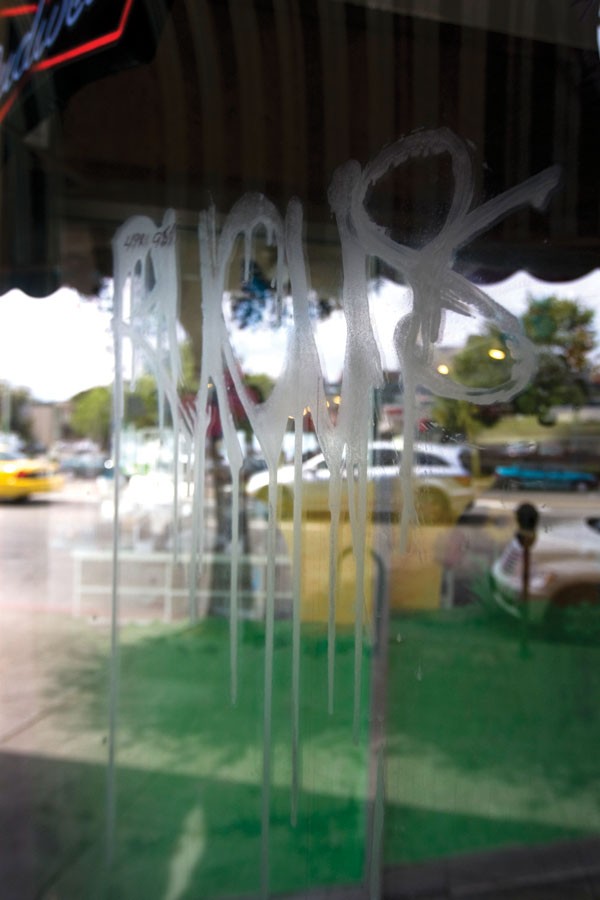
He also says Korean gangs put a note on his door, which read “get
out, this is Koreatown,” and that they etched graffiti into his window
using acid, so he can’t remove it. He alleges that his Korean landlord
came and threatened him. “I’m not sure if they wanted the property back
or to break the lease,” he said. “They killed my night business.”
His landlords, however, vehemently deny Jackson’s accusations. “He
is lying actually,” said Suk Hee Yoo, who added that her husband Keun
Bae went to introduce himself when they first bought the building along
with three other owners but that Jackson accused him of threatening
him. The couple says that the light was fixed and that they tried
replacing his front window three times, but each time Jackson failed to
show up. Now, they say he won’t talk to them without pointing them to
his lawyer.
“Because we use ‘Koreatown,’ people think they are being isolated,”
Yoo said. “This is not true, you see. What kind of ethnic group is
willing to invest in that area? Who’s willing to improve the area? …
That’s why I’m kind of upset when they say, ‘Why you using Koreatown?’
Then use your name then. Come here and improve it, put the effort like
we did. Without putting their effort, why they are complaining about
it?”
Such sentiments are nothing new to Alex Hahn, who operated
businesses in majority African-American neighborhoods for years. “We
have to understand: if you non-black community, you get in there, they
think you invade their territory,” he said, adding that the situation
is the same no matter what race the majority community is.
That’s why he says it’s important that the Korean businesses include
everyone, and be sensitive to their concerns. “I think we owe them
because we make money from their community,” he added. “We have to give
them opportunity.” When he operated Acorn Market in West Oakland, Hahn
said the majority of workers he hired were from the neighborhood. When
young people came and vandalized his store during the Rodney King
riots, he chose not to call the police because he said it would have
made the situation worse.
Whether business owners and residents like it or not, Koreatown
doesn’t appear to be going away. In fact, it’s growing. It has the
support of the city, the majority of property owners, and has the added
resource of investors in Korea.
Residents, board member Ben Schweng said, have always been invited
to add their input. “None of this went on beyond closed doors,” he
said. “The city council has known about this — they approved our
name.”
That might not please everyone, but Schweng believes it will
ultimately benefit them. “Democracy doesn’t mean that you always get
what you want,” he said, adding that there have been disagreements
among board members, too. “We want to be judged on what we’re doing for
the neighborhood, which is a lot I think.”