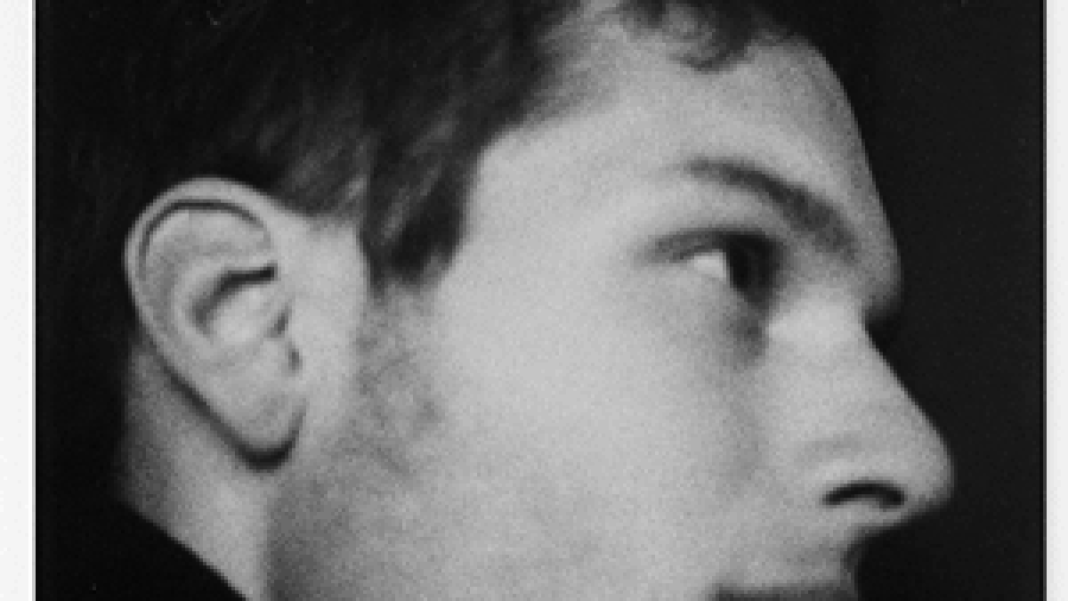
Simon Kinsella spent his first wide-eyed week in California at Jason Hasley’s San Francisco apartment. A casual friend from back home in Cincinnati, Jason was happy to put up Simon and his girlfriend while they hunted for an apartment near UC Berkeley. It was August 2002, and the 27-year-old who’d just collected his first degree would soon start journalism grad school. In two years he expected to be settled into a crappy Manhattan walk-up, cleverly working the folks at The New Yorker until they realized how foolish they’d be not to run his stories. It didn’t cross his mind that two years later he might land at Jason’s again, amid considerably less hopeful circumstances.
Simon’s first class at Cal, and mine, was a notoriously strenuous one called J-200, Reporting the News. Professor Neil Henry outlined an itinerary designed to school us in the criminal justice system: We’d ride shotgun with cops, witness court in session, visit San Quentin, and tour a county morgue. But our first assignment was to profile a classmate. The catch was that we couldn’t speak to the person directly, only to people who knew him or her. I got Simon. He gave me a firm handshake, scrawled “Anna Stewart” and a phone number on a piece of paper, and flashed me a mischievous grin.

Simon Kinsella Credits: Frances Duff 
Simon played baseball and plucked a guitar for fun. Credits: Frances Duff Frances Duff tried methadone once. It knocked her out of commission for two days. Credits: Bayeté Ross-Smith UC Berkeley senior Pat McCann died of a methadone overdose. Engineer Mike Yang takes methadone legally as a painkiller. Credits: Bayeté Ross-Smith



Anna and Simon had been inseparable since meeting six months earlier at a Cincinnati dance club. Simon, who at five foot ten stood a few inches taller than she, was an edgy, buzzing sort of handsome. He had a sharp jaw, a strong nose, bright brown eyes, and an Adam’s apple that jutted out as if he were still sixteen. In his uniform of dark jeans or corduroys, untucked button-down shirts that hugged his compact frame, and scuffed black oxfords, he had the urban hipster look down pat. Anna, 21, was bright, stylish, and, as Simon often told her, pretty enough to think seriously about modeling. She could be a total drama queen and knew just how to piss Simon off, but the times they lay awake laughing all night made up for it.
Simon was the son of working-class Irish immigrants, the oldest of five. He was a self-taught guitar player who’d spend hours learning a five-second lick. He was a lady charmer who never gave an insincere compliment, a captivating storyteller, an avid drinker, and a terrible driver whose license had been revoked. He didn’t back down from an argument, and often invoked one just to get a rise. His personality was exemplified by an anecdote from a friend I interviewed for my profile: In elementary school, a teacher had occasionally strapped Simon to his chair with a belt just to get him to sit still.
So I wasn’t altogether surprised when I got word, two months later, that he was in jail.
Simon’s 28th birthday had fallen on a Wednesday, but he and Anna agreed to celebrate it on Friday night. However, her regular babysitting gig ran hours late, and when she finally stepped through the doorway he’d just finished a bottle of Jack Daniel’s. He became irate, whacking a painting off the wall. She told him to get out. He refused. When she picked up the phone to call the cops, he snatched it from her and hurled it across the room. Then he threw it again to make sure it was broken. Anna slipped into the bedroom and dialed 911 on her cell phone.
“He shoved me, but he didn’t hurt me,” Anna said four days later when I called to find out why he’d missed school. “I was scared and I overreacted, but they won’t drop the charges.”
Simon’s bail was $10,000, and it would cost a grand to get him out. Anna said there was no way he’d disappoint his parents by calling them, and she doubted they could afford it even if he did. I mulled it over on the long drive to Santa Rita Jail, well aware that it would be insane to lay down cash I didn’t have for a classmate I hardly knew. Once I arrived, I learned that Simon couldn’t have visitors, but would be arraigned the next day in Oakland and then released. Professor Henry, who’d taken an instant shine to Simon, met me outside the courtroom — the same one we’d all visited for his class a couple weeks earlier.
Simon was released that night with walking directions to Dublin BART, a ticket with a few bucks on it, and a firm admonition to stay away from Anna. He headed straight for the journalism school, where he scarfed down some food left over from a reception and slept on the beat-up couch in the student lounge.
“I feel like such a fool,” he told me the next day during a long talk in the rose garden north of campus. His version of events was similar to Anna’s. “I was a jerk, but I didn’t touch her,” he said, twisting his hands together in his lap. “Look at me — I could hardly squash an insect.” I believed him.
He spun his five days in jail as a positive experience. He’d learned to conquer boredom. His cellmates’ lives were riveting. Everyone had respected his status as a journalist and grad student. “I could write hundreds of pages on it,” he said. In the following weeks, he did.
The police report, which I glimpsed last month for the first time, unearthed no shocking details. I was surprised to read about a hole in the bedroom wall where he had reportedly thrown a television during a heated argument a few weeks prior. And there was a final remark: “Anna expressed a reluctance to press charges, and with youthful optimism stated her belief that the two would either work things out or part company forever.”
They soon did the latter. Simon slept on the floor of a school friend’s empty apartment before moving into a room in North Oakland. One of his new roommates was a drug peddler who specialized in Ecstasy. Ironically, I eventually learned, it was one of the few drugs Simon didn’t like.
Back when Simon was still an undergrad, a frightening trend began surfacing in emergency rooms and morgues across the country. Accidental overdoses blamed on prescription drug use were soaring. It wasn’t exactly news that painkillers were high on the list, but everyone was puzzled by the rise of one newcomer: methadone.
Ask anyone what methadone is, and you’re likely to hear that it’s used to get people off heroin. German scientists synthesized it as a morphine replacement during World War II, and after the war, an American doctor brought it back to the states. Eli Lilly began churning it out under the name Dolophine, and in the 1960s it found its niche treating heroin addicts. Opioid treatment programs, known colloquially as methadone clinics, sprung up across the country.
In 2005, more than 200,000 Americans, including 28,500 Californians, sought help at these highly regulated clinics. Residents of Alameda and Contra Costa counties have more than a hundred to choose from. The vast majority of programs dispense methadone as a liquid mixed with fruit juice. A single daily dose blocks the effects of heroin, eliminates withdrawal symptoms, and curbs cravings without imparting a buzz. Regular drug testing and counseling are mandatory. In 2001, stringent federal guidelines finally relaxed to allow model patients to walk off with take-home doses. Accidental overdoses not involving other drugs have historically been rare.
Critics contend that methadone clinics merely replace one addiction with another. And while they have a point — some former users claim the medication is even tougher to kick than heroin — studies have shown that a former heroin addict’s brain on methadone looks and acts like the brain of a non-drug-user. Some experts compare it to diabetics who rely on insulin to stay healthy. But addictive or not, methadone lets thousands of otherwise ill-functioning people lead constructive lives.
Yet methadone has another use, approved in the mid-’70s but only common in the last decade: It works magic on pain. As any of the millions of Americans battling chronic pain might tell you, anything that can do that is worth its weight in gold. And methadone doesn’t take all that much gold.
“It’s cheap as dirt,” said Dr. Michael Moscowitz, a partner with Bay Area Pain Medical Associates in Mill Valley and a former president of the American Pain Society. “If a patient without insurance needs treatment for pain, methadone is about one-fifteenth the cost of the next drug in line.” The most popular med on the market, a sustained-release formulation of oxycodone marketed as OxyContin, costs pharmacies about $177 for a one-month supply. An equivalent supply of pill-based methadone, which has always been generic, is just $8.
But it hasn’t gained popularity solely because it’s a bargain. Doctors increasingly prescribe it because Vioxx was yanked from shelves in 2004 and OxyContin’s dubious reputation as an easily abused pill has cost them countless headaches, and even jail time. With doctors under increasing scrutiny from the Drug Enforcement Administration, methadone is an alluring alternative.
Thus the drug that always seemed a poor candidate for abuse quietly stepped into the role of the cool new kid in class. And the new kid started raising hell.
In May of 2003, as the federal government convened its first conference on methadone-related deaths, Simon successfully completed his first year of grad school. He was known around school as a funny, high-spirited guy who always had a cold can of Red Bull in his hand, and time to shoot the shit around one of the picnic tables in the courtyard. I assumed that the energy drink explained his ever-constant pep. I never thought to check his peacoat pockets for pills. When we went drinking every so often with classmates, he’d get fairly ripped, but in journalism school it was the teetotalers who seemed suspicious. We had an easy friendship that consisted largely of him offering advice — most laughable, some helpful — as I bitched about my languishing love life.
Among professors, he was frequently viewed as talented but exasperating. Professor Paul Grabowicz appreciated Simon’s directness: “There was nothing contrived about him. For better or worse, Simon seemed to say, ‘This is me.'”
A classic example was the day he showed up late to a new class. “Do you plan to be late next time?” demanded Todd Carrel, the infamously tough instructor who had nearly reduced another student to tears just moments earlier. “I don’t know,” Simon replied with a sloppy shrug, triggering a collective intake of breath around the table. “I don’t plan on it, but I could be.” The professor quietly asked Simon to stay after class. They walked around campus for an hour, swapping stories from their marbled pasts and forming an unlikely bond. “He’s a cool guy who’s been through a hell of a lot in his life,” Simon said later. “I think he gets me now.”
That summer, at the tail end of an internship at Diablo magazine, Simon spilled a gin and tonic on a hauntingly beautiful, hollow-eyed woman at a bar. Frances Duff, 24, worked the register at Trader Joe’s in Castro Valley, took classes at Chabot, and shared custody of her curly-haired two-year-old son. The attraction was immediate, and intense. On their third or fourth date, she told me recently, Simon caught her off-guard by declining a drink refill. “I don’t need one,” he said. “I loaded up on morphine at home.”
Frances didn’t miss a beat. “I asked him why he hadn’t brought some for me,” she recalled. On their next date, he did. She said she almost overdosed.
Classes started up again. Simon seemed preoccupied, but I chalked it up to his new job as a graduate student instructor, which required him to teach several sections of an undergrad communications class. It was a prestigious position that came with a $1,500 monthly paycheck, a hefty tuition reduction, and a massive workload. Then one day midway through the semester he showed up to school with his eyes glazed and his mind dazed in a way I’d never witnessed. When I asked, he insisted he was fine.
“He’d blow his entire paycheck on drugs,” Frances recalled. “He’d come home from teaching, flop on the bed, wake up an hour later, and crush pills.” But he’d also help her with her schoolwork and gladly watch her son while she was in class. “He was always telling me how intelligent I was,” she said. They hadn’t been dating long when Simon occasionally began adding heroin to the mix, showing her how to drop a pearl-sized ball of tar into an uncapped Visine bottle, add water, and drip it into her nose.
“As long as he didn’t put anything in his veins, he thought he’d be fine,” Frances said. “I didn’t tell him otherwise. I was right there with him.”
She was no novice, either. She’d been popping a medley of prescription pills since her junior year in high school. He’d taken up the habit at the wise old age of 23 or 24. OxyContin was his mood-booster of choice, but he experimented with other meds, and invested in a copy of the Physicians’ Desk Reference to figure out “what shit would fuck him up the best” — as Aaron Tyree, Simon’s friend and former roommate in Ohio, put it recently.
“He could never find that plateau that was enough for him,” Tyree said. “He burned as brightly as he could, and was constantly seeking out fuel. Sometimes he’d look at himself and think, ‘I don’t want to be a junkie.’ But then his ego would come into play and he’d say, ‘I’m not. I do this for fun.'”
Whatever Simon was up to didn’t look fun. His long fingers trembled all the time, and he’d pretty much abandoned the guitar. Frances remembers making their bed in the morning and brushing off the skin that had flaked off his dehydrated body during the night. But we’d drifted apart, and I didn’t offer to help. Director of admissions Michele Rabin tried to. She called Simon into her office, explained that friends and professors had expressed concern, and gave him a list of substance-abuse support groups and a referral to a counselor at the student health center. “I have no idea if he ever followed up on any of these things,” she said.
Simon flew home for Christmas, but stayed just two weeks instead of four. “I’d been worried about him for a while, but when he visited for the holidays I thought, ‘God, he really doesn’t look that good,'” recalled his lifelong friend Nathan Singer. Growing up, Simon didn’t do anything that 90 percent of young people don’t do, Singer said. In earlier years they’d often mused about how their full-throttle lifestyles would put them underground before they hit thirty. “It was one of those things that a lot of young men talk about,” he explained. “It wasn’t a scared thing. We just shared this feeling of having to get a lot done in a very short period of time, because we really didn’t know if we’d live very long.”
Tyree remembered that Christmas as the one time Simon spoke about his addiction: “I could see he was scared. There we were, in the middle of a strip club at a bachelor party, and he’s telling me, ‘I have a serious drug problem.’ But that was all he said. He knew the only thing that was going to stop him from doing it was himself. I told him I’d take him to rehab, right then and there, or he could stay in Cincinnati with me. He said, ‘I’ll be okay. Let’s get another drink.'”
In February 2003, The New York Times published a story on the spike in methadone deaths, calling it a “killer drug.” But experts agree that, when used correctly, methadone is no more dangerous than any other narcotic analgesic. The key, they say, is that doctors need to know how to dose it, and patients need to carefully follow their instructions. This coming year, the federal Center for Substance Abuse Treatment plans to roll out a California pilot program for doctors treating patients with methadone. “We think education will make a big difference,” director Robert Lubran said.
Methadone’s double-edged sword is its half-life, which is longer than that of any other prescription opiate. As a result, it can take hours to feel, far from the instant relief that pain patients may expect — or the insta-bliss recreational users count on. And half the dose remains in the body from one to four days. Thus, people who use other drugs or down a few drinks within that time frame are playing with fire.
“A slow onset is good in avoiding the very addictive, high-impact ‘rush’ to the brain,” explained Dr. Judith Martin, chair of the California Society of Addiction Medicine’s Opioid Dependence committee and the medical director of the 14th Street Clinic in Oakland. This is why it works so well in treating heroin addicts. “However, if a naive person is taking it on the street or at a party, they may feel it is weak because it hasn’t ‘kicked in,’ and may take more and more. When it finally reaches peak action, two or three hours after ingestion, the person may fall asleep and not wake up.”
In 2004, 32,000 people who’d illicitly taken methadone were admitted to American emergency rooms, triple the figure from three years prior, according to the federal Drug Abuse Warning Network. Some woke up; others did not, like UC Berkeley senior Patrick McCann. On the morning of October 14, the 22-year-old’s friends dropped his lifeless body at the Alta Bates emergency room and split. Berkeley police subsequently sniffed around. Between the in-law unit McCann had shared with a roommate, and the adjacent house, where three other guys lived, the cops uncovered six marijuana plants, six pounds of dried pot, four guns and hundreds of rounds of ammunition, a pillowcase stuffed with $14,000, and assorted pills, including more than one hundred stamped “Methadose,” a major manufacturer’s name for methadone.
Patrick’s mother told the coroner that her son had used marijuana — the only one of those items found in his living space — but methadone? Not as far as she knew. A couple weeks after his death, the toxicology results were in. Cause of death: acute methadone toxicity. Other than a small quantity of alcohol, it was the only drug he’d ingested.
California suffered 123 fatalities from methadone-related poisonings in 2003, the most recent year for which statistics are available. This represents an 89 percent increase from 1999, the year death certificates were first amended to allow mentions of methadone, and yet California still ranks last among the thirty states reporting data. At least, so say these figures from the National Center for Health Statistics — the only statewide statistics available.
“In an ideal world, every drug would be written down and coded for on the death certificate,” said Lois Fingerhut, an epidemiologist with the National Center for Health Statistics. But that’s often not the case, she explained. Methadone mentioned solely in a toxicology report doesn’t get counted anywhere other than that medical examiner’s office.
Records from Alameda County show how profoundly the official death toll fails to describe the problem. Of nineteen recorded overdose cases citing methadone in 2005, the word “methadone” wound up on only three death certificates. No official tally will ever note that methadone actually played a role in more than six times that many fatalities. The others involved multiple substances, and thus the cause of death was listed as multiple drug intoxication.
“One thing we can say with certainty is that there is more than one drug involved,” said Lubran of the Center for Substance Abuse Treatment. “It’s a rare phenomenon to see a person who has died and methadone is the only drug in their system.”
Thus the same slow-onset high that lulls people into mixing methadone with other drugs and makes its abuse so deadly also explains why this phenomenon has not attracted more attention.
As we headed into the home stretch of our final semester, Simon and I shared what I thought was a heart-to-heart talk over Indian food. I finally asked if he was using. “Oh, I was doing a lot of speed last semester,” he replied without hesitation, pushing his fork around a big plate of chicken tikka. “I got into some stupid shit, but it’s over. And I never came to class high.” I was so relieved that I didn’t press him further, though I knew the latter was a lie. He went on to blame his unkempt, unhealthy appearance on stress, then deftly changed the subject.
He was excited because Frances was moving in with him. It meant that her toddler would spend a few nights a week with them, which both awed and unnerved him. Not because of their drug use — Frances was adamant that they never got high when her son was around — but because Simon wasn’t sure he’d be a good role model. “I mean, look at me,” he said with a laugh. “What kind of a father figure am I going to be? I’m just a big kid myself!”
Before we hugged goodbye, he told me something that stuck with me. “You’d be surprised by how many people at the J-school use drugs, and I’m not talking about a little speed, or smoking up,” he said. “It’s crazy, Lauren. There are people in our class who are using heroin. Who are into serious shit.” I agreed that it was nuts.
On May 16, the class of 2004 collected our diplomas. Simon, whose family had flown to San Francisco for the event, was not among us. A week earlier, his master’s thesis had been rejected as both late and subpar. Though he was the first to admit he’d started it a few weeks before the deadline — not months, like most of us — it still came as a surprise that he wouldn’t be allowed to attend graduation. So I didn’t see him that day, or at any parties that weekend, and a few days later I moved to New York.
“Things are going well, though I have to find a job soon if I’m ever to continue living,” he wrote in an e-mail on June 4. His thesis was done, his degree won at last. “I really only started sending out résumés this past Friday, which is irresponsible, lazy, and totally me.”
When I complimented him on a beautiful story he’d written for a school magazine about his relationship with Frances’ son, he wrote, “That kid’s cute, isn’t he? Sad thing is, I don’t know how much longer Frances and I can last.” He addressed his lack of a job: “I met this chick who knows the editor for the Oakland Tribune. He drinks nightly at this bar by my apartment. I’ll have to get him wasted and convince him to hire me.”
That plan didn’t quite pan out, but a few weeks later Simon started an internship at the Express, where his editors were struck by his skill and charm but altogether oblivious to his drug use. His relationship with Frances slid steadily downhill, and when their roommate moved out they decided to live apart for a while. He sublet a room in a friend’s apartment in San Francisco, and passed lazy Sunday afternoons playing baseball in Oakland. He picked up his guitar again. He appeared to be holding things together, although he and Frances were still spending much of their free time at her place, getting high. One night he punched her, and she called the cops. Simon’s mother bailed him out the next morning, and a week later the charges were dropped. But the two couldn’t stay apart.
“He was the best apologizer in the world,” Frances recalled. “He really meant it, too. I know he loved me. He could get violent, but he’d also sing songs to me in bed, that his mother used to sing to him. And I’ve never been with anyone who held me all night long like he did.” But soon after he hit her, she started finding him in the bathroom at night, retching. “That’s when I knew he was buying bad junk from the street,” she said. “He’d hide it from me, but I knew.”
I did not. After we caught up by phone a month later, I came away feeling only mildly concerned. He didn’t mention his night in jail, though he did say he’d been mugged in downtown Oakland a few days earlier. A bunch of kids jumped him, cracked his jaw, and stole his iPod. He sounded embarrassed and angry, but brushed it off as no big deal.
On July 27, Simon sent me another e-mail. “Frances and I are no longer together. I do miss her, but it was a bad scene. I’m still putting the ‘free’ in ‘freelance.’ … I have a master’s degree from one of the best universities in the country and am a meal away from starving. I’m telling ya, this ‘paying your dues’ phase of my life had better end soon.”
A few days later, he packed his things once more and moved in again with Jason Hasley, who was about to go to Mexico with his girlfriend. For the next two weeks, their apartment was all his.
One of the most significant conclusions drawn from the 2003 national meeting on the surge in methadone-related deaths was that methadone clinics are not to blame. The numbers bear this out: In 1997, about 110,000 grams of methadone, primarily in pill form, were distributed to pharmacies across the country. By 2004, this retail volume had ballooned to more than one million grams. During the same period of time, the volume of mostly liquid methadone distributed to treatment programs didn’t even double. In many states, including California, more methadone is now dispensed to treat pain than to treat addiction. Nor is it clinic patients who are dying. Just one of the nineteen Alameda County residents who fatally overdosed in 2005 was enrolled in a program.
California’s methadone clinics actually have declining admissions — curious, because the use of heroin here hasn’t dipped. Research by Berkeley health economist David Rinaldo suggests this could be partly due to former clients who find it easier, and maybe even cheaper, to buy methadone on the street, or from a private physician.
It’s certainly a snap to find online. During a thirty-minute search, I made contact with two people pawning it on Google and Yahoo message boards, as well as a handful of “pharmacies” ready to send it to me without a prescription. Results of an annual study by Columbia University researchers, released in June, found 185 Web sites hawking prescription drugs. Only 11 percent of the sites require a prescription. One site offered some heavy-duty painkillers, but not methadone, so I shot off an e-mail to the address given for customer service: “how come no methadone??” Twenty minutes later, an e-mail from “Pablo Ortega” landed in my inbox: “methadone 40mg 20tabs $220.00 Thanks.”
“Jake” of Walnut Creek has been on methadone maintenance for nine years, yet said that he’s occasionally “forced” to obtain pills on the street. “At my clinic, if anything happens to your take-home doses, they will not replace those doses,” he wrote in an e-mail. “I can remember one time when I actually stepped on the take-home bottle by accident (early in the a.m., no coffee yet) and watched the medication squirt all over the carpet. My choice was to face withdrawal and incapacity or turn to the street for a replacement dose. I chose the latter. The street trade in methadone is alive and well in San Francisco.”
So who else is taking all the pills? Software engineer Mike Yang is a typical pain patient. The forty-year-old was in a car accident as a teenager that left him with spinal cord damage. Two years ago, when his pain became harder to control, he sought out a specialist. When the doctor suggested methadone, Yang didn’t think twice. “It was the first time my pain was quieted,” said the San Francisco resident, who added that he’s never gotten a high off the med. “I’d always felt a little bit of phantom something, but methadone really took it all away. I’ve read that it’s very addictive, and very difficult to get off of. But for me, it’s not a short-term thing. It’s forever.”
Nina’s situation is a bit different. Methadone zaps the back pain she’s endured for five years better than anything she’s ever tried. And she’s sampled a lot in her 46 years, both legally and not, from Valium to Vicodin to morphine. “Everything I used before eventually backfired,” said the administrative assistant, who works for a city agency in Berkeley. “I also have an unusual reaction — I get euphoria. I have energy that I don’t normally have, and I think it makes me nicer and easier to work with. To be frank, I love the stuff!”
Nina discovered methadone when a friend who used it for chronic pain gave her a few pills. She’d found her solution. But locating a doctor to write her a prescription was no easy feat. “They accused me of being a drug addict,” she said. Indeed, several East Bay pain specialists said that if a new patient asked specifically for methadone, they’d be highly suspicious and unlikely to treat her. When Nina finally found one who’d give her methadone, the dose was so low it didn’t help her pain. So she enrolled in a methadone clinic. “I called up Berkeley Addiction Services and got on the program,” she said. “Every morning I’d go over there at 5:30 and drink my pink drink.” After a few weeks she connected with an outside doctor willing to work with her.
Still, she struggles to stick to her prescribed dose, knowing that, for her, a little more methadone means a little more euphoria. “I’m trying to do what I’m supposed to do, because it’s given me my life back,” she said. “But the temptation to take more than I’m supposed to is always there.” To counter it, she stashes some of her pills at a friend’s house, and tucks just enough in her purse each morning to get her through the day.
When I asked if she ever drinks alcohol, she groaned: “Of course, I tried it! My goodness, I couldn’t pass out fast enough. I’m probably lucky I woke up.”
If Mike and Nina represent legal users, then Frances could be the poster child for recreational dabblers. Not too long ago, she recalled, she was at a friend’s apartment, drunk on beer and sake, when she wandered into his roommate’s room and spotted an Altoids tin. “No one keeps an Altoids tin filled with mints lying around,” she observed. Frances opened it and saw dozens of unfamiliar, white pills. When the roommate returned home a little while later, she asked him if he had anything he’d sell her for $5. He popped open the tin and placed a 5 mg pill in her palm. Then he added another, gratis. He told her what it was and she was all too aware of what it could to do her, but she didn’t care. “I just wanted to get high,” she said. She chewed on the first pill and took a few sips of water. A few minutes later she crunched on the other. Then she passed out on her friend’s couch. When she woke up the next morning, she was sweating.
“I felt as sick as I’ve ever been, like my whole body was poison,” she said. “If the house was on fire, I wasn’t going to go anywhere.” Twenty-four hours after taking the methadone, she finally managed to pull herself together enough to leave. “I remember sitting up to pull one boot on — and then the other.” She mimicked the task in impossibly slow motion. “I tell you, it took three hours. I drove home, about ten blocks, though how I made it I don’t know.” Though the sweats soon subsided, she compares the high to a bad two-day acid trip. She spent most of it in bed, or on her sofa. She said she hasn’t touched opiates since, attends the occasional AA meeting, and will start classes at San Francisco State as a full-time junior in a few weeks. “I’m working on my sobriety.”
Around noon on August 17, 2004, Simon called Frances and asked her to accompany him to Hayward, where he had some reporting to do. He mentioned checking out a local band at the Bistro on B Street, but Frances figured his real focus would be scoring drugs. A few nights earlier, they’d been lying in her bed, high on his last two OxyContin tablets, listening to a remastered Rolling Stones disc. “God, how I love opiates!” he’d sighed earnestly, and she’d laughed at how sincere yet silly he could be. Frances told Simon she couldn’t go.
He often went call-crazy when he was smashed, but on this night his friends said he broke all records, leaving long-winded messages with half of Ohio. Simon’s last call of the night may have been to Frances, who was at a show. She didn’t realize he’d phoned until the next morning.
Simon was snoring loudly on the couch when Jason and his girlfriend came in around one a.m. Although they had a spare bedroom for Simon to use, he’d been sleeping in the living room since their return a few days ago — he said he liked the way their cat hopped up and sprawled on top of him there. So they tiptoed quietly past him.
When Jason clambered down the stairs and sounded a wake-up call at ten the next morning, Simon didn’t respond. He wasn’t breathing, and when Jason pressed a hand on his chest a clear red fluid trickled between his lips. He was dead. The police found no evidence to explain it. No bottles or baggies or pills, not even an empty beer can or glass tinged with alcohol.
Across the bay in Oakland, Frances woke up and checked her voicemail. The time stamp read 10:41 p.m. She smiled at the sound of Simon’s voice:
“Francie, I’m leaving Hayward. I copped a bunch of methadone pills this guy practically gave me just for talking to him, and I want to come share them with you.” He hiccuped. “I hope you have a good night, because you know I will!”
Methadone, she remembers thinking. Now that’s something Simon hasn’t done before. She said she imagined he wandered into a couple bars on A Street and chatted a few people up until he found a connection. “He had a very clever way of working drugs into a conversation,” she explained. “He wouldn’t just ask for them.” She guesses that he popped one tablet right away, then waited a while to see if she’d call back before taking more. She can picture him impatiently awaiting the drug’s effects, which he had probably expected would give him a great whoosh like OxyContin and heroin did.
“Simon would go buy four Oxys, and then he’d sit there, all serious, and debate with himself forever about how he should ration them out,” she said. On that night, it seems, he swallowed however many he’d scored. Then he probably kicked back on the couch and watched the beautiful Olympic athletes in Athens dance across the TV screen.
On March 23, 2005, five months after what would have been Simon’s thirtieth birthday, the results of his toxicology exam were released at last, confirming what Frances alone had been sure of for months: It was the methadone.