"How Berkeley Can You Be?" Thwarted by Berkeley 

New costs, alcohol restrictions, and buzz-killers make festival untenable.

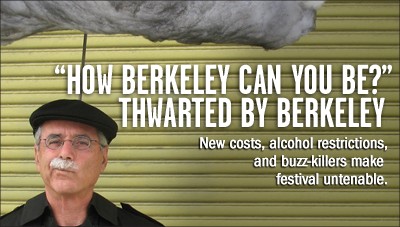
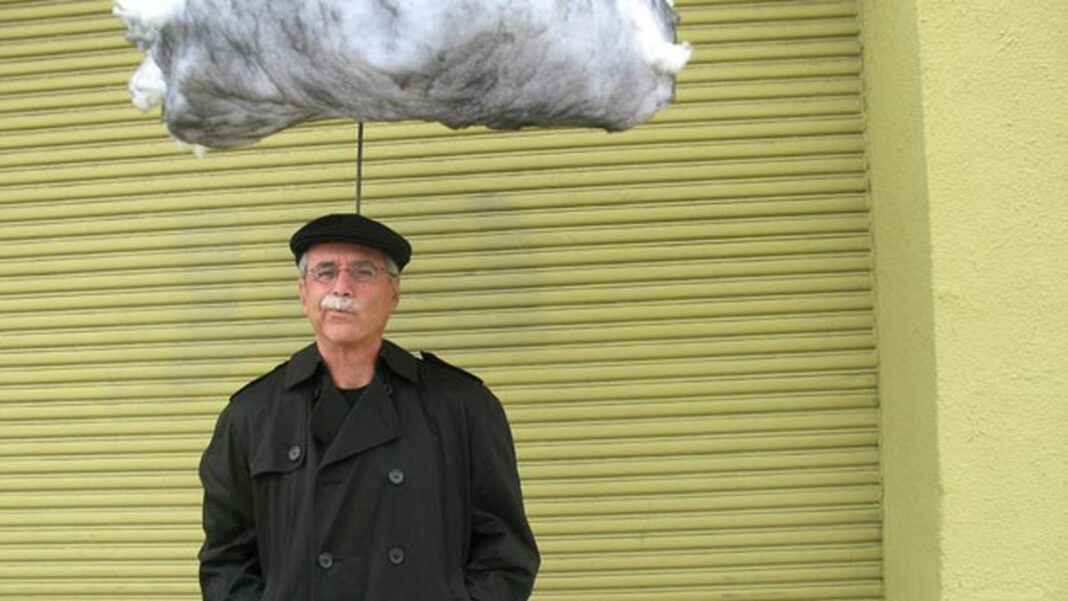
Skies were fair in Berkeley last Wednesday, but John Solomon had a raincloud over his head. He had attached a long pipe to his shoulders via a welded steel armature with a pillow of chicken wire and cotton padding on top. He had spray-painted the padding to have a dingy black cast, like the cloud that constantly hung over Joe Btfsplk in Li'l Abner. Beneath it, wearing glasses and a long trench coat, Solomon looked forlorn and crestfallen — with good reason. A few weeks ago, he had to cancel the "How Berkeley Can You Be?" Festival, an irreverent celebration that he devised back in 1996. After more than a decade of parading up University Avenue with a large retinue of lawn-chair brigadiers, art-car drivers, faux NIMBYs, and other celebrants, Solomon didn't have the ducats to put it on anymore. And Berkeley — the festival's namesake, chief target, and main honoree — had thwarted, rather than abet, his efforts.

Solomon has always had a pugnacious sense of humor. Formerly the owner of Ay Caramba taqueria (which went belly up in the mid-1990s) and Caffé Venezia (which he sold to his employees in 2005), the Brooklyn-born entrepreneur has run businesses in Berkeley since 1978. He's always had a penchant for silly costumes and quirky behavior. He's an odd breed of city booster. When Solomon got the idea to launch his own parade thirteen years ago, he wanted it to celebrate Berkeley and promote the retail corridor on University Avenue without seeming square or by-the-book. This was, after all, a place affectionately dubbed "Berzerkeley" and "the People's Republic of Berkeley."

Solomon thought a festival in Berkeley should resemble the Doo Dah Parade in Pasadena. It would honor — but also satirize — all the best-known Berkeley clichés: health-food fascism, NIMBYs, animal-rights activists, grizzled naked people, pot smoking, and political proselytizing. Moreover, it would represent a vast cross-section of Berkeley, allowing members of the Piedmont Lawn Chair Brigade to co-exist peacefully with sincere Communist pamphleteers, and KPFA to march side-by-side with the Chamber of Commerce. The ironic and the irony-deficient would hold hands and sing a happy Kumbayah. He pitched the idea to then-Mayor Shirley Dean, who loved it. She drummed up seed money for the inaugural parade and accompanying celebration. The name came easily.

City funding comprised one-third to one-half of the parade's $25,000 to $30,000 budget, Solomon said. The city contributed $8,000, while Berkeley's Civic Arts Commission dispensed an additional $2,000. The rest of the money came from private donors — including real estate developer Patrick Kennedy — booth fees, and beer sales in the park. In total, it was just enough for Solomon to break even, pay co-producer Karen Hester, and occasionally plow money back into the University Avenue Association. Three years ago, Hester and Solomon ceded production duties to Epic Arts, a South Berkeley arts organization that shut down right around the time of last year's festival. At that point, Solomon had a huge problem on his hands. Berkeley's police and fire departments, which had traditionally been somewhat permissive, now wanted $8,000 for event security. Such demands essentially canceled out the annual $10,000 grant to which Solomon had grown accustomed. Not to mention they required Solomon to cordon off his alcohol vendors in a fenced beer garden at Civic Center Park, which caused beer sales to plummet from $6,000 to $1,500.

"It's been a fiasco," Solomon said. "The police and the fire department have never been to Burning Man. They have no idea what happens at a good event."

Attempts to cultivate other revenue streams have been unsuccessful, Solomon said. Understandably, it's been tough attracting corporate sponsorship to an event as anti-everything as this one. At one point, he thought he could bait local car dealerships, since the parade has included a huge art car segment since 1999. No dice. Granted, he understands their hesitation. "We're sort of making fun of cars."

City spokesperson Mary Kay Clunies-Ross says it's more about the economy than anything else. "The hit that nonprofits are taking is forcing them to make some difficult decisions," she said, adding that as events like "How Berkeley" get bigger, the city has no choice but to charge more money and make more restrictions. "When you think about traffic control, you really have to do it right in order to have a positive impact," she explained. "With a parade you've got extra large impacts and people going everywhere and you're trying to keep people from getting hit by cars. ... You have to bump your game up."

Former Epic Arts program director Justin Katz, who helmed "How Berkeley" for three years, had a slightly different take. He attributed the parade's collapse to three factors: the hard numbers, the challenge of sponsorship, and the iron heels of city officials. "The city has been so much less tolerant about an event that has its own character," Katz said. "We got cracked down on for people throwing candy to kids. 'What if a kid goes running out into the street to pick up some candy and gets hit by a float?No candy. You guys have to put it in your contract: No candy will be thrown.' I was like, 'Well, what about carrots?'" He added that all the greatest hallmarks of old "How Berkeley" fests — fire, Burning Man installations, people serving drinks off floats — are now prohibited. There's much less incentive for the producers to donate their time because, frankly, it isn't as much fun.

A few weeks ago, Solomon sent a letter to several Bay Area newspapers seeking advice on how to sustain his event. After it ran in the Berkeley Daily Planet, a few people e-mailed Solomon to commiserate about the event's demise. He got a sympathetic note from Berkeley City Councilwoman Linda Maio. He also got one suggestion: To permit nudity in the parade again, but charge the nude people a fee. Solomon had allowed an older group called the Explicit Players to march in several earlier parades. In 2006 he bowed to pressure not to invite them. No one else knew what to do, and Solomon remains flummoxed by the situation. "I don't want to insinuate that we are the only festival that's being charged these things — all festivals are being charged," Solomon said. "But for a free event, it's hard. If we could get a buck from each person we'd be happy, and we'd be able to pay a producer. I've often thought if I could figure out some way for people to donate then they could mail a check, but it's a little untenable."

Katz has faith that "How Berkeley" will return in 2010 under the auspices of former co-producer Hester. Meanwhile, Solomon nurses fond memories of past parades. One of his favorites was a PETA spinoff whose acronym stood for "People Eatin' Them Animals." Its members butchered a hog's head with chainsaws. They shot Spam into the crowd with giant bazookas, and waged war against rival group the Vegit-Aryans. Another of his highlights was the somewhat distasteful Seoul Café, whose baristas served cocktail weenies and handed out pamphlets that championed a new way to dispose of unwanted dogs: Turn them into weenies. The weenie roasters had a barbecue fired up beneath a goat carcass that had been stripped of all its skin — so all you could see was muscle and bone. It did, indeed, look like a passable dog corpse. "The SPCA came," Solomon remembered. "Someone actually reported them."

You don't get much more Berkeley than that.

Comments (5) RSS

Showing 1-5 of 5

Add a comment

Thanks John Solomon for a great event and especially for all the work and smarts it took to get it past the phalanx of gutless, feral, Uriah Heep-like city bureaucrats.

Berkeley, the City that Can’t.
Berkeley, the intellectual birthplace of the Nanny-State.
Berkeley, UC Dept. of City and Regional Planning, the cradle of repressive, anti-human, anti-organic urban growth models.
Berkeley, home of Boalt Hall which along with Georgetown & Columbia Law School created the templates for the insane litigation and phalanxes of greed crazed attorneys that feed off small business and individuals much like intestinal parasites that eat the guts out of formerly healthy, productive hosts.

Small Business in their increasingly futile attempts to create, build and to generate income and wealth are the target, the meat for these grotesque creatures. Guys like John Solomon, small business owners and the real pillars of any actual community, are ever more an endangered species in places like Berkeley.

John contacted me in 1996 when he was putting the first parade together. He encouraged “complete unbridled creativity”.
My friend Joe Fenton and I had wanted to do a parody of the humorless People for the Ethical Treatment of Animals for some time. For the next three years Joe and I and dozens of friends dressed up as “Meat Providers”, characters like Leather Face from Texas Chainsaw Massacres, Carrie White from the Steven King story, Farmer Vincent from Motel Hell, etc., etc. From the deck of a flatbed carrying 3 Doggie Diner dog heads, we tossed cremated meat chunks out into the family crowds as well as thousands of GPC cigarettes - “hey kids! 1st ones free!!” We were protested by a mob of crossed carrot armband wearing, jack-booted “Veget-Aryans.” carrying signs and shouting slogans such as: “Don’t laugh at the meat people”, “We can smell you from here”, “I pity your tragic colon!” and the like. It was hella fun and for every humorless lefty who was offended there were hundred’s of smiling, laughing faces who got the joke.

In later years, we served “dog meat” on our Seoul Kitchen float. Some who laughed the loudest were Koreans who recalled the popularity of black chow dog meat back in the homeland. At the end of the parade we marched over to the tents of Shirley Dean and mayoral opponent Don Jelinek. The Reverend David Apocalypse shoved a skinned goats head on the end of a sword into each of the candidates faces respectively as the dozen or so of us chanted “kiss it and we’ll vote for you!”. Shirley pursed her lips and violently shook her head like a child refusing lima beans as the glistening skull hovered inches from her face. Don, the consummate politician, digging for votes ANYWHERE, did indeed kiss the head, as no doubt, he would have “smelled the glove” for our votes. We laughed as we walked away, shouting out: “we’re from San Francisco….. not registered to vote in Berkeley!” Shirley won.

As your article states, John and his association of business owners that created the Parade hosted the entire range of Berkeley institutions: businesses, artists, schools, cranks and naked people. From high school marching bands to Wells Fargo coaches to art cars to yogis to charities, all stripes were welcome. Even dirty, offensive, juvenile pranksters like PETA and Seoul Kitchen were welcome, right there in downtown Berkeley, one of the most judgmental, humorless places around.

I don’t know how you pulled it off for so long John, but thanks!

Posted by JLaw on July 29, 2009 at 3:50 PM | Report this comment

The inclusive spirit with which John created and nurtured How Berkeley Can You Be! over the years is to be wholeheartedly applauded! It's exemplary on so many levels and has always made me think fondly of Berkeley and what it represents symbolically in the world. It's a true asset to the city.

I have had the pleasure of marching in the parade as a bunny to protest humanity as part of The Billion Bunny March; and I know many who have put tremendous effort into participating in this event to honor the unique spirit of Berkeley and bring joy to others--even as we laugh at ourselves and human nature in the process. The parade and celebration of community and imagination--in all its most playful forms--is an incredible asset to the entire Bay Area and a much-loved annual event. It brings people together in SUCH a positive, playful and tolerant manner with a full range of human expression, which makes it a cultural and spiritual asset. That for me is reason well enough for it to continue, but it also brings people from all over to frequent restaurants and local businesses, so it has a positive and very practical economic impact in the local business district it takes place in. It works on many levels and has never been out of control or posed a public danger. Surely sensible city officials and every person who has ever enjoyed this unique experience, have a vested interest in helping revive and sustain it as an attraction, cultural asset, and unique community-building tradition. I'd also like to note that if How Berkeley can't survive as a free event without needing to seek major commercial sponsorships as its savior, Berkley has lost it's own battle to do right by the people who live there. And we've all sold and lost something silly and precious in ourselves.

The good news is that it only takes one person like John to make the world more fun and to show how we can work and play nicely with one another, but it takes an entire community--including city officials, police, permit agencies, the fire department, Park & Rec, local business interest groups, and residents--to band together to keep a good thing going. Or are we going to charge street fairs and parades so much that the only ones that can afford to use public spaces anymore have major corporate logos or strong profit motives associated with them? Don't we have room for a nice neighborly "FREE LEMONADE!" stand anymore?

Sometimes it takes something going away to know just how much it is loved and losing something only makes it more appreciated when it is regained. May How Berkeley rise again in all its glory! May each of us do our part. And if and when it does return, may we also celebrate the return of community, art, play and inclusive values. That is when Berkeley will be alive and well again. Thank you, John, for creating a parade I was darned proud to march in and I hope to march in once again. My hat is off to you!

- $teven Ra$pa, Arts Advocate & Special Events Producer, Burning Man

Posted by $teven Ra$pa on July 31, 2009 at 9:42 PM | Report this comment

There might only be room for one under John's raincloud - but clearly our city of Berkeley and greater community is feeling its raindrops.

I was 15 when my dad began the 'How Berkeley' creation. I remember the many dinners we would have in our house, that inevitably would turn to brainstorming sessions . I sat there in a state of true inspiration and awe of both my father's vision and what I knew he was capable of. Watching "How Berkeley' grow from an idea to one of our most clever and unique parades around was invaluable.

It was most important to my father that this would be an event that the city of Berkeley would embrace and call it its own - not only the staff and organizers, but its citizens, subcultures, university, arts, commerce etc. In Dad's mind - this event was created for the people of Berkeley to come together.

The How Berkeley Can You Be?! Parade was a mirror that once a year served to reflect the artistically unique side of our city. I clearly remember the early days - The Meat Providers and Veget-Aryans, of the spellbinding Art Cars making their way to our event, the beautiful Tibetan contingents, SF Cheer, Bizaar of India floats, Pink Man, the mad max flame throwers, of course the naked people and so many more. Being a performer and self proclaimed theater nerd myself, the parade has always been even more fun then entering a candy store. The first year, my 16yr old friends and I covered our nearly naked bodies with what we thought was mud and ran around grunting and acting like apes. I suppose this was a nod to our primordial ancestors or something. It wasn't until 4 hours later as we were attempting to hose the mud off that we realized we used potter's clay rather then mud, thus turning ourselves into hardened pottery. The next year we dressed as CAL Biology Students from a fictionalized conservative think tank and handed out pills to ensure the heterosexuality of parade viewer's unborn children. We dressed as members of the "Orange County Country Club" and encouraged people to "Green" their lives by watering their lawns more and using more water to keep their gardens green. This was a parade that breathed its brilliant breath only because of the efforts of all involved parties - not because of advertising and sponsorship. It is the JLaw's and the Steven Raspa's that substantiated 'How Berkeley's' namesake.

However, I am no longer 16 and unfortunately can't seem to find my rose-colored glasses. Last year when I took over producing the parade, I viscerally understood our parade's recent challenges: Sure there is the massive black hole of funds and the city's ludicrous and suppressive parade guidelines. However, in the recent years an equal challenge became rallying Berkeley-ites to participate and take their time to create parade contingents. Our conversations around the dinner table turned from creative brainstorming to figuring out why it has become so difficult to enlist parade contingents. Is it because of the city's restrictive mandates or are we as people moving away from such past-times?

Without the interest and action of participants, the parade is lost. I would like to see 'How Berkeley' rise once again, but we can't do it without the people of Berkeley. I am hopeful that we can bring back this event and I challenge us all to remind ourselves of the importance in community street celebration. Whether the city of Berkeley has morphed into a repressive entity or not - we as its citizens have it in our power to take matters into our own hands and stick up for what we deem important. I would like to see 'How Berkeley Can You Be?! Parade and festival come back with the true participation of its namesake - it would be unstoppable. Now that would be Berkeley.

Posted by Danya Solomon on August 2, 2009 at 3:22 PM | Report this comment

Let's get some real Berkeley-type things to show off at an event . . . .

1. Cyclists who make everyone jump out of their way-- on a sidewalk.

2. An idiotic City Council that wants to force its way into elders' homes to check if they have enough insulation-- only if that darned Constitution and its silly Fourth Amendment wouldn't get in the way.

3. A dirty, nasty downtown with plenty of boarded-up shops.

4. A list of special assessments on your property tax bill as long as your arm-- without any evidence at all that Berkeley is better off than other cities for these takings.

5. Rotten infrastructure. Thanks for fixing up Gilman. Why couldn't you have done that 30 years ago?

6. Aggressive panhandlers.

7. Rude prima donna civil servants at Shitty Hall.

8. A City Council with plenty of time to pretend they conduct International Affairs-- only they can't fix much at home.

Did I leave anything out?

Posted by Manuel DePiedra on August 3, 2009 at 2:40 PM | Report this comment

10 years ago I moved in with my brother, in Berkeley. I didn't have to many friends then, I just moved to the East Bay and all. These girls came to me and envited me to the parade. They said were not going to watch the parade were going to be in the parade. We put on face paint and marched through the street.

I felt like for the first time, I found a place where I belong.

- Brandon Gobi

Posted by gobionekonobi@yahoo.com on September 2, 2009 at 3:41 PM | Report this comment

Latest in Culture Spy

Author Archives

Calendar

Submit an event

Most Popular Stories

© 2009 East Bay Express    All Rights Reserved