
Too often when we design gardens we view the space as a static canvas. Those of us who can hardly draw a stick figure find plants the perfect foils for our ineptitude; clashing colors, repeating patterns, and that gorgeous spray where we dropped the seed packet manage to make us look like Rousseau.
Seldom does it occur that we’re also creating homes for wildlife; most often our efforts in that direction are confined to discouraging Bambi. We don’t consider how to make our gardens more inviting to anybody but two-leggeds.
Memoirist William Poy Lee had the winged in mind — birds and bees — when he redid his garden near North Berkeley BART. Lee learned a lot along the way, although another habitat creator, UC Berkeley entomology prof Gordon Frankie, challenges his conclusions on nearly every point. That’s gardening for you: nobody agrees, and nobody cares so long as it works.
“My years’-long idea was a habitat garden, and I picked plants to attract butterflies and bees,” Lee said. He was lucky enough to have a beehive, but the bees — Chinese bees acquired from someone who suddenly became allergic to them — disappeared in the general malaise that struck so many bees last fall. “I really loved sitting in the garden in the morning with a cuppa joe in my hand as they stirred and started to swirl out for a day’s work of pollen gathering.”
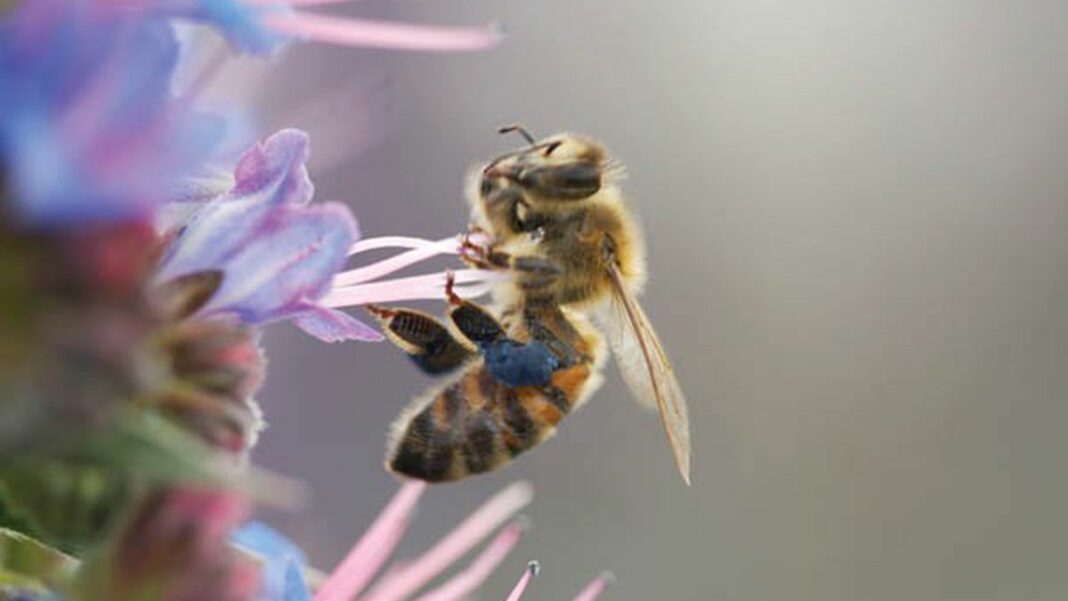
We take pollination for granted. Our lemon trees bear lemons nearly all year ’round, peaches defeat our mild freezes, squash set too much fruit, and wildflowers reseed, surrounding us with bloom four seasons of the year. None of this would happen without the work of winds, birds, and insects such as solitary native bees, which as befits their name, don’t live in hives. Bees are the champs: they pollinate a third of fruits, vegetables, and nuts.
If you want to attract native pollinators, plant native plants. This is what Lee did. The yard came with fruit trees: lemons, green and red apples, and plums, and someone had planted wild roses. “I put in a bunch of habitat plants I was told would attract bees, butterflies, and hummingbirds,” he said. “Some of the habitat plants were drought-resistant, but they never did that well. Maybe they got too much water, I don’t know. Others seemed to grow and keep growing, like the native milkweed.”
Early on, Lee installed a large clay bowl with a red globe in its center. Water glides down the surface of the globe. “Hummingbirds wash themselves in it,” he said. “Butterflies play in it. The pressure is very low, making it easy for critters to play.” One day an eagle landed on top of the globe and washed itself and drank. “I was in my bedroom looking out,” he said. “I didn’t have the guts to get any closer.”
Since the fountain was so successful, Lee installed two shallow flat bowls. “I just fill them with a hose to freshen up the water,” he said. “I put a potted plant in the middle, and flowers around the base. Bees like it because it’s flat.” He abandoned many of the languishing natives, noting more bee traffic with flowering exotics. The bees hover close to the ground, admiring his taste in groundcovers. “I don’t try to be an expert,” he said. “I just try to do what works and not what they tell me works.”
Lee has a proposal: “My biggest lesson is that this project should be neighborly. If you have a few plants, they will attract butterflies and bees. But if I could convince my neighbors, all of whom have cut lawns, to do this with me, we could really create a habitat. We could focus on one plant and put it in several yards. If a butterfly saw a number of the same plants, it’d be like finding an oasis. People facing south should grow this plant, and if you’re on the west side, you should grow this plant. That’s how I would organize it.”
Gordon Frankie doesn’t think much of Lee’s plan, though it pains him to say so. Frankie is the lead researcher on UC Berkeley’s Urban Bee Project, headquartered in a garden on Oxford Street, only a mile or so from Lee’s yard. The group’s informative web site, nature.berkeley.edu/urbanbeegardens, dates the genesis of the project from 1987, and over that time, Frankie and team members have identified 82 species of native bees in Berkeley. Bumblebees are among them, but you may not have heard others such as sweat bees, carpenter bees, and Osmia, a small metallic-green bee varying between emerald, neon, and jade.
Over the past ten years, the project expanded to Ukiah, Sacramento, Santa Cruz, San Luis Obispo, Santa Barbara, and a spot near Pasadena. “We sample and monitor bees associated with 31 target plants,” Frankie said. Each plant grows in the seven study plots, and Frankie and his group found that groups of bees associated with those plants are the same in every city. “If you plant poppies in Ukiah and down in Southern California, you’ll attract bumblebees, sweat bees, and honeybees in both places,” he said. “If you make frequency counts, the percentages of bees from the different groups are similar.”
What are these plants that draw bees like nectar? “People always ask this question,” he said. “First of all, bees are seasonal, so you plant to attract different bees in all seasons. Rather than exotic flowering plants, you push habitat gardening, particularly pollen and nectar plants. Ceanothus are really good for pollen, and so are poppies.” He doesn’t mention it, but the web site includes a garden planner with photos and suggestions of plants that best fit your site and lists of spring and summer plant picks.
“It’s very easy,” he said. “Just think about what the bees need. They need pollen, nectar, and sex.” So they planted sunflowers, groundcover, and cosmos in bare dirt in the project’s early days. “The bees followed us into the field,” he recalled. “We counted forty species of bees in that garden alone. First we put in ornamentals that people use locally, but now we’ve switched to mostly natives. We’re always experimenting with new things. If something doesn’t work, we toss it in the compost. Buckwheat works well, native sunflowers, penstemons, bush sunflowers, Erigeron glaucus, especially ‘Wayne Roderick.’ Bumblebees like tomato and squash flowers. One bee is specifically designed to pollinate squash: “They fly around really early in the morning like little rockets.”
When I floated Lee’s neighborhood oasis past Frankie, he was politic: “I think that’s a good idea except for this. The more diverse a garden, the better the bees like it. Bees have particular preferences. If you have a diverse garden, you’ll get bees spending time there. They’ll visit plants they won’t normally visit. Fleabane is visited if you have a diverse garden. Cistus hardly ever gets a visit unless you put it with diverse plants. It’s called the mall effect. Every stall has a different group of flowers.”
Frankie has a couple other pointers: only female bees sting, but that may not do you much good. Instead of worrying about being stung, consider your ground. “People mulch too much,” says Frankie. He explains that most of our native bees — and we have 1600 species in California — are solitary ground nesters. “They can’t negotiate three inches of wood chips,” says Frankie. “They’ll have to go somewhere else. Take up that awful black plastic and leave bare soil for the bees. And of course don’t use pesticides. You have to be thinking about habitat.”
And home. Gardens aren’t only eye candy; they’re somebody’s kitchen and bedroom. Act accordingly, and your flowers and fruit will prosper.