
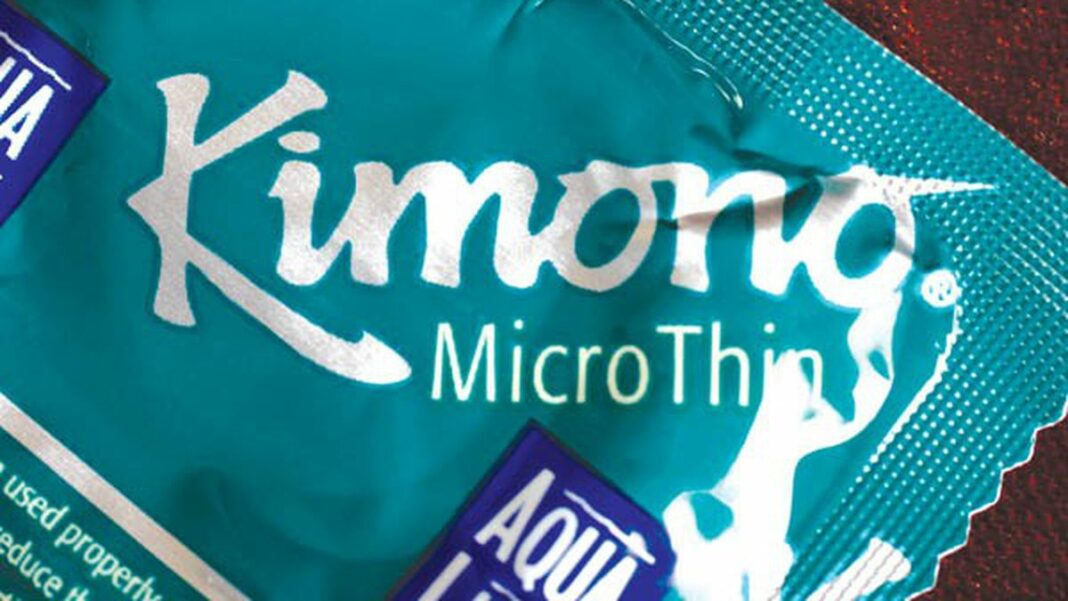
A 2005 commercial for Kimono condoms speaks volumes about the company’s self-image. In the ad, a woman sits at a poker table with four men. The setup is swank: Chandelier light reflects from the walls, glass tumblers litter the table, smooth jazz plays in the background. When the woman runs out of dough, she wagers a single Kimono condom, and another player sees her bet with all his remaining chips. It’s a fitting analogy for a company that presents itself both as an underdog, and a producer of high-end condoms. Consider the tagline: “Kimono. When the Stakes Are High.”
In a market dominated by Trojan and Durex, where images of male virility are the norm, Berkeley-based Kimono has created a brand identity that’s an anathema to the competition. Launched 21 years ago by Mayer Laboratories, a company founded by longtime birth-control advocate David Mayer, Kimono is the condom industry’s answer to couture. It’s a sleek, elegant Japanese import with a pretty patina — packages are designed with cranes, koi, and other Japanese imagery — and a price about 15 to 20 percent higher than most other brands.

Credits: Jamie Soja
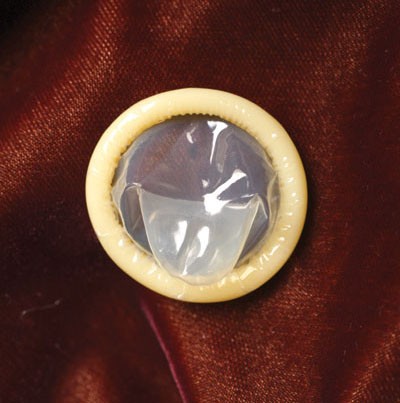




“Kimono as a name is a Japanese silk robe,” said Mayer at his office in downtown Berkeley. “But that was all part of our marketing when we started. … To try to communicate more that condoms can be silky and thin and sheer and elegant — and something that women might approach as a kimono versus as a Trojan.”
Mayer lowered his voice disparagingly on the word “Trojan,” the US industry’s dominant brand, which he considers to be the Exxon-Mobil of condoms. He’s repelled by the military imagery bound up in the Trojan name and the phallic metaphors in its advertising language. (After all, Trojan’s perennially popular Trojan Magnum XL just happens to share its name with the handgun used in Dirty Harry.) “I just think they’re marketed more toward men,” Mayer said of Trojan and other industry big boys like Durex and LifeStyles. “You know, race cars, high-performance sex. Women aren’t interested in that, but it tends to hit a different demo.”
Indeed, the American condom industry is anything but demure. In fact, it’s often quite cutthroat. Companies routinely appropriate one another’s terminology and brand identities. They send litigious letters to one another and race to beat one another to the trademark office.
Mayer and Kimono have gone against the grain in marketing their products, basing their brand identity on the apparently radical notion that there are other ways to market condoms besides affirming the penis size of the buyer. Instead, Kimono markets its condoms as being so thin and silky that they’re practically not there. In short, the company appeals not only to women, but also to a different side of male vanity — the squeamish impulses that make many guys resistant to using a condom in the first place.
Kimono may look like a sensitive girly-mon in the condom world, but it’s allowed Mayer to grow his business by cultivating a market that all the big boys now seem interested in infiltrating. Ironically, Mayer did this by claiming to sell the country’s thinnest condoms — a concept that seems to be at cross purposes with the very function of condoms, which is to provide reliable protection from pregnancy and sexually transmitted diseases without breaking.
Now, it seems like the whole condom industry is fighting over who makes the least-condom-like condom.
Mayer Laboratories is located in a pristine downtown Berkeley office complex, home to insurance salesmen, lawyers, and a popular local artist who illustrates New Yorker covers. The place is bright and well-ventilated, and a pebble garden in the foyer could have been transplanted from any high-end department store in Union Square. The lab looks like any other office space. There aren’t any Willy Wonka-type condom machines spitting colored disks of latex onto a conveyor belt; nor are there any seedy adult ads on the walls. Rather, it’s antiseptic, with cubicles and a large conference room in the back where, on a recent Tuesday afternoon, Mayer laid out his whole arsenal of products.
Arrayed on the long table were six packages of condoms from Mayer’s line Kimono, along with packages of other Mayer products such as Aqua Lube, Digitex gloves, and the fc female condom. In the condom world, these are all considered to be high-end designer products: more elegant, more expensive, and more feminine than the average Trojan or Durex contraceptive. For Mayer, they hold sentimental value, symbolizing his effort to carve out a distinctive brand identity that could sustain a small Berkeley condom-maker. They also illustrate Mayer’s seemingly counterintuitive quest to popularize the world’s thinnest condom.
Few people in the world can boast a condom history as long as that of David Mayer. In 1978, he launched National Condom Week as a freshman at UC Berkeley, spent several years working in teen programs in the Contra Costa County Health Department, and traveled to Haiti in 1984 to promote public health and family planning. Mayer describes himself as having a history of “male involvement in family planning,” and says that even if he had never spawned his own condom line, his impact would still be felt in the contraceptive world. The American Social Health Association still plans National Condom Week events every year (although after thirty years, Mayer said it has kind of gone the way of Valentine’s Day).
When Mayer launched Kimono in 1987, the AIDS epidemic had generated a surge in consumer demand, and companies just needed to fill the pipeline. By then, most condom companies had product lines with contoured tips, ribs, studs, and splashy colors. But Mayer thought he knew another type of aesthetic that could get people to buy more condoms.
From his company’s inception, Mayer sought out Japanese manufacturers. His reasoning was that Japan had higher quality standards and looser restrictions on condom thickness. Because Japan didn’t legalize oral contraceptives until 1999, its market for other forms of birth control was quite advanced. Mayer said Kimono’s reliance on more-advanced Japanese condom-making technology helped his company push up against the US Food and Drug Administration’s .03 millimeter (or 30 micron) minimum-thickness limit. Mayer conceptualized his brand accordingly.
Even before Kimono began cultivating the super-thin market, competitors paid close attention to its products. In 1988 Mayer Laboratories introduced the Kimono Maxx, a special plus-sized condom with extra head room (2.34 inches in diameter) and an additional .2 inches of length. Roughly seven months later, Trojan unleashed the Magnum XL, an 8.5-inch “King of the Big Boys” that has become the gold standard for large-sized condoms (given that it’s name-checked in rap songs and worthy of its own Wikipedia definition).
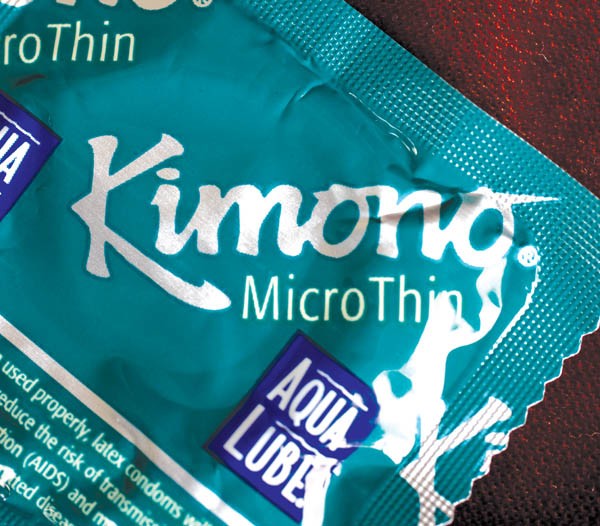
Not to be outdone, Kimono shifted its focus to thinness and delicacy. In 1992 it came out with the Kimono MicroThin, which the company claims is 20 percent thinner than the original Kimono. For sixteen years, Kimono has claimed that MicroThin is the thinnest condom sold in the United States. According to Mayer, regular Kimonos — at 55 microns of thickness — were already 20 percent thinner than most other brands. The new MicroThins measured 49 microns, Mayer said, “So now we really ahead of our competition offering that really thin, sheer experience for users.”
The product was groundbreaking, according to one local retailer. “I do believe they were the first people to bring in ultra-thin condoms that were strong and comfortable, but offered the maximum sensation that allowed people to feel like they weren’t wearing anything at all,” said Coyote Days, senior buyer at the adult store Good Vibrations, which has carried Kimono for well over ten years. “They’re a premium line; they have different contours and different sizes. A piece of their own marketing was that they were Japanese-made, and that stood for a high quality.”
Before Kimono hit the market, Days said, there wasn’t much incentive for big companies like Trojan (now 88 years old) or Durex (now 93 years old) to enlarge their brands or expand their customer base. But slowly that’s changing. “It’s ‘the way we’ve always done it’ versus ‘the way we’re gonna do it now,'” Days said. “Someone comes in with a new idea, a strong brand, and something you don’t have, you’re gonna feel a little threatened and you’re gonna step up to the challenge.”
And step up they did. Although Mayer says it took his competitors several years to acquire the ability to produce super-thin condoms (which they too accomplished by sourcing from Japan), they began appropriating his company’s language right away — even for condoms whose thinness he claims is questionable.
“Now it’s ‘Sensi-Thin,'” said Mayer, referring to the new thin condom category from Durex, “but before that they had ‘Ultra Sensitive,’ ‘Extra Sensitive.’ Those would be the terms they would use, but it would more or less be the same condom. … And then Trojan came out with a line called ‘Ultra Thin.’ They came out this year with ‘Thintensity.’ And then ‘Magnum Thin.'”
In fact, there’s no shortage of “thin,” “sensitive,” or Japanese-styled condoms on the market. Visit the popular web retailer RipnRoll.com and you’ll find — in addition to the aforementioned Trojan and Durex products — Lifestyles Skyn condoms, Lifestyles Ultra Thin, Paradise Super Sensitive, Intellx spiral-shaped Inspiral, and Okamoto’s Beyond Seven with aloe (another Japanese import).
Mayer recently began appending a bar graph to Kimono packages claiming that even its regular Kimono Thin condoms are as thin as Durex Extra Sensitive and thinner than Lifestyles Ultra Thins. And Kimono claims that its MicroThin beats everyone — including the super-stretchy Trojan Ultra Thin condoms — by several microns.
“We’ve been calling ourselves ‘Microthin’ since the beginning, and now one of our other competitors, Trojan, they came out and started using the ‘Microthin’ for their condoms,” said Mayer. “Now we’re having to look at, do we need to take them to task?” Mayer says Trojan appropriated the “Microthin” label last year, right around the time its “Thintensity” condom line hit drugstore shelves. The company also took Kimono’s tack of manufacturing the Microthin condoms in Japan. “They went to one of our competitors,” he said, bitterly. Mayer concedes, however, that Kimono never got around to trademarking the term Microthin until April of 2008, sixteen years after it first started using the phrase.
Mayer says the word “microthin” appeared on Trojan Ultra Thin packages in 2007, which advertised the new Ultra Thin condoms as being “made with ‘microthin technology.'” “In some ways it was a concession,” said Mayer, alluding to the use of his brand name to describe a competitor’s product. Although these words no longer show up on Trojan’s web site, their occurrence in consumer product forums suggests that Trojan did indeed use them. But then, “micro” is a ubiquitous adjective, recycled again on a package of Trojan Supra “Microsheer” Polyurethane Ultra Thin Lubricated Premium condoms.
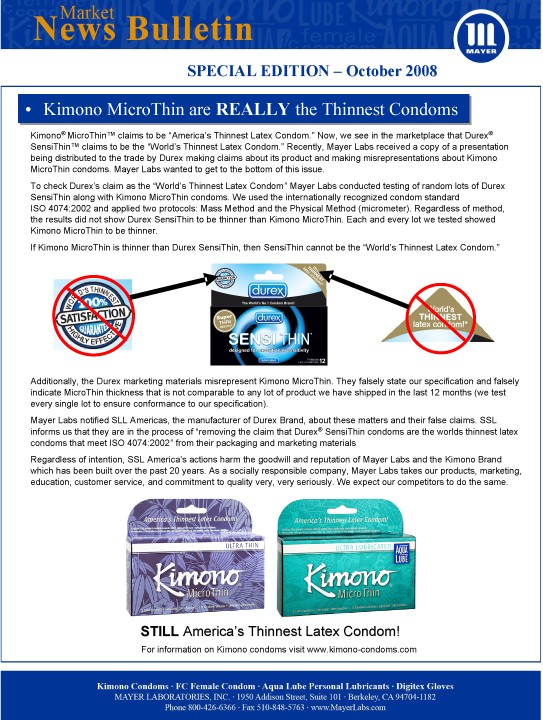
Meanwhile, a couple months ago, one of Mayer’s customers informed him of some new marketing material from Durex, which advertised its new “Sensi-Thin” condom as “the thinnest in the world.” When the product hit stores a month later, Mayer got a pack and read the marketing claim, which he said was specious. Mayer said Durex alleged that the Kimono MicroThin was 59 microns thick, while falsely advertising itself as being 45 microns thick. Not true, said Mayer, who insisted that MicroThin had always stuck with its official 49 micron measurement. He was incensed, to say the least.
“We went and tested several boxes of their product. They had this interesting language that claimed they were the thinnest condom in the world … based on what they called the mass method of measurement.” According to Mayer, this measurement standard is seldom used by manufacturers. “What it is, you take your weight of your condom, divide it by your length of your condom, divide it by some other things, and it comes out with a calculated thickness.”
So Mayer measured the Kimonos against the “Sensi-Thins,” using both the Durex method and his own, which takes the thickness of the condom walls at three points using a micrometer caliper (an instrument accurate enough to measure the width of a single hair). In both cases, he claims, Durex’s claims were wrong. Mayer wrote a letter to Bill Siegel, the president of Durex, asking him to cease and desist. Mayer said Siegel replied with a promise to rescind the “world’s thinnest condom” slogan, although he defended Durex’s data. (In fact, Sensi-Thins are still advertised as “the thinnest latex condom in the world” on several web sites.)
Durex representatives did not respond to repeated requests for comment. Asked to comment for this story, Siegel of Durex replied with this canned statement: “As the world’s number one condom brand, Durex® leads the way in research, innovation, and technology which allows us to offer a wide range of high quality condom options for consumers all over the world. We do not feel it’s appropriate to discuss competitors in the media and are therefore not in a position to respond further to your inquiries.”
In any case, shortly after his exchange with Siegel, Mayer sent a press release advertising this tit-for-tat as a “David vs. Goliath story.” An attached picture showed the Durex Sensi-Thins package with the slogan “World’s THINNEST latex condom!” circled and crossed out.
For Mayer it was a small victory.
Condom advertising is more visible today than ever before, and it’s not uncommon to turn on a Top 40 radio station these days and hear one of the new ads for Durex, Trojan, or Lifestyles. Among the far more adventurous web commercials are a Trojan Olympic sport called “pelvic power lifting” and the alleged “president” of Durex slamming his wang with a car door.
But despite the macho swagger of ads such as these, the industry’s commercial imagery has softened and even grown a little more sophisticated over three decades, which might be related to the gradual feminization of condoms. Clearly, there’s an overwhelming interest in thin condoms. Days of Good Vibrations says it’s no accident. “Both women and men buy them in massive amounts. We sell tens of thousands of Kimonos a year, and of the super-thin condoms in general.”
Trojan spokesperson Nyla Saleh said the competition to sell America’s thinnest condom is driven by consumer demand. “People want something that’s gonna have more of a natural feel, and Ultra Thin condoms are able to provide a lot of consumers with that,” she said in a phone interview. “We also have very extensive focus groups that we have for each product. We take into huge account consumer reactions and personal testimonials to all of our products.”
But is “thin” really what consumers are looking for, or companies just rebranding their existing products? A random survey of current and former condom buyers suggested that men and women have a wide range of reasons for buying a particular brand of condom.
Some consumers unequivocally champion thinness. In an online discussion entitled “What’s the thinnest, least ‘intrusive’ condom on the market?” at the web site MetaFilter, one anonymous commenter described the thinking of many condom buyers. “I’m pretty tired of my penis being encased in what feels like an inch of rubber. I’m not concerned about STDs because I’m in a monogamous relationship and we’ve both recently had STD panels, but I’d really prefer not to have little anonymouses around. Any suggestions on really super-thin or super, um, sensation-transferring condoms?”
Kimono condoms are generally conceded to be desirable by consumers interested in thin condoms. The web retailer SpicyGear.com named Kimono MicroThins the “thinnest latex condoms made,” and competitor CondomUSA is similarly enthusiastic: “Japanese condoms are our favorite because they are thinner and feel better. We vote Kimono MicroThin as our Editor Choice because we believe it is one of the best and thinnest condoms in the market. It surprises us by its thinness and quality. Because it is so thin, it reduces the ‘rubber’ feeling and feels like nothing at all.”
“Big J,” who reviewed Kimono MicroThins on the Walgreens web site, wrote: “This is the best condom ever. It’s like wearing nothing at all.”
Other people agreed with Mayer, albeit with reservations: “The problem is if you’re doing anal sex, they’re less sturdy,” said “Chaz.” “But you can definitely feel more.”
But many seemed unimpressed with claims about which brand is thinner.
“Sure, thicker condoms reduce the physical sensation of sex,” said Steve, who described himself as a lifelong Trojan buyer. “But is a little less sensation really a bad thing? When I buy a condom, I’m thinking about babies and disease. If the condom also happens to slow things down a bit, hey, that’s fine by me.”
Joe, a long-time Trojan user, said thinness doesn’t necessarily seal the deal for everyone. He suspects that if some company made a thick condom and promised it would make you last longer, a lot of consumers would probably go for it. “There are people who would make that decision, yes, definitely,” he said. “I mean think about it. Guys buy condoms for two reasons. One, random hookup; they’re just hittin’ it, quittin’ it. Or, two, there’s people who buy condoms because they’re with a partner and it helps them last longer.” Joe goes for Trojan because of brand allegiance — it’s been burned into his brain, “like Kleenex.”
Tiffany said it might behoove these companies to advertise a super-thick condom, specifically targeting people who never get laid, and don’t want to bust the moment it finally happens. She says she knows several people who would fit this consumer demographic: “They got (condoms) in their shoe, their sock, their back pocket. Probably wearing one at all times.”
Kevin said, “The idea of a thin condom, it makes me nervous. It’s a little tiny piece of rubber. You’re gonna make it thinner? That freaks me out.”
Some of Kimono’s competitors make the same argument. “The thinner the condoms are, logically the more likely they are to break,” said Brian Osterberg, president of condom-maker Intellx, whose said his company’s shaped contraceptives represent “a new milestone” in condom-making. “There’s two trains of thought here: Super-thin so that you feel through the latex, or a normal condom with oversized shapes that creates the ridges and folds, and that’s what creates the friction. We turned upside down the idea that a superthin condom is the best.”
But Mayer of Kimono disagrees — he’s never had a product recall, after all. Moreover, he sees no irony in his efforts to market the least-condomy condom. “The number one reason people don’t use condoms is it interrupts the moment,” he said. “Number two is that it’s like wearing a raincoat. If we can make something that’s silky and next to nothing at all, then more people will use it. Hopefully we can increase utilization because of it.”
The market has gone through many significant changes since Kimono started making condoms in 1988. Discussion of sexuality and birth control has become more socially acceptable, information about AIDS and other STDs has increasingly come into the public eye, and more and more companies are marketing directly to female consumers. “Now women are buying condoms with pride,” Days explained, “because it’s about securing your own sexuality and feeling like a savvy buyer of sex products.”
As a result, the advertising patois has changed. A popular new Trojan commercial features a Midwestern sports bar packed with pigs and beautiful woman. One of the pigs turns into a man after buying a Trojan condom from a bathroom dispenser. The slogan, which comes at the very end, seems apropos: “Evolve.” Days of Good Vibrations found this ad particularly intriguing. “I thought it was really interesting that they put a spin on it that was almost female-positive,” she said. “It was almost one of those ‘real men drink beer’ [slogans], but it was ‘real men wear condoms.’ I thought it was really interesting to put it like ‘the evolved man uses condoms’ — and definitely ‘the evolved woman.'”
To Mayer, all this goes to show that the big guys are finally latching on to something he realized twenty years ago. Kimono perceived itself as being a more feminine brand than the others, which is the clear logic behind the gender analogy in Kimono’s “Stakes Are High” commercial. Twenty years before Trojan’s “Evolve” campaign, Mayer foresaw the importance of appealing to female consumers and going thin. “We kept showing the data that that’s the growth, people want good quality, reliable, thin condoms,” he said. “We keep innovating. We keep coming out with thinner, better condoms, and we take the high ground.”
But as the idea of importing condoms from Asian manufacturers caught on in recent years, Kimono’s strategy of making its products in Japan is no longer a major selling point, Days observes. To top it all off, she added, Lifestyles recently came up with an innovation of its own: a latex-free super-thin condom designed for people with latex allergies. “It’s fantastic,” she said.
In an industry in which a small number of companies battle for supremacy and most advertising is directed at retailers rather than consumers, it’s a challenge for a brand the size of Kimono to stay afloat. The recent buyout of Long’s Drugs by CVS, which is based in Rhode Island, could hurt Mayer Laboratories, since it’s likely the newly consolidated retailer will favor national brands over regional ones.
But Kimono keeps soldiering on with innovations of its own. The company sells a girly change purse designed to hold a stash of condoms that it calls the “Kimono Kouture Bag.” And last year the company began decorating its condom boxes with animals culled from Japanese myth: The Phoenix that adorns Kimono Thin packages is said to symbolize “the union of the Yin and the Yang.” The ram on Kimono Maxx is “powerful, yet graceful.” Kimono’s textured condom, the tiger, is “daring, vigorous and passionate.” There’s a painterly quality to these images, suggesting that perhaps Mayer Laboratories has a backroom staff that hand-draws each package with bamboo pens and Sakuyo paintbrushes. Granted, Mayer wasn’t the first condom-maker to use animal imagery. The Intellx Dolphin, a condom with a cute mammalian snout, came out in a few months ago and is now on the shelves of CVS drugstores nationwide. “It’s one of their hot new items,” said Osterberg, who said his company has several other new shapes forthcoming — including a bell, a baseball bat, and a condom that looks like a beer glass.
Video Extra: Express Labs Tests Condom Breakage. Which condom will come out on top in our controlled bathtub testing? Watch our video and see.