
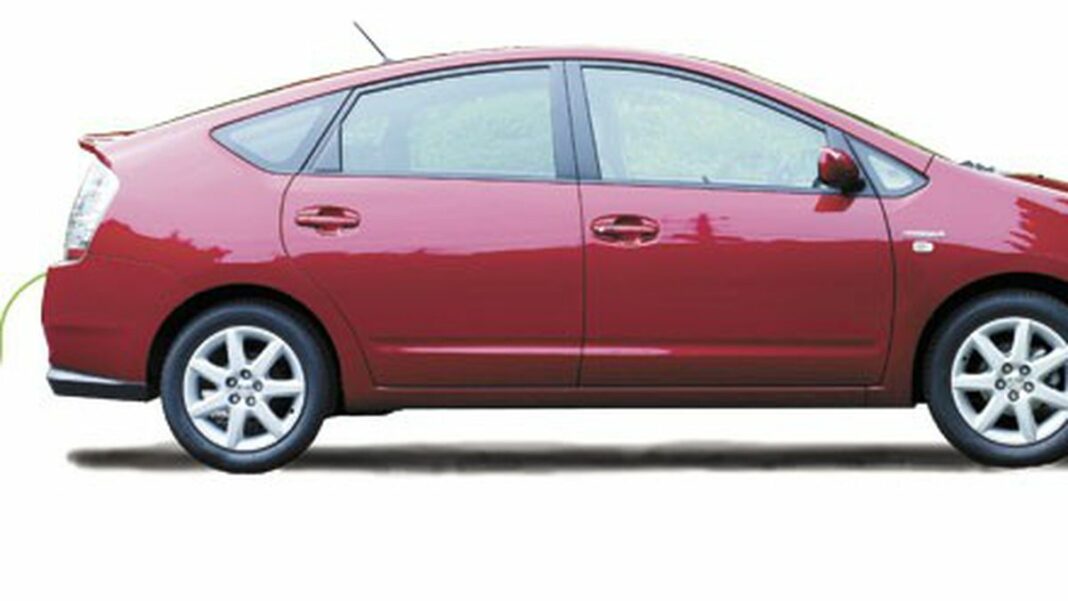
Many environmentalists believe that plug-in hybrid cars could be an
effective tool in the fight against global warming. Plug-ins have the
potential to lower greenhouse gas emissions because they run partly on
electricity and thus get much better gas mileage than traditional
hybrid vehicles. But some critics note that plug-ins aren’t all that
eco-conscious. They use electricity, after all, and many US power
plants generate a lot of carbon dioxide. Recent studies, including one
from UC Berkeley, resolve this controversy. They suggest that plug-in
hybrids will indeed reduce greenhouse gas emissions — but only if
you live in a state, like California, that doesn’t rely on coal
power.
One of the more recent studies, conducted by UC Berkeley researchers
and published by the Brookings Institution, shows that plug-in hybrids
can decrease greenhouse gas emissions in California by more than 60
percent in comparison to conventional cars and by nearly 50 percent
when compared to traditional hybrids. California doesn’t generate much
energy from coal, so when you recharge a plug-in here, it doesn’t
produce a lot of CO2. “Coal is about as bad as you can get” in terms of
greenhouse gas emissions, explained Derek Lemoine, a UC Berkeley
doctoral student who was one of the study’s authors.
In the Bay Area, plug-in hybrids will be especially effective in
fighting global warming because Pacific Gas & Electric gets very
little energy from coal power. In fact, coal only represented 4 percent
of the total electric power that PG&E sold to its retail customers
in 2007, according to the most recent data available from the utility.
PG&E’s largest supply of energy — 47 percent — came
from natural-gas-powered plants, followed by nuclear power at 23
percent, hydroelectric power at 13 percent, and renewable energy
sources, such as biomass, geothermal, and wind power, at 12 percent. Of
those, only natural-gas-powered plants produce significant amounts of
CO2, although still much less than coal plants do.
Even if California relied entirely on natural gas, then plug-ins
would still make sense. Plug-in cars powered by electricity generated
from natural gas produce 54 percent fewer greenhouse gas emissions than
conventional cars and 40 percent fewer than traditional hybrid cars,
the UC Berkeley study revealed.
By contrast, the study also showed that plug-in hybrids powered by
coal plants end up producing 25 percent more greenhouse gas
emissions than traditional hybrid cars. As result, buying a plug-in
would actually contribute to global warming if you live in an area,
such as the South, that relies heavily on coal power. In fact,
Lemoine’s data was based on greenhouse gas emissions from newer,
cleaner coal plants. So the amount of CO2 that would be generated by
widespread use of plug-in vehicles would be even worse than the study
predicted in areas that depend heavily on older, less-efficient coal
plants. “We were looking at efficient coal-fired plants,” he explained.
“But many existing coal-fired plants are less efficient.”
Another problem for plug-ins, according to the UC Berkeley study, is
that they’re not yet cost-efficient for consumers, and won’t be until
the large batteries they use become cheaper and gasoline prices rise.
However, many consumers may choose to buy plug-ins anyway because
they’re good for the environment — at least in California and
other places not dependent on coal. Plus, if researchers can discover
how to effectively sequester CO2 emissions, then plug-ins may end up
making sense even in coal-powered states.
As the use of renewable energy sources rises, the effectiveness of
plug-ins will rise with them. According to the UC Berkeley study, a
plug-in powered by renewable energy produces 99 percent fewer
greenhouse gases than both a conventional car and a traditional
hybrid.
Wind energy may be the most effective source of renewable power for
plug-ins. The reason is that most plug-in hybrid owners will recharge
their cars’ batteries at night, while they’re sleeping. And it just so
happens that wind energy is the best renewable at night, Lemoine noted,
because that’s when the wind blows hardest. Now, if we could only get
the wind-power companies to start using turbines that don’t kill so
many birds, we’d be in business.
New Rules Will Still Harm Plug-ins
Earlier this year we published a story about how the California Air
Resources Board was considering a set of strict new regulations that
threatened to put many small plug-in start-up companies out of
business, including 3Prong Power of Berkeley (see, “Who’s Killing the
Plug-In Hybrid,” January 14, 2009). But after our story came out, the
board ordered its staff to come up with a compromise measure. However,
the “compromise” could go before the board later this month, and it’s
creating serious financial concerns for small companies like
3Prong.
Originally, the air board’s staff wanted to force start-up companies
to pay for expensive air emissions testing, because even though
plug-ins can produce fewer greenhouse gases, staffers were concerned
that they also could generate more air pollutants, such as unburned
gasoline vapors. Plug-in conversion companies maintained that those
fears were unfounded, claiming they had devised a simple fix that would
make the plug-ins run cleaner than traditional hybrids. They also
didn’t object to the testing per se, but said the expense — the
tests cost between $20,000 and $125,000 — would bankrupt
them.
After studying the issue for a few months, the air board staff now
recommends that small companies don’t pay for the tests until they have
converted at least ten traditional hybrids into plug-ins. But Daniel
Sherwood, co-owner of 3Prong, says that his company won’t be able to
generate enough profit from selling ten conversion kits to pay for the
tests. The conversions sell for about $6,700, including installation.
So the new rules will have the same effect as the old ones —
they’ll put small companies like 3Prong out of business. Sherwood plans
to urge the air board to allow small companies to sell 50 conversion
kits before having to pay for the tests, allowing business owners to
generate enough revenue to cover the costs.
Tom Bates and Pacific Steel
Casting
Two weeks ago, Eco Watch told you about how the Bay Area Air Quality
Management District had conspired with a longtime Berkeley polluter,
Pacific Steel Casting, to withhold vital public documents. At the time,
we weren’t sure of the role played by Berkeley Mayor Tom Bates, who had
requested a copy of Pacific Steel Casting’s “Odor Management Plan,”
which details the company’s proposal to limit noxious emissions. But
Bates also sits on the air district’s board of directors, so it wasn’t
clear whether he knew that his request would result in district
staffers inviting Pacific Steel Casting to sue the district so that
they wouldn’t have to release the odor management documents to the
public.
But then last week, Bates called Eco Watch and said that he hadn’t
received the two phone messages left with his staffers seeking comment
for the story. Bates said he wasn’t attempting to duck questions, and
maintained that he had nothing to do with the air district staff’s
actions. He said that after Pacific Steel Casting produced the odor
management plan last October, he requested a copy, and that district
staff gave him one that was highly redacted.
Bates said he then showed the redacted document to a toxics expert
on the city payroll, who said the air district had no right to blacken
so much of the document. The air district had maintained that the
redacted portions represented Pacific Steel Casting’s trade secrets.
But Bates said he told the air district staff that he wanted the whole
document, calling the redacted version “unacceptable.” Soon after,
Pacific Steel Casting sued to stop its release, he said. But when Eco
Watch asked for a copy of the redacted document, Bates said he “threw
it away.”