
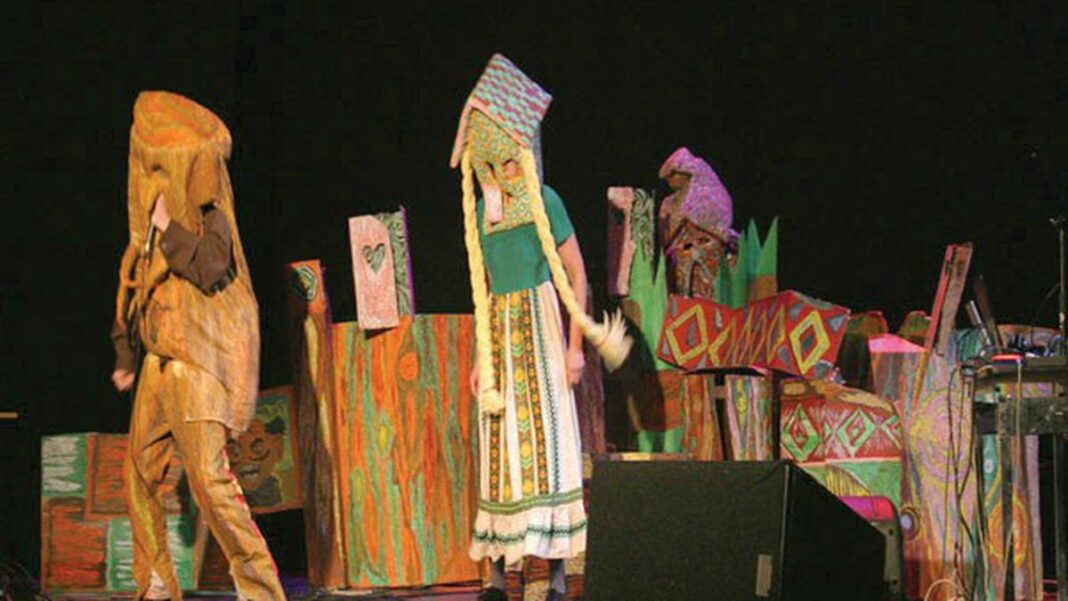
The Bay Area has long been at the forefront of experimental
electronic music, and since 2005, Resipiscent Records has been
documenting the latest developments in this vital tradition. Working
within the thriving local scene and beyond, Resipiscent has released
CDs and cassette tapes by artists like Liz Allbee, Core of the Coalman,
and Anti-Ear. The music is diverse, but always both exploratory and
playful. Label cofounder Hans Grüsel, for example, charts out the
vast timbral possibilities of analog electronics, costumed as a
nightmarish cuckoo clock.
These threads of experimentation and playfulness can be traced at
least as far back as the Bay Area’s early innovators of electronic
music. The San Francisco Tape Music Center was founded in 1962 as an
underground institute for fostering the emerging electronic music. That
same year, Don Buchla established his electronic musical instrument
company in Berkeley, where he soon invented the analog modular
synthesizer. From these strong foundations, musicians have continued
pursuing new sensibilities with self-reliant invention. Resipiscent
Records exists to make them heard.
Many of Resipiscent’s artists still work with analog equipment
derived from Buchla’s invention. Modular synthesis is all over the
Resipiscent catalog, notably in use on two new releases: Loachfillet’s
Electric Pond: Solar Solution, and Serge Modular Users
2009, a compilation of music created with Serge modular
synthesizers. Serge directly follows the innovation of Buchla, and was
itself based for a time in the Bay Area.
Hans Grüsel, the compiler of this anthology, was first
introduced to electronic music while visiting South Transform Systems
in Oakland in the early 1990s. “I remember visiting … after they took
over production of the Serge Modular, and being amazed at the depth and
focus of this instrument’s design,” he recalled. “I was still composing
with pen and paper for ‘classical’ instruments, and had never touched a
piece of electronics in my life. I saw the modular mindset as a palette
that could be placed under the composer’s fingers, opening up, for me,
a world that was not unlike that of the traditional symphony
orchestra.” Preferring this expanded palette and its immediacy of
control, he soon set down pen and paper in favor of patch cable and
knob, founding Hans Grüsel’s Kränkenkabinet in 1999.
Grüsel usually performs dressed as a Black Forest cuckoo clock
in a Hansel and Gretel fairy-tale-nightmare diorama owing as much to
local noise-folkies Caroliner as to the Brothers Grimm. His devices are
electronic rather than mechanical, but Grüsel’s music nonetheless
resembles the clockwork alluded to by his costume. Synthesizer clicks
and buzzes, in looping rhythms like so many layered gears, create a
complex mechanical texture driving much of his work. This music is good
for hanging on a wall, announcing the hours.
A heavy-handed clockwork march rhythm, maddeningly insistent, drives
Grüsel’s contribution to the Serge compilation. Over this
militaristic pulse, he showcases the Serge synthesizer’s range —
a whole spectrum of timbral possibilities sliding over each other.
Like Grüsel, Oakland’s Loachfillet also focuses on the analog
end of electronics, controlling terrifying tape loops, oscillators, and
defective circuits, enshrouded in his kitschy vampire cape. His 2006
album, Cut Throat Rogues, was a cauldron of murky, groaning,
brutal noise showing the influence of old horror and sci-fi sound
effects and soundtracks. His new Resipiscent CD, Electric Pond,
shows him stretching out into an area of tasteful restraint. With the
addition of a modular synthesizer, the album is permeated with patient
stasis. The strongest tracks on the album are subdued atmospheric
pieces, with long tones slowly developing as Loachfillet patiently
observes the synthesizer’s self-modulation at work. He explains, “The
entire album is more or less an homage to the synthesizer albums of the
20th century,” notably works by SF Tape Music Center cofounder Morton
Subotnick.
Electric Pond also contains a few hints of Loachfillet’s
passion for psychedelic world pop music, a passion more properly
manifested in his role as a DJ for the monthly International Freakout A
Go-Go. The album closer is a psychedelic krautrock freak-out: With
delayed guitar soloing and dissonant organ chords over a driving bass,
it’s evocative of the jams of Can and Bitches Brew — “a
melted brain bake in the studio.”
Loachfillet characterizes his album as a distillation of playful
experimentation in the studio; experiencing a live performance fills in
the cracks between these chosen moments with the vitality of discovery
and the anxiety of failure. Despite the philosophical implications for
his record label, Grüsel’s partner in Resipiscent, James Decker
insists, “The artists we put out have to be heard live since
experimentation is so much about time, accident, and the manifold rifts
between thought and action.” Witness the playful experimentation of
Hans Grüsel, Loachfillet, and other Resipiscent artists unfold in
real time on Sunday, October 25, at Annie’s Social Club. The new albums
will be released officially on Oct. 31.