
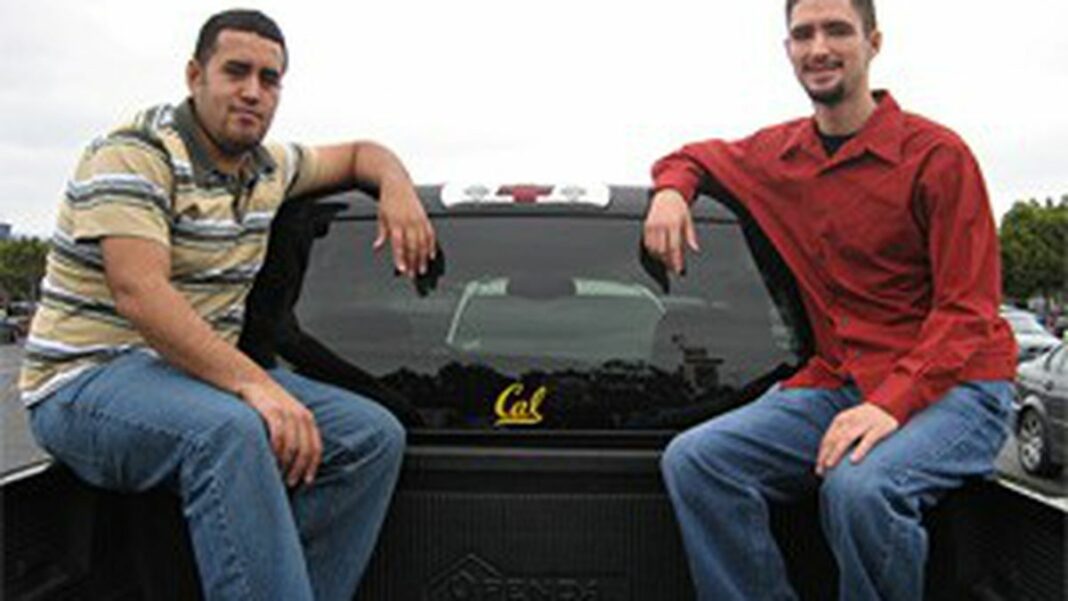
Javier Tenorio didn’t want to be saddled with student loan debt, so he resolved to work his way through college. A month ago, using his black Chevrolet Silverado pickup, the 23-year-old Cal business major and Stockton native started a moving business with classmate Jared Wooldridge, 21, of Pleasant Hill. They advertise on sites such as Craigslist, student work portal BarefootStudent.com, and social networking site Facebook. On the side, the business partners work full-time jobs for a total of sixty hours per week, all while taking summer school classes.
“It can be draining,” Wooldridge admits, sitting with Tenorio at an Emeryville Starbucks. “The best thing to do is to have a goal system, so you can always see the light at the end of the tunnel. That really helps.”
Tenorio, left, and Wooldridge. Credits: Kathleen Richards 
Joseph Scalice

In light of increasing tuition and other costs to attend UC Berkeley, students like Wooldridge and Tenorio find themselves hustling to make ends meet. Higher costs have made it more challenging for students from middle-class and lower-income backgrounds to attend Cal. And financial aid hasn’t kept up with the increases. As a result, some students are forced to work extra jobs to make ends meet.
“They’re studying at the top public school in the nation, so that’s crazy,” said Angela Lintz, director of higher education programs at Level Playing Field Institute, a San Francisco nonprofit that runs the IDEAL Scholars program. “They’re competing with kids whose parents are doctors and lawyers and studying full-time. … It’s very hard to keep up.”
IDEAL Scholars was started seven years ago to give services and financial support to minority undergrads at Cal. This year, the fund is helping 62 students, but Lintz says many more need financial help. About 32 percent of UC Berkeley undergrads get Pell Grants for people with low incomes, according to Cheryl Resh of the campus financial aid department. Most of those families make less than $45,000 a year, she says.
At present, Tenorio works 48 hours a week at a data center, and another ten-plus hours for his moving business. He and Wooldridge charge $30 per hour to shuttle items from places such as Home Depot or IKEA, and then $25 per hour per person for moving them. When the semester starts, Tenorio estimates he’ll cut back to 35 or 40 hours of work per week. Wooldridge also works full-time at Staples, where he makes $11 an hour, and he plans to continue working 60 hours into the fall.
It’s not as though the two have no other financial assistance. Tenorio receives scholarships and grants. He also joined the military when he was seventeen in order to receive $45,000 for college. But with roughly $20,000 in annual expenses, he says that leaves a big shortfall. Wooldridge, who receives $2,000 per semester from a scholarship offered by Staples, spent three years at a community college, and took a semester off to work full-time and save. But neither has taken out any loans, and they plan to keep it that way.
Many other students who aren’t in such dire financial straits still work. Dhara Desai and Sumedh Inamdar, both third-year students, say they have to work part-time jobs on campus at $10 per hour, although they feel the aid offered by the university is sufficient. They say the majority of their friends have parents who pay their fees. Desai, originally from Santa Rosa, gets scholarships and grants and hasn’t taken out any loans. Living with her brother has helped her offset costs. “I get paid pretty well and I have scholarships to last me four years,” she says, but adds, “I think if I didn’t have a job my life would definitely be better.”
Ben Smith, 26, was just passing Sather Gate with reporting forms for one of his scholarships. “I’m always running short,” notes the fourth-year philosophy major from Bakersfield. Smith says he’s taken out at least three emergency loans, which offer a $650 maximum and must be repaid within two months. To cut costs, he says he eats less and cooks at home: “It’s a constant worry, second only to my courseload.” He thinks the middle class gets screwed because rich families can afford to pay the tuition, while low-income families qualify for financial aid. “There’s a large segment in the middle that doesn’t qualify for either,” he laments.
With housing costs high, some students rely on co-op living or cheaper housing farther from campus. Jennifer Heller, communications coordinator for the University Students’ Cooperative Association, says there’s a very long waiting list for fall, “one of our longer ones in recent years.” Co-op residents pay from $440 to $750 a month, which includes some meals and utilities. In the summer months, it’s even cheaper — as low as $280 a month if you share a room.
But for some Cal students, the concept of affordable housing is but a distant memory.
Perhaps no segment of UC Berkeley’s student population struggles more than the family housing residents at University Village. Take Joseph Scalice, a thirty-year-old doctoral student. Scalice, who lives with his wife and three young children, has taken to extreme measures to cover his rent, which he estimates is 90 to 95 percent of his income. He and his wife, also a student, have been dumpster diving to find things to sell on eBay and Craigslist. In the last year, he began opening credit and bank accounts that offered promotions such as $100 gift cards, and then quickly closing them to avoid incurring fees. He estimates he has opened and closed roughly eighty such accounts. Meanwhile, they live extremely frugally. The family spends just $150 a month on groceries by diligently clipping coupons.
“We’ve tried to come up with different ways of cutting corners on time so this doesn’t cut into our sanity,” Scalice says. He adds that his methods, which allow him only about four hours of sleep a night, also don’t leave much time for studying toward his Ph.D in South and Southeast Asian Studies.
Scalice is one of five people whose tales of financial woe are featured in the short documentary Student Family Housing — Problem & Solution, produced by the Village Residents Association and posted on a blog titled Affordable Student Family Housing. The association made the film in response to rent increases that have essentially priced out many students. “One of the main mandates of our group is to protect affordable housing,” notes Maile Urbancic, secretary and treasurer of the residents’ association. “So when we saw what was happening, we knew we had to do something.”
Initially, University Village was divided into three housing tiers: Section A, Section B, and East Village — Section A was cheapest, East Village priciest. Section A, which was essentially dilapidated military barracks, closed on June 30 and is being demolished for redevelopment. Section B was demolished in 2005 and 2006 and replaced by the more expensive West Village, part of which is still in construction. Another small low-income section, Smyth-Fernwald, is slated for demolition in 2010. Between 1997 and 2007, rent for the cheapest two-bedroom apartments jumped 330 percent from $410 a month to $1,360, according to the video. Over the same decade, the average monthly salary of graduate student instructors increased only from $1,393 to $1,699.
That, Urbancic says, means the partner of a student with a GSI salary would have to bring in at least $40,000 a year just to cover rent, childcare, and transportation — and that figure doesn’t include expenses such as food and clothing. The result is that certain students — single parents, families without a professional working partner, and international students — are being forced out. And the situation is likely to worsen, Urbancic says. Rates for East Village went up 5 percent this summer, and are projected to increase another 5 or 6 percent annually for the next five years to cover the construction bond. That means the cheapest monthly rent in the village in 2012 would be $1,892.
The association sent the video to campus administrators on June 26, and a few weeks ago a delegation of students met with Chancellor Robert Birgeneau. The association wants profits from the sale or lease of the former Section A land be applied to housing subsidies or grants for needy students at the village.
Indeed, according to the video, university land-use policies and committees over the years have recommended below-market rents and rental assistance for village residents, as well as salary boosts for graduate instructors and readers. Urbancic says the association has been told that none of the money from the redevelopment of Section A land was budgeted for the village.
Peter Hoenig, interim associate vice chancellor for student affairs, says the video did a fairly good job of portraying the issue, but insists there’s not much the university can do about high rents. The older Section A and Section B housing was unfit for living, and to cover the new construction, the university had to take on a mortgage, which is why rent for the new apartments is significantly higher. Hoenig says this has been on the table the last eight or nine years and that administrators have discussed the situation with village residents. “Unfortunately, we don’t have any alternatives,” he says. “The choice is expensive housing or no housing at all.”
While providing affordable housing is a goal of the university, the definition of “affordable” is a source of contention, Hoenig says. He adds that the chancellor is very concerned with the situation and plans to look into it more deeply. Urbancic says she’s pleased with the university’s response.
In the meantime, students at University Village are doing what they must to pay their rent. Village Residents Association board member Ron Bialkowski says some are subletting their apartments in violation of university policy. This, he says, is particularly common among international students, who cannot work legally and aren’t eligible for financial aid. Bialkowski, a single father who legally sublets his two-bedroom, says he’s recently become aware of numerous such cases.
Dozens of comments on the Affordable Student Family Housing blog in response to the video reveal just how desperate some students have become. “We started out in East Village, and quickly blew through our savings and started going into debt,” one doctoral student wrote. “I was spending all my time working various (under the table) jobs trying to make rent, and almost no time doing things like publishing papers.”
“I have a working spouse, however we still struggle to make ends meet,” wrote another poster. “In fact, our financial aid eligibility is restricted by his income so we are in a position where we make too much to get many forms of assistance, but not enough to pay our rent. Each year this gap gets larger. Sadly, sometimes I feel that it would make more sense for my spouse to be unemployed so that we were eligible for more grants to pay our expenses.” (http://ucbfamilyhousing.blogspot.com/2007/06/student-family-housing-problem-solution.html)
(http://ucbfamilyhousing.blogspot.com/2007/06/student-family-housing-problem-solution.html)