
Here are a few numbers to keep in mind regarding the future of hydrogen-powered cars:
Tailpipe emissions: zero.
Dependency on foreign oil: zero.

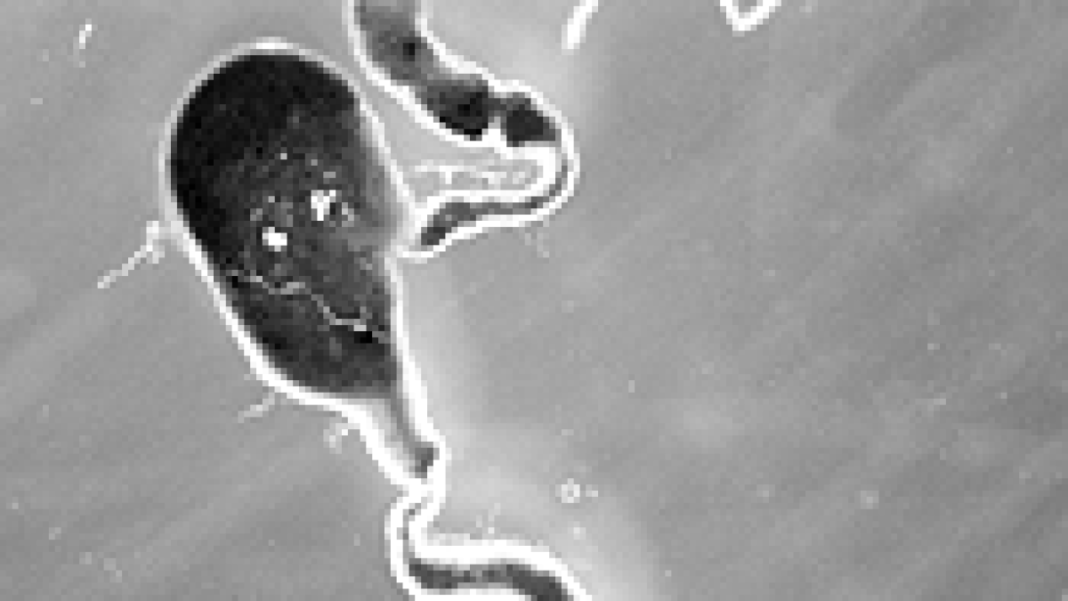
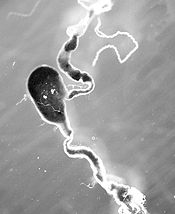
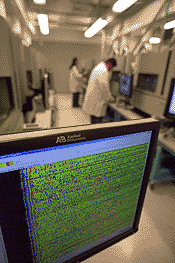
No guts, no glory. Credits: Image courtesy of Diversa Corporation JGI researchers Falk Warnecke and Philip Hugenholtz. Credits: Chris Duffey JGIs David Gilbert likens the challenge to assembling five or six complex jigsaw puzzles whose pieces have all been mixed together. Credits: Chris Duffey In the back of their minds, the researchers know their work has the potential to change the direction of the hydrogen economy. Credits: Chris Duffey


Number of termites crawling the planet: One hundred quadrillion. That’s a one followed by seventeen zeros.
Granted, not many people are hip to the termite part of the equation yet. And most of those who are can be found in Walnut Creek working at the Joint Genome Institute, a branch of the federal Department of Energy that is looking for alternative fuel sources in some very unexpected places — like a termite’s gut.
Even groups as disparate as environmentalists and auto industry execs can agree that hydrogen is a promising alternative to gasoline. Engines powered by the stuff are twice as efficient as their gas or diesel counterparts, and emit only distilled water — which means no smog, no refineries, no $3-a-gallon gas. The public is hungry for clean vehicles, most auto manufacturers are developing prototype fuel-cell cars, and California recently ponied up $54 million to build hydrogen fueling stations statewide.
So what’s the holdup? Sure, there are still significant technology issues, and fuel-cell vehicles are years from commercial viability, but perhaps the most profound problem lies on the supply side: Nobody knows where all this fuel is going to come from.
You can’t just tap into a pre-existing supply of hydrogen the way you drill for oil. It has to be manufactured, which is typically done by stripping hydrogen molecules from water or natural gas using electricity. But hydrogen produced this way is only as environment-friendly as the electricity source used to make it. So-called “brown” hydrogen is indirectly derived from the big three — coal, oil, and natural gas — with greenhouse gases and other pollutants as byproducts, while “green” hydrogen requires electricity from sources such as wind and solar, which are renewable but represent a minuscule fraction of US electricity production. For years, energy experts have been searching for the holy grail: a way to make hydrogen that is cheap, nonpolluting, and scalable to the mass market.
Philip Hugenholtz, head of the microbial ecology program at the Joint Genome Institute, thinks nature may have the answer. Many microbes make hydrogen, after all, sometimes in vast quantities. His team believes the most promising candidates are bacteria that live in a termite’s gut, quietly breaking down plant matter and releasing hydrogen as a byproduct. These microbes make termites the most efficient hydrogen producers on the planet: From a single sheet of printer paper, a termite can produce two liters of the valuable gas. “We don’t know how they do it, but we know they do it well,” Hugenholtz muses.
And there’s the rub — until recently these bugs within a bug have received scant attention from scientists. We know the bacteria are a motley crew consisting of at least six different lineages more distantly related to each other than human beings are to trees, but little is known about how they operate. Of at least 200 different microbial species living in the termite’s nether regions, 190 are pretty much terra incognita. Indeed, when the JGI team sequenced microbial DNA from the first test batch of termites they found in Costa Rica, they were elated to discover as-yet-uncharacterized species of bacteria.
The trick is to figure out which bacteria make hydrogen, and which enzymes they use to do it. With this information, Hugenholtz says, you could replicate those enzymes in mass quantities to produce hydrogen on a commercial scale. What’s more, you could fuel the process with agricultural and industrial waste — lumber-mill tailings, scrap cardboard, and the endless tons of corn husks and sugarcane stalks that are burned or discarded because they’re too tough for farm animals to eat. “It’s kind of recycling, making use of what’s already there,” says Falk Warnecke, a JGI microbiologist working on the project.
This line of inquiry excites energy experts who think we’d be better off farming our energy resources than drilling for them. “It’s going to be in the long run a dirt-cheap way to make hydrogen in a very easy-to-do manner,” says physicist Daniel Kammen, director of the Renewable and Appropriate Energy Laboratory at UC Berkeley. “I think that’s exactly where hydrogen could and should come from.”
It’s too early to tell, but you can’t beat the irony that one of our planet’s most reviled species could be key to cleaning it up.
Jared Leadbetter didn’t get into the termite business to save the world. The fact is, he just really, really likes termites. An assistant professor of environmental microbiology at the California Institute of Technology, Leadbetter first proposed the project to the Joint Genome Institute, and now serves as its lead investigator. He has been studying the inner workings of termites for fifteen years, sucked in, he says, by the complexity of a wild kingdom so tiny it fits inside a drop of fluid. “The termite hindgut is filled wall-to-wall with these fascinating morphologies of organisms,” he explains. “I was really gripped with it in the same way you might be interested in going through a rainforest — you don’t have to be a scientist to appreciate that this is a beautiful place.”
Termites owe their survival to their exotic profusion of gut inhabitants. The symbiotic relationship between insect and bacteria has been fine-tuned by millions of years of evolution to make termites and their tenants utterly codependent. Air is poison to these microbes, so living in the gut keeps them safe. The termite also chews wood into tiny pieces its guests can manage. In return, the bacteria digest the termite’s food into something it can use. Without them, the insect would starve.
Wood and woody plants are rich in long, complicated polymers called lignocellulose, the stuff that gives trees structural rigidity. But most animals, including termites, can’t extract energy from this roughage. Ruminants like cows and sheep can handle grass, but, as Leadbetter points out, “Grass is like butter compared to wood.” The termites’ tenants most likely tackle the tough stuff as a team: First, bacteria called fermenters break the polymers into simple sugars, releasing hydrogen into the gut as a byproduct. Other bacteria use the hydrogen and sugars to make acetate, basically vinegar, which the termite can process as food. The ultimate byproduct is the greenhouse gas, methane; these termite-gut bioreactors produce an astounding 4 percent of the planet’s atmospheric methane.
The insects aren’t born with the microbes — they are fed the bacteria by other members of their colony, and must be re-fed every time they molt. It’s a sort of eternal flame that has been passed by one termite generation to the next since the insects first appeared in the fossil record more than a hundred million years ago. “Termites are one of the truly social animals like ants or bees or ourselves, and it’s believed that one of the underlying reasons for why they’re social is to maintain their microbiota,” Leadbetter says. “They can’t live alone.”
This partnership has clearly succeeded: Termites are one of the planet’s most abundant animals. There are more than 2,500 species, each adapted to eating whatever plant material is at hand. To sample some of them, Leadbetter and his fellow scientists traveled to Costa Rica this past summer. They hacked chunks of termite nests from trees and trucked the live bugs in their nests back to a local lab. The termites were iced to slow down their metabolism, and then individually dissected to recover the fluid from their guts — hundreds were needed to fill up even a tiny vial. The researchers then extracted DNA from the microbes and sent it to the Walnut Creek lab for sequencing. By scouring the sequences for genes that encode known bacterial structures — a flagellum here, a protein pump there — they can get a better idea of how each microbe is built and which chemical pathways it uses to eat its lunch. The group plans to visit a half-dozen other sites around the world in search of termites that live on different types of plant materials, and, ultimately, the specialized microbes that allow them to do so.
Best-case scenario: The scientists identify a single microbe with a single gene encoding a single enzyme that is responsible for producing hydrogen. “If breaking down the lignocellulose is mediated by just one pathway or just a few enzymes, then that becomes something that may be able to be made easily into an industrial process,” Hugenholtz says. “However, if it turns out that there are fifty different organisms each contributing fifty different enzymes to the process, then it’s going to be much more difficult.” But nature seldom takes the simplest path. Leadbetter and Hugenholtz agree that a more complex situation is far more likely — after all, Leadbetter notes, if only one or two of those two hundred species were doing something useful for the termite, evolution would have booted the freeloaders millions of years ago.
Assuming they can identify the right microbes or enzymes, how would the scientists proceed? There are several approaches. They could build a bioreactor to simulate termite-gut conditions and use it to grow mass quantities of the bacteria, feeding in agricultural wastes and harvesting sugars and/or hydrogen. Or they could pinpoint the genes essential to hydrogen production and splice them into a microbe like E. coli or the yeast Pichia, which are easy to grow on an industrial scale. These host microbes would serve as factories for the desired enzymes, which a hydrogen producer could then use to break down plant matter directly. This is becoming a standard technique — most of America’s insulin supply, for instance, is produced this way. Diversa Corporation, the project’s private partner, already uses similar strategies to manufacture nearly a dozen enzymes for agricultural or pharmaceutical use.
However it’s accomplished, the result would be the same: a new economy of scale in production that could make hydrogen a more serious contender in the global energy marketplace.
Alternative energy was far from the minds of Human Genome Project officials in 1997 when they consolidated genome-sequencing centers at Livermore, Lawrence Berkeley, and Los Alamos National laboratories into a single entity. The federal government was locked in a tight race with the private firm Celera Genomics to unravel the blueprint of life, and the new Joint Genome Institute’s priority was to crack the code of three human chromosomes.
The institute’s Walnut Creek production lab, where 240 massive machines now crank through samples night and day while a stock ticker counts off how many base pairs have been analyzed, became so fast at sequencing that it almost put itself out of a job. Now it routinely bangs through roughly 3.1 billion DNA base pairs a month — the equivalent of the entire human genome — and the price per base pair has plummeted from $10 in 1990, when the Human Genome Project was formally launched, to a tenth of a cent today. “When I was sequencing DNA in the lab in the mid-’80s, if you sequenced a thousand bases it was good enough for a Ph.D thesis,” says JGI spokesman David Gilbert. “Nowadays, if you sneeze, we’ve sequenced a thousand bases at this facility.”
With the human genome behind it, the institute has been tackling genomes of other species, mostly at the request of individual academics. To date it has knocked off some 230, from the poisonous fugu fish to the funguslike critter that causes sudden oak death. But because the facility is run by the Department of Energy, its overriding interest these days is to scour the natural world for new fuel sources and ways to clean up the energy-related messes we’ve already made.
Of special interest are “extremophiles” — organisms that thrive in places once thought too hot, cold, or toxic to support life. They are largely single-celled creatures that have carved out an existence in places like Superfund sites, abandoned mines, or the superheated water around geothermal vents on the ocean floor. Scientists have found bugs that can metabolize some of the nastiest stuff on earth. Want to get rid of sulfur or uranium? Find something that eats it.
Trouble is, extremophiles tend to die if you try to culture them in a lab. In fact, Hugenholtz says, pretty much everything does poorly when you try growing it out of its home environment. “Less than 1 percent of all organisms out there can actually perform this magic feat of growing on a petri dish,” he says — which means up until recently, scientists were able to study only the tiniest slice of the microbial world.
Hugenholtz’ team has begun extracting DNA directly from microbes in their natural environments rather than try and culture the organisms. The problem is that if you’re sampling, say, sewer sludge, or termite guts, your sample will include DNA from several microorganisms that share the same habitat. Then you have to sort them all out. Gilbert likens it to assembling five or six jigsaw puzzles whose pieces have been mixed together. While challenging, this new approach, known as metagenomics or community sequencing, is a very powerful tool that has given scientists their first accurate glimpse of the other 99 percent of the microbial universe. The termite project is a perfect fit: a complex society of microbes that can’t really be isolated from one another. And it doesn’t get much more extreme than the bowels of a termite.
Your car won’t be running on termite power anytime soon. In fact, it’s anyone’s guess when hydrogen cars will hit the market — five to fifteen years, depending on whom you ask — but they’re likely to trickle out the way hybrids did. The success of hybrid technology is a good omen for hydrogen vehicles: You can hardly walk anywhere in the Bay Area these days without tripping over a Prius, even though they cost about $3,000 more than the comparable gas-only model. “Toyota and Honda can’t make enough to keep up with the demand,” Cal physicist Daniel Kammen says. “There is no question this experience with hybrids has given us hope that a little policy muscle and stick-to-itiveness can change an industry.”
Granted, the Bay Area — and California in general — is usually out front in adopting new technologies and environmental policies. The California Fuel Cell Partnership, a collaboration of government agencies, energy companies, and tech interests, already has seven automakers on its roster. Honda is one to watch: It has one of the more aggressive fuel-cell research programs, maintains a small test fleet in the Bay Area, and was first to launch a commercial hybrid, the Insight, in the United States in 1999. Stephen Ellis, Honda’s manager for alternative fuels and fuel-cell vehicle marketing, says America’s warm reception of hybrids is encouraging. His company expects to sell 45,000 hybrid Civics, Accords, and Insights in the United States this year — and not just to science nerds and hippies. The company’s market research shows that hybrid buyers are increasingly just regular folks: families who use an SUV to take the kids to soccer practice but drive to work in a hybrid, or people who may be uneasy about America’s involvement in Iraq and dependence on foreign oil, even if they’re not very politically minded. Many, of course, are simply trying to save money on gas — every time the price of crude inches up, Honda sees a corresponding bump in hybrid sales, Ellis says.
But he’s quick to note that hybrids are a stopgap solution. “We can’t say we’re going to hybridize our way out of dependency on oil, because they use gasoline,” he says. “The growth in population and vehicle use will continue to outstrip any gains we can make from hybrids. Don’t get me wrong: They’re a great thing — they can slow down the curve, but they can never roll it back. Only pure alternatives will roll the needle backwards.”
Hydrogen could play that role. Fuel cells harness energy through catalysis, not combustion, and produce neither solid pollutants nor greenhouse gases. A car powered by “green” hydrogen is carbon-free and pollution-free “from well to wheel,” as energy experts put it. The fuel is also versatile — you can make it with electricity derived from any source. Equally important, no nation can monopolize it. “Any region in the world can make their own hydrogen using any renewable energy they have,” says Chris White, spokeswoman for the California Fuel Cell Partnership. “Whether it is wind, sun, or geothermal energy, they can all be used to create electricity that splits water into hydrogen and oxygen. You can do it as easily in the Sudan as you can in the Arctic.”
Some futurists envision a national network of hydrogen-generating plants powered by local green-energy sources — California might use solar panels, North Dakota windmills. Biological solutions such as termite microbes could be employed anywhere, and making the fuel in smaller batches closer to where it’s needed would decrease the cost of trucking it from plant to consumer (hydrogen can’t be transported through pipelines). If you’re not beholden to any one industry, corporation, or method to fuel the transportation system, Kammen says, “You won’t be held over a barrel.”
At the moment, however, hydrogen is very expensive. It costs about twice as much to fill up with hydrogen as with an equivalent amount of gas. But fuel-cell engines consume their fuel more efficiently, notes Tim Lipman, a research engineer at UC Berkeley’s Institute of Transportation Studies. “In a gasoline engine, about 16 to 18 percent of the energy in the gasoline actually makes it to the wheels to drive the car forward,” he says. “For hydrogen, that figure would be more like 45 to 55 percent.” And with gas prices rising steadily, hydrogen could soon look cost-efficient by comparison. “People say hydrogen won’t succeed until it reaches the cost of gasoline,” says Honda’s Ellis. “In ten to twenty years, can anyone tell us what the cost of oil will be?”
Perhaps not, but many energy experts predict the days of cheap gas are almost over. Steven Chu, director of Lawrence Berkeley National Laboratory, an affiliate of the Joint Genome Institute, says world oil production could peak anytime between now and the next forty years. “It’s clear we’re on a downward trend,” he says. “Once you’re on the downward trend of something like that, the price is going to make $60 or $65 [a barrel] look really inexpensive.”
Established energy interests, however, will certainly push for the continued use of other fossil fuels. According to Chu, the United States and China both have several hundred years’ worth of coal reserves, and Canada has already started strip-mining its tar sands that can be melted into a lighter-weight oil. But these methods are truly nasty for the environment. “It’s very scary, because if you go there you have a huge chemical pollution issue as well as a carbon dioxide global warming issue,” the Nobel laureate says. Methane is another option, but that won’t last forever, either — Chu estimates that natural-gas reserves are comparable to oil reserves, which means it would be a transitional, rather than permanent, solution. Then there’s the nuclear option, but that requires enormous capital investment and creates both a waste problem and proliferation issues.
So in which direction do we turn? For every hydrogen fan, there’s someone who swears we’d be better off with natural gas, ethanol, or biodiesel cars. All these fuels burn cleaner than gasoline, and can all be manufactured stateside. Current hydrogen car prototypes have serious issues. For one, they don’t last as long. Gas-powered cars can be driven about five thousand hours, while most fuel-cell stacks run only two thousand to three thousand hours, Lipman says. And that’s under lab conditions, not on the road. Another limitation is tank capacity. You can’t compress hydrogen gas much without using prohibitively thick and heavy gas tanks to prevent rupture. Researchers are looking into other storage possibilities, but for now gas vehicles average about 300 to 350 miles per tank, White says, while most hydrogen test vehicles do only about 200 miles.
Energy suppliers, meanwhile, need practical ways to get hydrogen to drivers. The lack of a refueling infrastructure poses a classic chicken-or-egg problem: “Are you going to build a car when there’s not a station, or a station when there’s not a car?” White asks. The process did get a boost this April when California kicked off its Hydrogen Highway project, which will spend $54 million to build refueling stations along 21 state freeways by 2010. Hardly a station on every corner, but it’s a start.
Energy experts attribute the slow pace of progress in part to foot-dragging by American car companies, which can make more money selling SUVs than compact alternative-fuel cars, and haven’t invested heavily in fuel-cell R&D. Even those rolling out hybrids are mostly licensing technologies developed by Toyota and Honda, both Japanese companies. Proponents of ethanol and biodiesel argue that drivers can use these fuels now, rather than waiting around for hydrogen’s commercial debut. They complain that automakers which ignore these technologies in favor of hydrogen vehicles are simply giving themselves license to do nothing in the near future. Even hydrogen fans say the cars would be available much faster if the auto industry got cracking. “I think the US automakers are lapping up federal dollars saying they’re going to do work on fuel-cell cars, but until they see a change in the sales of their vehicles — less SUVs and more hybrids being bought — they are the biggest impediment out there,” Kammen says. “If they were really working, they could have ten hybrid vehicles on the market today and fuel-cell vehicles in a few years.”
But experts such as Kammen and Lipman note that hydrogen’s versatility is also its biggest liability. They fear coal and oil interests will monopolize the hydrogen market and champion fossil fuels as the sources of electricity needed to produce it. Given the political clout of Big Coal and Big Oil, renewable energy advocates worry that these industries will win the lion’s share of government grants and subsidies to develop hydrogen-production technologies. Sure, the cars that use it will run clean, but the manufacturing process could be very dirty indeed. “Hydrogen for the sake of hydrogen is not worth it,” Lipman warns. “If done wrong, it may not be worth doing at all.”
Yet some express words of caution for those who would pursue only “green” hydrogen production. Ignoring mainstream energy sources could undermine the feasibility of hydrogen vehicles and delay their commercial deployment for years. “We think that’s a noble goal, but at this stage of hydrogen vehicle and fuel-cell production, it would be very harmful to try to expect this perfection in every case,” Honda’s Ellis says. “We all know the ultimate goal is the zero-carbon-based hydrogen, but if we’re ever going to achieve that ultimate goal, we need everything we can get any way we can get it.”
The consensus among energy experts is that all options should remain open. Why try to predict the winner of a race that has another ten years to run? And there’s no reason, they say, that fuel-cell vehicle technology can’t be developed alongside ethanol, biodiesel, and natural gas. After all, having a mixture of low- and zero-emission cars on the road works toward the ultimate goal of cleaner air.
Back in their lab, Hugenholtz and Leadbetter try not to get too mixed up in the politics of their research, or speculate about where it might lead. All they can promise is that, by this time next year, they’ll know a heck of a lot more about how termites do what they do, and that it will likely open up some very interesting possibilities. Yet in the back of their minds, they know their work has the potential to change the direction of the hydrogen economy. “We would dearly love to see this basic research result in cleaner energy,” Hugenholtz says.
Will we really find tomorrow’s energy source in the gut of an insect that is right now busy eating your house? Well, if your car keys are any example, things are always in the last place you look.
Liquid Gold
From one insect, two alternative fuels.
As it turns out, termites might be good for more than just hydrogen. San Diego-based Diversa Corporation, the project’s corporate partner, is seeking enzymes that will degrade currently unusable biomass into simple sugars, which can then be fermented to make ethanol, a fuel that burns cleaner than gasoline and is sometimes used as a gas additive. Ethanol is usually derived from sugar-rich crops such as corn, sugarcane, and sugarbeets, but company scientists hope termite microbes will hold the key to mass-produce it from farm and industry wastes such as sawdust, leftover paper pulp, scrap lumber, wheat straw, corn stalks, and bagasse, the stuff left over from sugarcane pressings. “We can learn so much from these very, very small factories that have evolved over hundreds of millions of years to be perfectly suited to this material,” says Eric Mathur, Diversa’s vice president of scientific affairs. “That fluid is gold.”
In addition to the strategies Hugenholtz is contemplating, Diversa scientists, are eyeing a third way to mass-produce enzymes of interest. It would entail splicing the enzyme DNA directly into the genomes of plants such as corn or sugarcane so their husks would begin to self-degrade automatically after the harvest. This could be controversial, given recent findings that genetically altered crops regulators thought were tightly controlled have cross-pollinated with other plants and spread their lab-modified genes. The findings have reinforced fears about potential threats to biodiversity, and the prospect of new allergens suddenly appearing in the food supply. Diversa reps are quick to stress that if the company does pursue this option, the modified crops would be used only for industry, not food. “Nobody is eating this,” says Diversa spokesman Martin Sabarsky. “It’s talking about ethanol going into a gas tank, so presumably you don’t have the same kind of controversy.” — Kara Platoni