AC Transit's Hydrogen Boondoggle 

The agency plans to spend $28 million on hydrogen fuel-cell buses even as the Obama administration says the technology is too costly and impractical.

Earlier this month, the Obama administration all but killed the federal government's hydrogen fuel program. Department of Energy Secretary Steven Chu, a former UC Berkeley professor and Nobel Prize winner, believes hydrogen vehicles are still decades away from practical development, primarily because they're far too costly. Chu, instead, wants to focus scarce federal dollars on developing electric vehicles and hybrids powered by biofuels. Yet despite the administration's decision, AC Transit is forging ahead with its extremely expensive hydrogen bus program. In fact, the cash-strapped agency is about to buy twelve fuel-cell buses for $28 million — a price that could pay for more than 55 new hybrid buses.

But AC Transit isn't the only one to blame for this hydrogen boondoggle. The California Air Resources Board also deserves criticism for effectively mandating AC Transit's costly program. In fact, starting in 2011, the air resources board may require that up to 15 percent of AC Transit's bus purchases be expensive hydrogen buses. The mandate is part of the board's long-term plan to greatly reduce tailpipe emissions throughout the state.
However, the air resources board is now beginning to rethink its mandates. First adopted in 2006, the zero-emission bus regulations were based on an effort to curb air pollution. But now that the state's emphasis has changed to reducing greenhouse gases as quickly as possible to limit the coming global warming crisis, the board is considering whether to relax, or even eliminate, its current requirements. One simple fix would be to require that transit agencies buy hybrid buses because they are affordable and can cut greenhouse emissions by about 33 percent. The air resources board is holding two public workshops on the issue this week. However, at this point it is unclear what the board will do, in part because AC Transit, one of the largest transportation agencies in the state, remains gung-ho for hydrogen.

So why is AC Transit still hot for a technology that the Obama administration and other environmentalists now think is uncool? Some critics note that AC Transit's hydrogen program is tied up with its obsession for Belgian-bus manufacturer Van Hool. As this newspaper has previously reported, AC Transit has maintained an exclusive contract with Van Hool since 2002, and has purchased hundreds of the Belgian buses at a time when the agency has struggled financially and despite the fact that Van Hools cost more than some of their American-made counterparts. Agency officials have staunchly defended the buses, while at the same time taking repeated junkets to Europe on the taxpayers' dime.

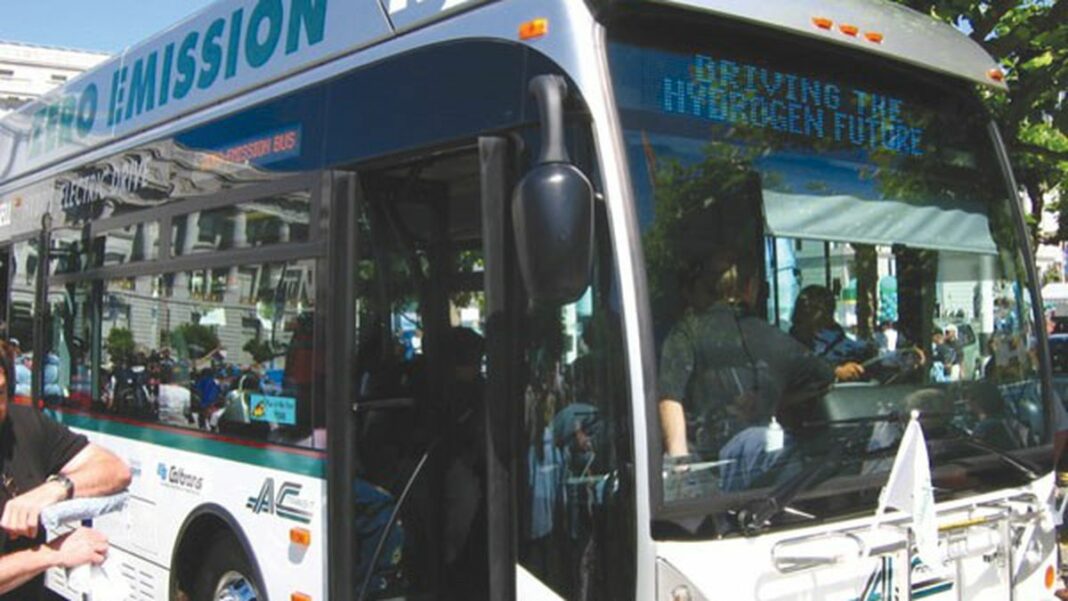
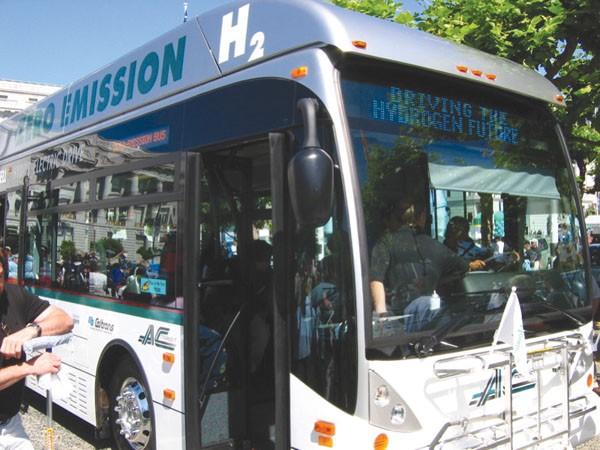
AC Transit began purchasing hydrogen fuel-cell buses from Van Hool in 2005. The first three buses cost $3.16 million each. By comparison, a hybrid-diesel bus sold by Hayward-based manufacturer Gillig currently lists for about $550,000, according to Gillig Vice President Brian McLeod. A regular diesel bus costs about $350,000 to $400,000; most of AC Transit's Van Hool bus fleet are regular diesels. The first three hydrogen buses that AC Transit bought from Van Hool were considered an experimental project that was effectively mandated by the air resources board. The board considers the next twelve hydrogen buses from Van Hool, which will cost about $2.25 million apiece, to be the second phase of AC Transit's research and development program.

The air resources board mandates are part of its zero-emission bus program for large transit agencies — that is, those with at least 200 buses in their fleet. Agencies can meet the mandates three ways: First, by installing electric trolleys. San Francisco's Muni has already met all of the air board's requirements because of its longtime electric trolley system, according to Anna Gromis, an air board staffer. The second way is by buying hydrogen fuel-cell buses. And the third is by purchasing battery-powered electric buses. Los Angeles is taking this route, although battery-powered electrics are not considered suitable for agencies such as AC Transit because they don't perform well on hills and can't go for long distances without recharging. LA plans to use the battery-operated buses on short, flat routes during commute hours, said John Addison at CleanFleetReport.com.

Bus agencies can meet the air board's initial mandates by partnering with each other. AC Transit is the lead partner and chief financier of a consortium with Golden Gate Transit in Marin County, Valley Transportation Authority in Santa Clara County, and SamTrans in San Mateo County. However, the agencies will have to begin purchasing zero-emission buses on their own, en masse, beginning in 2011 — unless the air resources board relaxes its standards.

Some environmentalists and bus manufactures contend that it makes much more sense for the air board to switch from a zero-emissions requirement to a low-carbon-emissions one. While it's true that hydrogen fuel-cell buses emit no greenhouse gases, their huge expense makes them impractical for widespread adoption. As a result, they're decades away from affecting global warming, and the requirement that bus agencies begin buying them in bulk two years from now is a colossal waste of taxpayer money.

By contrast, a switch to hybrid diesel buses could make an immediate impact on greenhouse emissions because hybrids are affordable and already commonplace in the industry. According to Addison of CleanFleetReport.com, hybrids represent one quarter of new bus purchases in the United States. "The question is: 'Does it make sense to follow a zero-emissions path at all?'" said Addison, who also wrote the book Save Gas, Save the Planet. "At this point, hybrids make a great deal of sense for public transportation."

And it's not as if the air resources board hasn't relaxed its mandates before. Earlier this decade, the board stepped back from its zero-emission standard for cars, light trucks, and SUVs and gave low-emissions credits to hybrids, recognizing that zero-emission vehicles are costly and that hybrid technology is affordable and already established.

Hybrids, in fact, could be especially effective for AC Transit, because the agency operates in a mostly dense, urban area with lots of bus stops. That's an advantage for hybrids because they can switch over to their electric batteries when idling, and the batteries recharge when applying the brakes. "Generally, the industry has agreed that hydrogen fuel cell technology is just not realistic, and they've dropped it in favor of hybrids," said McLeod of Gillig, which has been making hybrid diesel buses since 2001.

But AC Transit is bucking the trend, and still believes that hydrogen is the wave of the near future. In fact, the AC Transit board voted last Wednesday 4-2-1 to approve a $1 million no-bid contract with a lithium-ion battery maker to partner with Van Hool in developing the twelve hydrogen fuel cell buses. The only board members to vote against the deal were Elsa Ortiz and Greg Harper (board member Joe Wallace abstained). Harper was visibly frustrated by the idea that AC Transit was plowing ahead with its expensive hydrogen program when the Obama administration was basically abandoning theirs. "If we're going to have a $2 million or $2.25 million bus — that's just as useless to us as if it didn't work," he said. "I think our project now is in trouble."

But the board majority brushed off those concerns. Jaimie Levin, who heads up the agency's hydrogen bus program, is one of the agency's biggest cheerleaders for Van Hools, and has traveled around the world at public expense to find the right battery, said at the meeting that the air resources board considers AC Transit's program to be "the gold standard." That may be true, but it also should be pointed out that neither Levin nor any other AC Transit official noted at the meeting that the air resources board was thinking about relaxing its requirements. Nor was their any recognition that if AC Transit, a major player in the state's transportation world, decided to park its hydrogen program and ask the board to set aside its mandate, it could help save the planet, while saving public funds at the same time.


Comments (7) RSS

Showing 1-5 of 7

Add a comment | All comments »

It's foolish and short-sighted for a cash-strapped transit property like AC Transit to be "experimenting" with fuel cell buses. AC Transit's job is to
provide the best and most efficient bus service possible. A bus full of people, even if propelled by a diesel engine, beats a street full of automobiles.
It's time AC Transit rededicated itself to its primary task, which to render its service more attractive to more riders and would-be riders.

Gerald Cauthen,
Oakland
510 208 5441

Posted by gerald 101 on May 20, 2009 at 7:07 PM | Report this comment

AC Transit Board, Please do not purchase the fuel-cell vehicles at this time.
Thanks,
Saj from Oakland

Posted by Saj on May 21, 2009 at 11:37 AM | Report this comment

Thank you for mentioning me and my book – Save Gas, Save the Planet – in the article about AC Transit.

AC Transit should be admired for giving people ways to stay out of rush-hour gridlock on major streets and highways like 880 and 580. They have been an innovator using buses that people want to ride, bus rapid transit, and zero-emission buses. So that my words are not taken out of context, here is my full report about AC Transit’s hydrogen program:

http://www.cleanfleetreport.com/fleets/riding-on-sunlight/

AC Transit is not engaged in a hydrogen boondoggle. They have been complying with California Air Resource Board regulations. By taking early leadership, they have secured significant federal, state, and non-profit funding to pay for these buses.

Yes, these are tough economic times, so I can appreciate your investigative journalism and questioning of expenses. We need more buses on the road.

Your paper also supports BART and BART airport extensions which are far more costly than zero-emission buses. We do need BART and we also need better bus transportation.

A couple of weeks ago, I was at an Oakland meeting with Dr. Richard Swanson, founder of SunPower. He has observed that 30 years ago, solar costs 30 times as much per watt, as today. Solar was attacked 30 years ago as being a boondoggle. In the beginning, it actually took more energy to create PV than was recovered in using the panels. Thanks to innovators, this is no longer true. Production of solar increases ten-fold every ten years. Yet, the coal industry continues that attack today solar today. The fossil-fuel industry attacks solar for getting millions in tax breaks, while oil and coal get billions.

Since 2002, the U.S. Department of Energy reports that fuel cells have dropped in cost from $275/kW to $45/kW. Fuel cell warranties are ten times those of a few years ago. Within a decade, fuel cell buses could cost less than diesel hybrid buses and take full advantage of electric drive systems and regenerative braking. The key is volume manufacturing instead of today’s low volume production.

It would be unfortunate if AC Transit killed its zero-emission program. The 12 new buses that are on order will lower the cost of zero-emission transportation and carry thousands of riders each day towards a better future.

Respectfully,
John Addison

Posted by John Addison on May 23, 2009 at 7:32 AM | Report this comment

John Addison definitely has not ridden AC Transit’s Van Hool buses when he refers to them as “buses that people want to ride.” Nothing could be further from the truth. They are disliked by most riders and, in fact, despised by the elderly and disabled because most of their seats are on 12” high pedestals. In fact, ALL the seats are on pedestals on the zero-emissions buses. And these buses, by the way, struggle up hills.

And, by the way, they do not have bus rapid transit, and are not likely to in the future, because they are finding it difficult to deliver even bread-and-butter service. According to the Congestion Management Agency, they were the only transit agency in Alameda County to have a decrease in ridership and by 2.8%. And they plan to cut service by 15% to save $18 million. I can document over $30 million that was squandered on Van Hool buses that were either not needed, bigger than needed and/or were overpriced.

I went to your link, and your information about AC Transit sounds like the hype that AC Transit puts out about their fuel cell program probably written by Jaime Levin who heads the program and is a PR man not an engineer. And that is where you got the idea that Van Hools are “buses that people want to ride” because he goes to Expos on AC Transit’s dime promoting Van Hools claiming “they’re a big hit and everybody loves them in Oakland.” That, besides the fact that AC Transit buys all their buses from Van Hool without bidding, is an indication of how, and I do not say this lightly, “in bed” they are with Van Hool.

This week I attended an Air Resources Board Workshop to Discuss Updates to the Zero-Emission Bus Regulations. They are seriously questioning the readiness of hydrogen fuel cell bus technology because of its lack of reliability and durability and high purchase and maintenance costs. For instance, the miles between road calls (MBRC) for AC Transit’s fuel cell buses was 1,395 while for diesel buses it’s between 8,000 to 9,000. And fuel cell buses are not necessarily zero-emissions. It depends on, as they say in the trade, a well-to-wheel, analysis as CARB did with ethanol and is poised to do with fuel cell.

Gammon’s article pretty closely mirrored CARB’s concerns. An investigative reporter like him, who does his homework and considers his sources is more credible than someone who appears to swallow whole the hype produced by an agency which has an interest in promoting expensive buses from a particular bus manufacturer.

Posted by Joyce Roy on May 23, 2009 at 6:48 PM | Report this comment

Joyce Roy seems to have her hand firmly planted up this writer’s @ss. What Robert Gammon tirade on AC Transit hasn’t had her name attached to it? Others of us are not only fine with the buses, but prefer them to the congestion of extra vehicles or the pollution of diesel in our suburban communities

And BTW, few have used the word "boondoggle" since about 1942. As always, thanks for the snark, Ms. Roy.


X.C., Berkely

Posted by Xcuses on May 26, 2009 at 5:49 PM | Report this comment

Latest in Eco Watch

  • Bay Trail Still Faces Roadblocks

    Supporters believe they have a plan for the path through a heavy industrial section of East Oakland, but it needs approval from key property owners.
    • Feb 3, 2010
  • On a Roll

    Walk Oakland Bike Oakland works grassroots and government angles to spread its message.
    • Jan 27, 2010
  • Dinner and a Movie

    East Bay restaurants make a case for sustainable seafood.
    • Jan 20, 2010
  • More»

Author Archives

  • John Yoo Gets Away With It

    A Justice Department investigation reportedly will recommend only a slap on the wrist for the UC Berkeley law school professor who authorized torture.
    • Feb 3, 2010
  • The Trouble With Electric Cars

    Plug-in vehicles may remain little more than a novelty until cities begin making it easier for motorists to recharge their batteries at home.
    • Feb 3, 2010
  • More»

Calendar

Submit an event

Most Popular Stories

  • Yelp Extortion Allegations Stack Up

    More business owners come forward with tales of unethical behavior by the popular San Francisco-based web site.
  • Yelp and the Business of Extortion 2.0

    Local business owners say Yelp offers to hide negative customer reviews of their businesses on its web site ... for a price.
  • Berkeley High May Cut Out Science Labs

    The proposal would trade labs seen as benefiting white students for resources to help struggling students.
  • A Troubled Rape Case

    The high-profile rape charges against Deputy District Attorney Michael Gressett are tainted by questionable facts, unorthodox prosecutorial conduct, and the unmistakable whiff of politics.
  • The Trouble With Electric Cars

    Plug-in vehicles may remain little more than a novelty until cities begin making it easier for motorists to recharge their batteries at home.

© 2010 East Bay Express    All Rights Reserved