To anyone not keeping up with the bumpy road of the fight over the proposed coal terminal in Oakland, it might seem recent news is uniformly bad for the “no coal” movement. Court rulings have gone against No Coal in Oakland (NCIO), its allies and the City of Oakland. Then on June 3, the Trump administration announced a $75 million grant to help fund building the terminal.
This was done by invoking war powers under the Defense Production Act, and is part of $700 million designated for financing new coal-fired plants in Alaska and West Virginia, as well as support for coal plants in 10 states that voted for Trump in 2024.
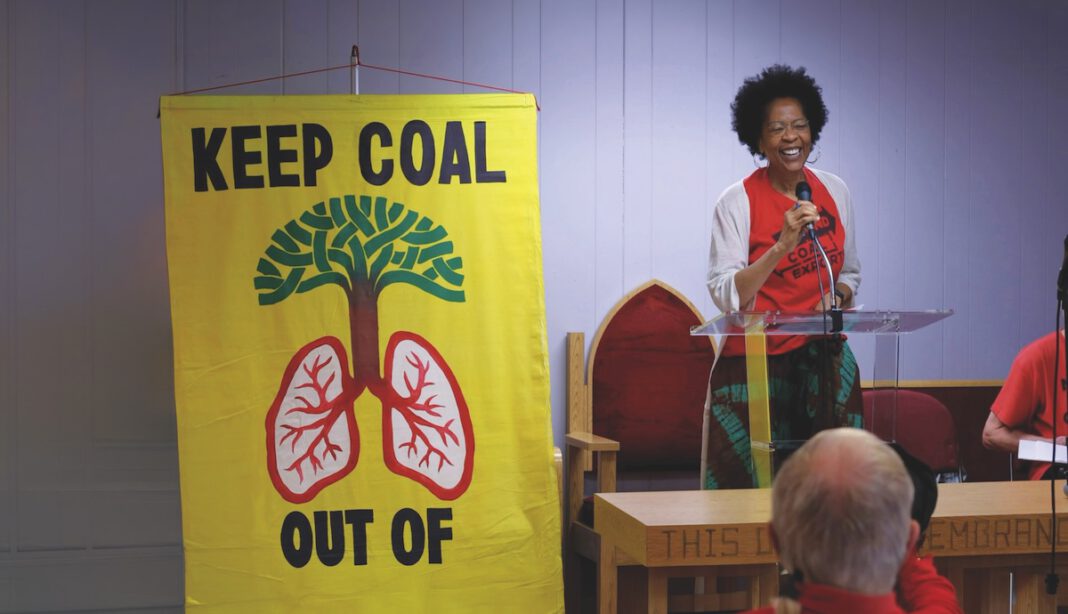
But that’s just one side of the story. The all-volunteer NCIO and its many allies, including the West Oakland Environmental Indicators Project (WOEIP), are even more determined to keep fighting what they deem a potential environmental disaster for the East Bay—and they have multiple new strategies to do so.
Oakland resident and NCIO volunteer since 2015, Aaron Reaven, said, “We are already neck-deep in fighting back.” Although developer Phil Tagami prevailed in a recent legal judgment, the judge included multiple environmental safeguards that would have to be met, he said.
And, although Oakland Mayor Barbara Lee announced shortly after her election that she would “strongly support” the Oakland City Council’s resolution to ban coal being shipped through the city, Reaven said NCIO’s efforts are shifting to the Bay Area Air District (BAAD, formerly BAAQMD), since air quality is directly affected by “fugitive dust” blown off coal cars in transit, and the distribution of this toxic dust by wind isn’t limited to the communities next to rail lines.
(East Bay Express published a story in 2023 about the extensive study documenting the existence of coal dust in communities along the rail route to the Levin Richmond Terminal: eastbayexpress.com/dust-proof/).
The long-established WOEIP is also re-focusing efforts on the BAAD, said Executive Director Veronica Eady. The organization is also looking to state representatives, such as Assemblymember Mia Bonta and Congresswoman Latifah Simon, to step up support for stopping the terminal. On June 15, Bonta introduced AB 40, the Community First Coal Review Act which, if passed, would require a “full Environmental Impact Report before any local agency may grant a discretionary approval for a new or expanded coal handling, storage or export terminal with a design capacity exceeding five million short tons per year.”
The bill also requires an updated environmental review when the type or quantity of coal changes materially or when the existing EIR is 10 or more years old, according to Bonta’s website. On June 16, Simon filed a federal amendment that would block the use of energy and water funds for coal projects.
Eady noted it’s disputable that the Defense Production Act, created during the Cold War, can legally be used to fund further coal development. Legal proceedings calling the use into question are almost inevitable. And, she said, the tab for building the terminal is estimated to be as much as $400 million.
Then there’s the bigger picture. Despite Trump and EPA Administrator Lee Zeldin, whose links to conservative groups promoting fossil fuels are well documented, coal continues its decline. A June 15 Associated Press article quoted recent data from global energy think tank Ember which showed “the continued growth of solar and decline of coal in the United States despite federal policy. In May, for the first time, solar supplied more of the nation’s electricity than coal, or 12.8%, Ember said. Coal supplied 12.2%, its fourth-lowest monthly share ever.”
And although coal shipped through Oakland would be going to Asia, where it is still dominant, the picture is changing there as well. Ember reported: “The region’s own power mix is shifting: clean generation rose from 34.1% to 37.1%, with solar and wind (17.5%) now edging above the world average (17.3%), and renewables reaching 32% of Asia’s electricity mix overall.”
Both Reaven and Eady encouraged those interested in preventing the terminal build to attend the community meeting scheduled June 25. “Especially young people,” Eady said. “There is room for fierce young allies in the Bay Area.”
Community meeting from 7-8:30pm, June 25, at La Peña Cultural Center, 3105 Shattuck Ave., Berkeley. nocoalinoakland.info