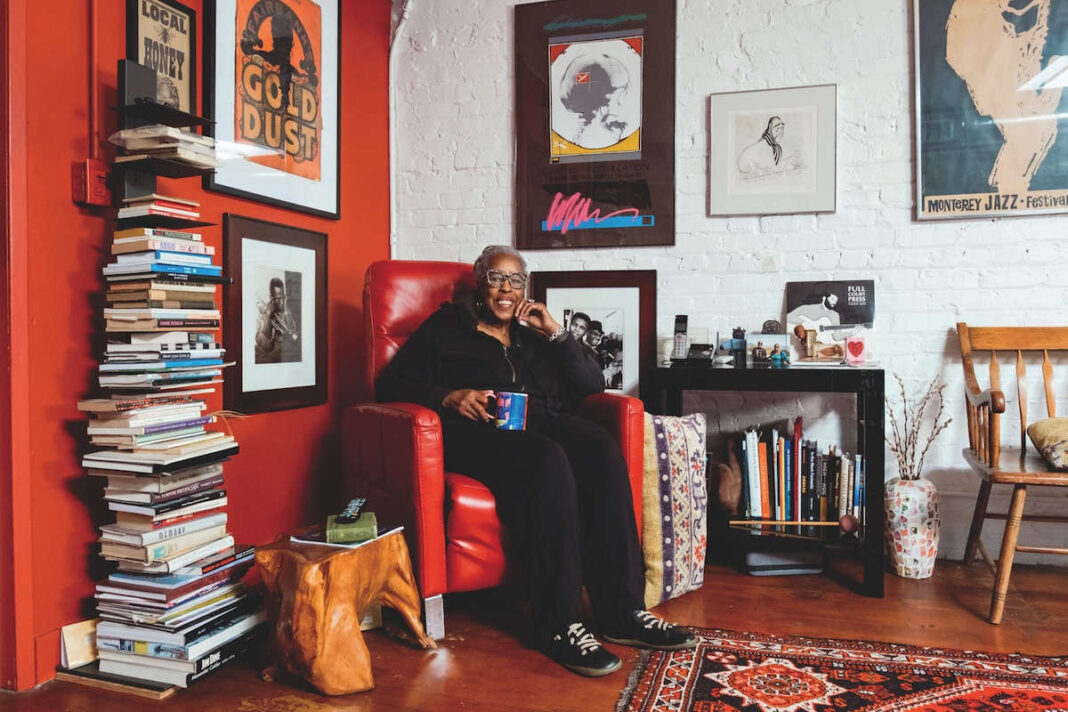
The work of artist Mildred Howard can be summed up in one admittedly reductive word: astonishing. Amazement is abundant in the Oakland Museum of California (OMCA)’s new exhibition, “Mildred Howard: Poetics of Memory.” Presenting the first major retrospective of the Oakland-based artist June 12-Oct. 11, the exhibit fills the Great Hall with installations, found-object sculptures, archival materials, audio and video recordings, and new works.
Spanning five decades, contrast prevails throughout the collection, which includes grand and quiet expressions, dramatic and tender contemplations of history, and explicitly exposed or intriguingly veiled memories. In every corner, the output of a curious, clever, bold, creative mind carves a portrait of hope and a voice expressing bountiful protest in hope’s absence.
Born in 1945, Howard grew up with her parents, Rolly and Mable Shrock Howard, in the East Bay. Her parents operated an antiques business and were highly engaged in civic activism. In an interview, Howard says, “Art was everywhere.” Recalling frequent trips to visit San Francisco’s de Young and the Oakland Museum of California—at the time, a tiny place she remembers primarily for displaying Victorian-period furniture—artistic inspiration was always immediately at hand.
A lifetime of making art began with using leftovers—fabric, furniture, glassware—from vintage items Howard’s mother collected. Along with plentiful material to explore at home, arts and crafts classes at the nearby South Berkeley Congregational Church led to “magic” interactions with crayons and copper enamel. Seeing musicians like Leontyne Price and Duke Ellington at the Paramount Theatre, participating in civil rights marches, attending dance classes, and deep dives into American and world history expanded her interests. A film camera she received at age 14 introduced movement to her artistry. In subsequent years, the Harlem Renaissance, African American folk culture and global politics became subjects of her focus.
Howard holds an associate of arts degree and a certificate in fashion art from the College of Alameda, and a master’s in fine arts from Fiberworks Center for the Textile Arts at John F. Kennedy University in Berkeley. Among numerous honors and awards, she received a Guggenheim Fellowship in Fine Art in 2025.
As an educator, Howard has taught at Stanford University, the San Francisco Art Institute, and the California College of Arts and Crafts, and established the Institute for Inquiry workshops and other curriculum at San Francisco’s Exploratorium. Locally, her artwork is found in the permanent collections of OMCA, Berkeley Art Museum, the de Young Museum, SFMOMA and San Jose Museum of Art.
In a phone interview, Howard says childhood visits to OMCA and other museums influenced her worldview. “OMCA was a lot of period furniture, not as contemporary as it is now,” she says. “I saw how the world is full of diverse things. When we were done, we’d have lunch on the lawn at Lake Merritt and watch the ducks.”
A retrospective at this time in her life and in the current political climate presents particular challenges and opportunities. “I’m not going to let this climate and administration determine what I do, present and say,” she says. “Fortunately, the museum has been fantastic. They’ve given me the Great Hall, and that’s a wonderful thing. I could have filled the whole museum. We went over every single thing that’s being exhibited. I didn’t even think about the administration, although yeah, it’s always on my mind. You can’t avoid it.”
One work in the exhibit, What Came First, Howard made in 2007. She suggests it is as important now as it was then. A miniature U.S. Capitol created with bakelite is mounted by what appears—due to its relative size—to be a gigantic chicken.
“It applies now directly to the administration,” Howard says. “Why? Because the president’s a bully; he’s destroying our rights. Even worse, he’s getting away with it. But my work is about so much more. I don’t want to give him all my space while we talk about my work.”
Indeed, the show presents a multiplicity of significant thought points told through fact-backed history, personal and collective memory, and oral stories handed down through generations. “History is memory,” Howard says. “Yes, memory is not always correct, but the more you develop your ability to transcribe what has been, the clearer it becomes. Just because we haven’t seen or don’t notice something doesn’t mean it doesn’t exist. But I’m also interested in the now, because it’s all related.”
Howard says each work, and the concepts generating it, determine scale, materials and other elements. “I don’t always know I’m going to put 4,000 bottles in a house [sculpture],” she says. “The work demanded that. Sometimes it’s layering paper with fragments of memories; sometimes it’s what paint to use, what color red or blue or shade of gray. Figuring it out is the fun part. Scraping away layers, putting other components down. It’s continuous learning and understanding.”
Moving Stills is a video installation combining a captured past and immediate, in-the-moment movement. A film Howard made when she was 14 is projected on layers of sheer fabric that shift with the slightest breeze and bring spontaneity and three-dimensionality to the work.
Crossings had Howard buying thousands of faux eggs. “I thought about the Middle Passage and the fragility of life,” she says. “The person who delivered them was being so very careful. I showed him [what they were], and he laughed and laughed.”
Black Has Always Been a Color paraphrases the title of an essay by artist Raymond Saunders. The work is a declaration, a statement; but it is also an artist’s simple investigation of a color.
“They always say black is the absence of color,” Howard says. “But it isn’t. And why must black always be dark and furious? The night is dark, but it’s also beautiful and layered. So much about race is made up. History, when I was growing up—you rarely saw anything other than the white race. That’s erasure. If not for [untold] stories and the civil rights movement, what would we have? White men … but the world is changing, and there’s no going back.”
Other works in the exhibit draw in the Soweto Massacre and the advent of color Xerox, as well as Howard’s fondness for jazz music and her deep connections to family. Through time, place and people—collaged, painted, sculpted, filmed, discovered, recognized and celebrated—Howard’s past and present work is an astonishing display.
‘Mildred Howard: Poetics of Memory,’ Friday, June 12–Sunday, October 18, 2026, at Oakland Museum of California, 1000 Oak St., Oakland. For more info visit museumca.org/on-view/mildred-howard-poetics-of-memory.