It’s not yet rush hour on a breezy, sunny Wednesday afternoon, but the streets of International Boulevard in Oakland’s Fruitvale district are already clogged. Moms pushing kids in strollers, folks getting off work, and men hawking ice cream from their carts fill the sidewalks, while cars, buses, and trucks jam roads trying to cross or get through the commercial district of this heavily populated area.
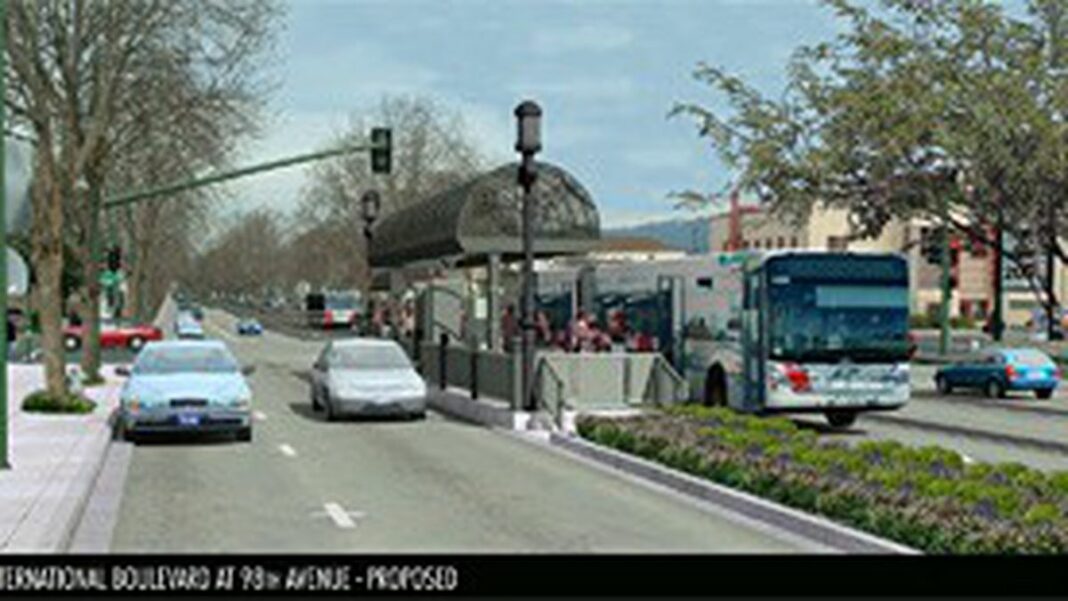
The traffic jam is exactly why AC Transit thinks its Bus Rapid Transit project will be a success. It’s also exactly why many others think the plan is a disaster. That’s because BRT calls for taking the two center lanes along some of the East Bay’s busiest four-lane thoroughfares and making them bus-only. The bus line would run roughly seventeen miles along East 14th Street, International Boulevard, and Telegraph Avenue from San Leandro through Oakland, ending in downtown Berkeley, and would significantly affect neighborhoods along the route.

Fantasy: 98th Ave. and International Blvd. Credits: AC Transit 
Reality: 51st St. and Telegraph Ave. Credits: Bayeté Ross-Smith
The project’s main selling point is that riders would get around faster. Buses would arrive more often, stop farther apart, and interact with traffic signals to avoid having to slow down. To avoid fare-paying delays, riders would prepurchase tickets from kiosks located on station platforms in the middle of the road, and auditors would occasionally board buses to check for scofflaws. If approved by all three cities, BRT project manager Jim Cunradi says, the new system could break ground in 2009 and be complete by 2011.
Cunradi insists the changes will improve the experience for present-day riders and that it will boost ridership by 4,600 to 9,300 trips per weekday. But a recently released draft Environmental Impact Report suggests that the benefits may not be terribly significant, given the project’s cost. And, with public comment on the draft report set to close on July 3, many residents of affected neighborhoods are unaware of the plan’s specifics. (The report is available on AC Transit’s Web site.)
Most East Bay residents support public transit, in spirit at least. But liberal ideals and harsh realities are likely to clash over the dedicated lanes, which are by far the most ambitious of the project’s components. Besides traffic and parking issues, the time savings and environmental benefits detailed in the draft EIR are questionable, slim, and in some cases nonexistent.
Meanwhile, nearby homeowners who know of the plan’s details fear what is probably inevitable: With car traffic down to one lane in each direction on Telegraph and International, drivers stuck at major intersections will seek shortcuts through residential streets.
AC Transit says it plans to mitigate congestion in intersections by adding lanes, adjusting signal timing, restriping, or possibly widening roads. There are at least four key intersections, however, where these impacts cannot be fixed: International Boulevard and High Street, High Street and San Leandro Boulevard, Alcatraz and Telegraph avenues, and Fulton Street and Bancroft Way. If the cities can live with the impacts, Cunradi says, the transit agency will forge ahead.
Roy Alper is a local developer and vice president of the business improvement district for Temescal, a neighborhood that could be profoundly affected. While his group supports Bus Rapid Transit, he says the draft EIR improperly analyzes key intersections, including those at the Rockridge/Temescal border where Claremont, Telegraph, and 51st Street converge. The report states that the intersections operate at a “generally acceptable” level of service.
Alper begs to differ. “The removal of two traffic lanes will create complete gridlock,” he says. He believes the problem could be handled by making the bus lanes nonexclusive in those intersections.
But traffic along the entire route could worsen further if AC Transit keeps the existing bus lines, which stop about every two blocks, in the auto lanes. Another proposal is to combine the existing and new bus lines into one that uses the bus-only lanes but stops every one-third mile, rather than every half-mile, as currently proposed for the BRT line.
Vincent Casalaina, a TV producer and president of the Willard Neighborhood Association, speaking on his own behalf, concurs that AC Transit’s data is unreliable. For instance, a traffic analysis that was only partially included in the draft EIR claimed drivers attempting to reach downtown Berkeley from Woolsey and Telegraph would turn left on Ashby and right on Shattuck. Casalaina counters that Parker Street is the obvious shortcut. “How can we believe the traffic analysis when we know on some level it’s totally wrong?” he asks.
Dedicated lanes would also reduce parking: The plan for in-road station platforms would eliminate 945 to 1,300 street spaces. Cunradi claims the impact wouldn’t be so bad since many of the spots in question often sit unoccupied. Not so in Temescal, one of Oakland’s fastest-growing commercial districts, where parking already can be a challenge. Under one BRT option, the district would lose more than 65 percent of its metered parking along the business corridor. “We feel that’s totally impractical under the circumstances, and they need to come up with replacement parking,” Alper says. He means a parking lot. AC Transit’s solution: Add time restrictions or plant meters along side streets.
Alper is also concerned that the study ignored the neighborhood’s most-used crosswalks across Telegraph: those at 50th, 51st, and 45th streets. Instead, the wonks looked at 48th, 52nd, and 55th streets — which he calls a “pedestrian wasteland.”
Alper’s business group detailed its concerns in a letter to AC Transit prior to the draft Environmental Impact Report, but he says the concerns were “completely disregarded,” despite the agency’s assurances. “Temescal Telegraph Business Improvement District is strongly supportive of the Bus Rapid Transit system,” he says. “We think it’s a real plus for the city, the community, and for the environment. We just want it to be done right.”
Even if it’s done right, carving up the main drags of three cities offers questionable benefits, even to daily bus commuters. For one, AC Transit just unveiled a new rapid bus service that doesn’t require dedicated lanes. Standard buses travel an average of about ten miles per hour along their routes. The rapid buses are expected to do thirteen on average. With dedicated lanes, the BRT buses are projected to exceed that by only four miles per hour. “Four hundred million for thirty seconds — it’s crazy to spend that kind of money on that kind of service increase,” Casalaina says.
That’s a bit of an exaggeration, but a customer who rides BRT five miles would save less than five minutes over the rapid bus — and BART, which runs roughly the same route, is far faster than either. Cunradi believes this time savings warrants the cost, which would be significantly lower per rider than other big transit projects.
AC Transit still has some big hurdles to clear to make BRT a reality. It would have to lower the project’s estimated price tag to $250 million from its current $310-$400 million in order to qualify for a federal grant called Small Starts. So far, it has secured $175 million.
Then there are the political barriers. Cunradi says AC Transit has the political and community support to make the project happen. And yet, while cities are remaining open-minded until the final EIR comes out, many are wary of the dedicated lanes. “When you have a four-lane street like International and Telegraph and you take two of those lanes away, obviously there’s going to be a significant impact,” says Wladimir Wlassowsky, Oakland’s manager of transportation services.
“It’s a very significant change to the street experience both in downtown and the south side of the campus area,” agrees Cisco DeVries, spokesman for Berkeley Mayor Tom Bates, adding that the mayor has “taken a look, but we’re not at a point of taking a particular position.”
San Leandro city manager John Jermanis calls dedicated lanes a “political challenge” in light of a recent multimillion-dollar investment to beautify the median on East 14th Street and “significant congestion” on that thoroughfare during rush hour.
The cities do seem to support the less-ambitious rapid bus program. The new $20 million project, launched last Sunday and funded by Alameda County Measure B, combines the 82L and the 40L into one line called 1 Rapid. It follows roughly the same route as that proposed for BRT, stopping every half-mile. Like Bus Rapid Transit, the buses can communicate with stoplights to allow them to stay green until the bus passes. Rapid buses have already been successful on San Pablo Avenue. So some question why the agency is pursuing Bus Rapid Transit rather than expanding or enhancing the far cheaper and less-disruptive system already in place.
Casalaina believes BRT’s “bells and whistles” could be applied to the rapid bus. For example, prepaid tickets would shorten travel times, and could be purchased at local stores, as opposed to in-road kiosks. Another option would be to add more rapid buses to ensure frequent service. The BRT is projected to come every three-and-a-half to five minutes during peak periods, whereas the rapid bus comes every fifteen minutes. Cunradi counters that adding buses to the road without dedicated lanes isn’t a cost-effective solution, and prepaid tickets require infrastructure.
As far as any environmental benefits, Bus Rapid Transit is basically a wash. Cunradi says the system would reduce overall gasoline use by a thousand gallons a day in Alameda County, but admits this is insignificant. The draft EIR didn’t study carbon dioxide emissions because the Environmental Protection Agency didn’t consider it a pollutant when the study was commissioned, and the report shows only a negligible difference in carbon monoxide emissions between the rapid and BRT buses.
So, given the dubious benefits and likely problems associated with dedicated lanes, why is AC Transit pushing for them? One reason may be to strengthen its fragile funding base. Cunradi says only 16 percent of revenues come from the fare box, while the rest is government subsidies. “It’s like a big shell game,” says Michael Katz, a Berkeley writer who published a recent op-ed about the project in the Berkeley Daily Planet. “To get federal money, they run empty buses for show.”
The seeds for Bus Rapid Transit were planted in 1999 when AC Transit received funds to look at various transit projects. Three modes were considered: light rail, BRT, and the rapid bus model. “When cities told us they wanted transit-oriented development and to serve major destinations, it whittled it down,” Cunradi says. “They wanted the whole project to be affordable. That eliminated the light-rail option. Bus Rapid Transit was selected because it provided most of the benefits of light rail without the cost.”
He admits most people would prefer light rail, but says Bus Rapid Transit is gaining popularity, especially in developing countries, because it’s cheaper. He says more than one hundred cities worldwide are proposing similar systems — from Paris to Hanoi. In the United States, Los Angeles, Cleveland, and San Francisco are exploring the idea.
Calvin Fong, an assistant to Mayor Bates, recently checked out a Bus Rapid Transit project in Bogotá, Colombia. While he’s supportive of the concept, he cautions against comparing a place like Bogotá with the East Bay. “The density is different and population is different,” he says. “That being said, we have a real need to consider alternative transportation modes and we need to encourage alternative transportation systems here because of the impacts of climate change and the role of automobiles in contributing to that.”
Although many of the people who would be affected don’t yet know of AC Transit’s plan, it’s on its way to becoming a polarizing issue. The basis, says Mark Celsor, who runs the blog WillardPark.com, may be class. “To grossly overgeneralize I would say that you have progressive voices on one side excited about inexpensive housing and increased urban bustle, with established homeowners on the other side concerned that the same factors will have a negative impact on their property values and quality of life,” he says in an e-mail.
Back in Fruitvale, people interviewed on the streets weren’t familiar with the Bus Rapid Transit project, but many welcomed faster service, even if it meant taking away a traffic lane. Doris Campos, nineteen, was waiting for the 82 line on International at 34th Avenue. She thought dedicated lanes would help reduce travel time. It takes her about twenty minutes to go twelve blocks, she said. Maria Guerrero, a 65-year-old housekeeper who doesn’t have a car, agreed that BRT would be much faster than the current bus. Yeimi Medina, a 23-year-old mother of three who works at the Ritmo Latino music store, thought it would help customers because they take the bus to get there. However, she doesn’t ride the buses, because they’re too crowded and unsafe for her to travel with her young children. “I’d just rather walk,” she said.