

John Mancini is a talented and detail-oriented professional, with an aversion to authority and a tendency to talk more than is good for him. In another life, he might be a gadfly, haranguing government bureaucrats at city council meetings. But because Mancini had some very marketable skills, he became a bureaucrat himself, working in Iraq and Kuwait for some of the world’s largest defense contractors. Over the course of sixteen months in 2003 and 2004, he worked for and clashed with three of the companies at the center of the debate over privatizing the military. Every time they pissed him off, they lived to regret it. “I’m not passive,” he explained. “I was born and raised in New York City, okay?”
Mancini has helped streamline military and espionage budgets ever since the 1970s. He started with Loral Electronics, which rebuilt worn circuitboards on F-16 fighter planes. After moving to Arizona in the 1980s, he worked for Motorola and Sperry Space Systems, buying equipment for Ronald Reagan’s Star Wars program and surveillance satellites launched from the space shuttle. He took a break from defense work to buy data-processing equipment for American Express, but began to get restless. “I had gotten divorced,” he recalled, “and I always had opportunities to travel throughout, but being married, and you know, you had a child, that put limits on your ability to move.”

John Mancini blew the whistle on Halliburton after he was transferred to a war zone. Credits: Giulio Sciorio 
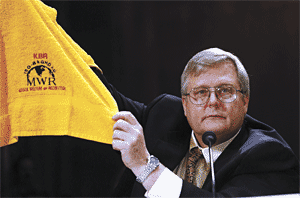
The Pleasanton offices of Mancinis last employer, Procurement Services Associates. Credits: Chris Duffey Henry Bunting with one example of waste: a monogrammed KBR towel. Credits: Tom Williams Mancini says he cant work today because of the swelling in his feet. Credits: Giulio Sciorio


In 2001, Mancini took advantage of one of those travel opportunities, moving to Kuwait and working for Combat Support Associates. American and Kuwaiti militaries were conducting joint training operations at the time, and Mancini’s job was finding cheaper ways to repair military equipment. Before he came along, the army would ship worn tank barrels back to the United States for repairs. Then he found a Kuwaiti machine shop that could do the job on the cheap. “I cut the time from nine months to three months, and cut 50 percent of the costs,” he boasted.
That was Mancini’s career in a nutshell: hunting for cheap, efficient ways to conduct military operations. It seemed so simple and uncontroversial — look for competitive bidders, scan for excessive costs, and apply some common sense — at least until he signed up with Halliburton.
In 2003, Mancini became one of the soldiers in the new, privatized American military. During prior wars, the Pentagon relied only sporadically on private companies. But in Iraq, critical functions in the occupation have been farmed out to multinational corporations, some of which are led by former government officials who may have used their connections to secure no-bid, multibillion-dollar contracts. Today, 25,000 American civilians are working on logistical and security functions in Iraq, and Halliburton alone employs another 37,000 civilians from other countries such as the Philippines and Bosnia.
Meanwhile, the number of Pentagon auditors and contract managers has steadily fallen, crippling the government’s ability to ensure the public’s money is being spent wisely. The inevitable result has been corruption, sloppy accounting, and a sense that no one would hold these new civilian soldiers accountable no matter what they did. Mancini watched all of this from inside secure compounds in Kuwait and Iraq. He saw people waste millions of dollars and dream up complicated kickback schemes. He saw British mercenaries get drunk and play with guns in 120-degree heat. He saw the banality of human beings who have too much money and authority and too few restraints.
In 2004, the Pleasanton-based temporary employment firm Procurement Services Associates (PSA) hired Mancini to do purchasing paperwork on behalf of Perini Corporation, which had secured the contract to rebuild the electrical infrastructure in southern Iraq. A little more than a month into his new job, Mancini was badly injured in a car accident in Kuwait. Perini officials flew him home, but Procurement Services Associates initially refused to pay for his rehabilitation — a decision the company probably came to regret. Mancini filed a claim with the federal government, alleging that PSA had shafted him in violation of federal law. In addition, he has been cooperating with the Los Angeles Times, which has begun investigating claims that civilian workers injured in Iraq and Kuwait have been illegally denied medical care.
If Mancini turned out to be a big headache, PSA officials should have realized who they were dealing with. After all, he was one of the two men who blew open the $1.4 billion Halliburton overbilling scandal. In fact, Mancini has been at or near the center of some of the worst mistakes in the war. From Halliburton to Abu Ghraib to this emerging civilian health-care dispute, Mancini had a close view of all the occupation’s stupidity, arrogance, venality, and cruelty.
His story is the story of the privatized military in Iraq. First he worked for a company that screwed the American taxpayers. Then he worked alongside men who allegedly tortured countless Iraqis. Finally, he claims, his third and final employer ended up giving workers like him the shaft.
In 2001, Halliburton received a no-bid, multibillion-dollar contract to provide logistical support for any and all military operations in the Persian Gulf region. No other company was considered; the contract just landed in the company’s lap. This set the tone for what would become a remarkably casual use of government money, as Halliburton employees allegedly ignored the basic principles Mancini had spent his professional life upholding.
Halliburton subsidiary Kellogg, Brown and Root (KBR) hired Mancini fourteen months later to keep an eye on cost overruns in its Middle East operations. War was approaching, and KBR executives knew they would have to provide everything from mess halls to water purification plants for the occupation. Mancini landed in Kuwait and was driven to “Camp Khalifa,” a former tourist resort that had been converted into KBR’s base of operations. The heat hovered above one hundred degrees, but Mancini and his colleagues had no time to splash around in the resort’s swimming pools. They were busting their humps fourteen hours a day, doling out hundreds of millions of dollars in public funds through buy orders for everything from cell phones and fire trucks to exercise equipment.
Mancini found an operation in complete disarray. Kellogg, Brown and Root had no computers with which to record its transactions. Everything was written on scraps of paper, and employees skimming off the top or taking bribes from subcontractors could simply tear up and rewrite the records. According to Mancini, KBR managers told employees not to worry about the price of whatever they were buying, that it was “cost-plus,” and that the company would be reimbursed by the government, with a profit slapped on top. One employee, Mancini said, logged a multimillion-dollar contract as a $200 purchase in company records. Company officials told Mancini to keep individual purchases under $2,500 as often as he could, to avoid the headache of soliciting bids.
Slowly, Mancini grew friendly with Henry Bunting, a “field buyer” who shared his misgivings about how business was being conducted. “One of the things that KBR said was the fastest way to get sent home from Kuwait was talk to the press, talk to the congressmen, or get drunk or use drugs,” Bunting said. “We used to joke that if they kept harassing us, we’d talk to our congressman.”
Mancini’s worst discovery involved the purchase of cell-phone contracts. KBR official Jeff Mazon was using a Kuwaiti middleman to secure cell-phone services for KBR, and charging a 10 percent markup. With just a few phone calls, Mancini learned that neither the middleman nor the markup was necessary. After he pointed this out to his supervisor, KBR officials took the project from him and transferred it to a different department. Mancini began to suspect that Mazon was on the take.
That, Mancini said, was the beginning of a campaign of harassment and intimidation by KBR officials. His Bosnian supervisors informed him that they were transferring him to a new office inside Iraq, where mortar fire and attacks were frequent. Mancini refused to go. “They restricted me to quarters; ‘You’re not doing this, you’re not doing that,'” he said. “I says, ‘Fuck you. You’re not even an American.'” Eventually, Mancini’s bosses gave him an ultimatum. “They say, ‘You have to go, you’re leaving tomorrow,'” he said. “And I said, ‘Fuck you, I ain’t leaving.’ They got pretty nasty. But I had contacted the embassy. I wanted to make sure nothing happened to me. The thing is, it’s a big desert out there. People do disappear.”
In midsummer 2003, Mancini quit and got on a plane home to Phoenix. He kept in touch with Bunting via e-mail, and the two men got angry. “I just got fed up with the poor business practices,” Bunting said. “They weren’t good stewards of the government’s money. … I think they were in cahoots with many of these vendors that they had on this preferred-vendor list. I can’t prove it, but it’s mighty suspicious when you’re not looking for the lowest price.” Bunting quit in August, but as the months went by, he realized that someone had to hear about Kellogg, Brown and Root’s business practices. In January 2004, he decided to talk.
Bunting spilled his guts in e-mail to Congressman Henry Waxman, the ranking Democrat on the House Committee on Government Reform, the body charged with ensuring that government contracts are free of corruption and fraud. When Waxman’s staff contacted Bunting, he provided a host of supporting documents and told them to talk to John Mancini. The two men became the first Halliburton employees to expose what would become a historic scandal.
On February 12, Waxman released an open letter to the Pentagon, demanding an investigation and summarizing what Bunting and Mancini had told his office. Halliburton was leasing cars at a rate of $7,500 a month. Plywood was being bought for $100 a sheet. The company bought 50,000 pounds of nails that were the wrong size, and dumped them in the desert. Their employees’ mobile homes were falling apart. Company employees were splitting purchase orders into pieces to get around rules about securing the lowest possible bid; Mancini estimated that up to 80 percent of purchase orders were manipulated.
“What is most disturbing about these allegations from the whistleblowers is the regular and routine nature of the overcharging,” Waxman wrote. “The whistle-blowers describe a company that paid inflated prices for goods and services on a daily basis and then passed these overcharges on to the US taxpayer. An approach of ‘Don’t worry — it’s cost-plus’ may be lucrative for Halliburton, but it should be of great concern to the government and the taxpayer.”
The investigation began to snowball. Waxman set up a hotline for Halliburton employees, and informers crept out from the shadows. Truck driver David Wilson told Waxman’s office that Kellogg, Brown and Root would drive empty trucks around Iraq, billing taxpayers for transporting phantom cargo. In addition, he claimed that KBR managers refused to stockpile spare tires and oil for the engines, and whenever employees got a flat tire, they abandoned the $85,000 vehicles to looters. Employee Marie De Young claimed that the company spent up to $1.2 million on laundry services, or $100 per bag. In July, Bunting testified before Congress, where he displayed one of hundreds of towels KBR had monogrammed at $7.50 apiece, or three times the going rate. Meanwhile, Mancini was providing anonymous tips to the Washington Post and the Los Angeles Times, claiming KBR had spent $750,000 buying fire trucks whose hose mountings couldn’t work with the hoses in Kuwait; at one point, he said, firefighters had to sit back and watch as a building burned to the ground.
After Bunting’s testimony, the Pentagon’s Defense Contract Audit Agency initiated an investigation into two Halliburton contracts and identified $1.4 billion in questionable or unsupported costs. Jeff Mazon, the employee who negotiated the cell-phone contract Mancini found so excessive, was indicted by a federal grand jury in March 2005 on ten counts of fraud. Mazon allegedly bid up a contract to supply fuel tankers for the occupation by as much as $3.5 million, in return for a $1 million kickback. His trial is still pending. Last July, Army spokespeople announced they were ending Halliburton’s contract for logistical help in Iraq. By then, the company had earned approximately $18.5 billion.
Halliburton representative Melissa Norcross did not respond to several requests for comment, but issued the following statement at the time of the contract’s dissolution: “By all accounts, KBR’s logistical achievements in support of the troops in Iraq, Kuwait, and Afghanistan have been nothing short of amazing.”
Halliburton’s Iraq windfall has defined the era of the privatized war machine. According to Brookings Institution scholar Peter Singer, who documented the trend in a Foreign Affairs article last year, three elements converged to place global military action in the hands of private armies and supporting companies. The end of the Cold War led to a substantial reduction in the size of standing armies around the world, even as civil wars and tribal conflicts created a new demand for mercenaries. The American military grew to depend on high-tech tools innovated by private companies, and a general ideological trend toward privatization led policymakers to apply the new standards to the military, which had heretofore been the exclusive province of the state. Sixteen years later, the results are clear, according to author Pratap Chatterjee, who has been tracking corporate involvement in Iraq and Kuwait. During the first Persian Gulf War, one in one hundred personnel was a private contractor. Today, Chatterjee claims, that ratio is one in three.
These private employees, who number around seventy thousand in Iraq and Kuwait, do everything from shooting the enemy to feeding the army. Soldiers hired by Blackwater and Erinys International patrol the oil pipelines and guard convoys driving through Baghdad. Employees from CACI and Titan Corporation participated in interrogations at Abu Ghraib. And, of course, Halliburton was responsible for a vast array of support services, operating at least sixty camps in Kuwait and Iraq, shipping in supplies and serving food, purifying water and delivering mail — even setting up movie theaters, videogame arcades, and Subway sandwich outlets. Chatterjee, the author of Iraq, Inc. and executive director of the Oakland-based Corpwatch, claims that Halliburton is so intertwined with official military strategy that many of its employees actually enter the theater of operations ahead of soldiers. “In Bosnia, the military invaded, and Halliburton followed,” he said. “In Afghanistan, the military invaded, and Halliburton followed. … Here, Halliburton arrived before the military. This was unique to Iraq.”
In the surreal world of bases such as Camp Anaconda, located just north of Baghdad, the globalized economy has been eerily replicated. The Army’s old quartermaster battalions have been replaced with tens of thousands of Indian and Filipino migrant laborers, who clean the toilets and serve three flavors of ice cream to American troops. Many soldiers are grateful to Halliburton for the first-class treatment, but Chatterjee notes that the outsourcing of support services focuses the troops’ duties on nothing but killing and patrolling, leaving them more vulnerable to post-traumatic stress disorder.
In addition, Peter Singer claims that that the practice of posting soldiers next to mercenaries who earn up to ten times their salaries will create a serious problem, as private armies poach the military’s best special forces and beef up their “coalition of the billing.” In essence, the Pentagon is now paying for the training of sophisticated and talented soldiers, but these same troops will quit at the first opportunity and join the private sector, where they can shoot their guns for whatever side will pay the most.
Sometimes, Chatterjee claims, the military’s very capacity to perform is crippled by privatization, for the simple reason that private contractors don’t have to follow orders. In April 2004, when the burned corpses of four Blackwater soldiers were hanged from a bridge in Fallujah, and eighty Halliburton trucks were attacked in insurgent operations, Halliburton simply stopped delivering supplies. “For two weeks, they were not delivering food in Iraq,” Chatterjee said. “The Army had to reduce the number of meals in a day; they were switching to MREs even in the Republican Palace. You know, they say an army travels on its stomach? Well, Halliburton feeds that stomach. And when they stop, the soldier starts to starve.”
Finally, private armies in Iraq can get away with things the government can’t be seen to be doing, and they help obscure the true cost of the war from the American public. For example, the Department of Defense does not include reports of contractors killed or wounded in its official tally of casualties. And when contractors commit war crimes, no one really knows what legal authority, if any, is supposed to prosecute them.
Take Abu Ghraib. Singer wrote that although the Army found that CACI and Titan employees were involved in 36 percent of the incidents, “not one of these individuals has been indicted, prosecuted, or punished, even though the US Army has found the time to try the enlisted soldiers.” The only authority that investigated these contractors, he added, was their employer: “CACI investigated CACI and, unsurprisingly, found that CACI had done no wrong.”
Donald Rumsfeld and Dick Cheney’s vision of a leaner, more agile military supplemented by companies performing specialized support work has been a multifaceted disaster, and its most dramatic failings — a steady insurgency, sectarian chaos, the proliferation of torture — are all too familiar by now. Mancini’s story illustrates a lesser-known but equally important lesson: Turning over functions to well-connected corporations, combined with the absence of basic government oversight, has produced little but corruption and crony capitalism. Ten of thousands are dying or maimed, but someone is getting rich. Even the practice of doling out the private contracts has been privatized. That’s exactly what John Mancini found himself doing after he left Halliburton and took his next job with CACI.
Even as Mancini was anonymously leaking to Congress and the press, he was hankering to get back to the war. In March 2004, he signed up to handle contract administration for CACI, the company that was about to be implicated in the Abu Ghraib torture scandal. Although Mancini never knew Steven Stephanowicz, the CACI employee listed in an Army report as “responsible for the abuses at Abu Ghraib,” he was required to go through a “soldier readiness program” prior to shipping out. In April, he arrived in Fort Bliss in Texas, where he participated in the training with CACI employees who were assigned interrogation detail in Iraq. “So I’m going through there, and you know the military, hurry up and wait,” Mancini said. “And they give you some off time, you go to the bowling alley and the PX. And you talk with them, and those people are kinda scary. Some of the stories they used to tell about their experiences; these were special-ops people, and you know, they didn’t admit they were CIA, but I definitely got the impression.”
By the summer of 2004, Mancini found himself in Baghdad’s Green Zone, pushing papers in the presidential palace and sleeping in a tent with fifty “of my closest friends.” The floor was bare sand; Mancini recalls showering in tents and being covered in grit by the time he put on his clothes. But the food was decent, and there was plenty of beer — sometimes to his dismay, as he watched mercenaries assigned to guard him get hammered: “The majority of people are responsible, okay? But you had some of these British and South Africans, some of these private security details, and you’d see them on Thursday night, which was your weekend. They’d be drunk by the pool, throwing each other in the pool with weapons. I said, ‘Make sure you change those fucking bullets before you protect me.’ … The Brits were friggin’ crazy, I tell ya. I wouldn’t trust my life to a Brit.”
Despite the parties and CACI’s role at Abu Ghraib, Mancini claims that he often felt more comfortable around the mercenaries than American soldiers. “The army, they were children,” he said. “You know, you can understand why they outsource security. … There’s a lot of bad press about these private security people, but they save lives. The army, they’ll leave you out to die.”
Just a few weeks into his latest stint, Mancini was nursing a new set of grievances. He believed CACI had stiffed him on his paycheck, and the mortar rounds landing around the Green Zone were starting to wear down his nerves. In July, he was headhunted by Procurement Services Associates to work as a purchasing manager on behalf of Perini, the company rebuilding the electricity grid. But on September 23, while he was driving back to Perini’s office, a car carrying a Kuwaiti woman and six children slammed into the back of his Land Rover at 75 miles an hour. The Kuwaiti car rolled three times, and Mancini was knocked unconscious. When he woke up, he found himself at a hospital reserved for “third-country nationals” — menial laborers imported to do shitwork. He had a broken ankle, a broken wrist, and contusions to his ribs.
While Mancini cooled his heels in what he calls “the cockroach hospital,” he talked on the phone to Travis Williams, president of the temp agency contracting his services to Perini. According to Mancini, Williams claimed that Mancini had no medical coverage, despite the fact that federal law requires companies working with the military to guarantee health insurance. “He goes, ‘Ah, you’re injured. You didn’t sign up for the medical care. What are you gonna do?'” Mancini said. “I go, ‘This was employment-related, this is covered under workman’s comp. What are you gonna do?’ And then there was complete silence. And then he said he’d check into it.” Williams declined to comment on Mancini’s claims.
Perini officials transferred Mancini to a private hospital, but after just a few days, a company representative came to his bed. “Perini said, ‘We gotta get you out now. When the doctor comes in, say I feel good enough to travel,'” Mancini claims. “I say, ‘Well, I don’t.’ He repeats, ‘Tell the doctor you feel good enough to travel, and we’re going to get you on a flight tonight. Otherwise, they’re going to put you in prison.'” The implication, Mancini thought, was clear: Kuwaiti nationals had died in the car wreck, and the government was looking for a scapegoat. Perini employees raced to his apartment and threw some of his underwear and socks in a gym bag. Another official shoved Mancini in a wheelchair, flashed a few bills at the hospital staff, got a doctor’s note, and pushed him through the exit into an unmarked car. “They said, ‘We can’t put you in an ambulance, because we don’t want to attract attention,'” he recalls. “A couple of Perini people said, ‘Be careful — they may arrest you.'”
With that, Mancini was on a flight back to the States. At Logan International Airport, he claims, he took a call from Williams, who said he’d meet Mancini in Phoenix. In the meantime, there was a snafu in the arrangements, and no one from the company could accompany him. Mancini was left in the airport in a wheelchair, where he used his remaining cash to pay people to help him on the plane. PSA paid only for economy class, Mancini said, and his injured leg was jammed down into the cramped seats. When he arrived in Phoenix many hours later, Williams was nowhere to be found. Instead, his ex-wife, Susan, was waiting; Williams had asked her to handle things from then on.
Susan Mancini, who has worked as a surgical technologist for 25 years, took one look at her ex-husband’s leg and took him to the hospital. Mancini’s legs were badly swollen from being crammed into a tight space without being elevated; the flesh strained against the casts. “His feet were cold, like there was no circulation,” she said. “I took him to the emergency room, and they had to cut both casts off. I was fairly worried. … He could get blood clots on his legs; he could have gotten gangrene.”
Mancini spent a month in a nursing home, where he was informed that PSA did not have health insurance under the federal Defense Base Act, which is supposed to cover all civilians working overseas for the military. After working in the deadliest piece of real estate on Earth on behalf of his country, Mancini was left high and dry. He checked out of the nursing home, but filed a claim against PSA with the Department of Labor. After months of arbitration, the company acknowledged that federal law required it to purchase Defense Base Act insurance for its employees, and agreed to pay all Mancini’s medical bills from the time of his accident to March 1, 2005.
Mancini is still fighting with Procurement Services Associates. He claims that he still can’t work, and that his former employer is liable for compensation for as long as his injuries endure. His ex-wife said he has yet to recover from his time in Iraq and Kuwait. “He’s been feeling pretty depressed because he can’t work,” she said. “His feet are still swollen to, like, twice their normal size, and he has difficulty walking. He can barely even buy shoes. They’re like squares.” In a brief filed with the Department of Labor last month, PSA’s attorney David Nolan claims that Mancini’s own physician found him “fit to return to work … in early April 2005,” and that the company is not liable for any further payments. Any claims otherwise, Nolan wrote, are “the fantasies of the very troubled Mr. Mancini.”
In August, Mancini was sitting at home seething when, he claims, he heard from one of the reporters he talked to during the Halliburton days. “Do you remember how we talked about the story on injured contractors?” T. Christian Miller of the Los Angeles Times asked in an e-mail forwarded by Mancini. “Well, you can be of help to me now in getting it done.” The Times, Miller wrote, had filed a lawsuit to acquire details of civilian contractors killed or injured in the war, and whether the federal government was adequately compensating them: “Would you be willing to contact our attorney, and give a short declaration about your case?”
On August 28, Mancini signed a declaration summarizing his fight with PSA. Miller referred all questions to the newspaper’s public-relations department, which refused to comment. But Karen Henry, an attorney with the firm handling the lawsuit, confirmed that Mancini was cooperating with the investigation. “We want to get specific information regarding civilian contractors who have been either killed or injured while in Iraq and Afghanistan,” she said.
So once again, Mancini is spilling his guts. No one knows what this new investigation will dig up, but if the federal government and its private partners have refused to provide medical care for civilians injured in the course of the occupation, it will be just one more in a long list of scandals. And Mancini will be at the center of it one more time.
On the other hand, Mancini thinks that for all Halliburton’s sins, it’s still better than the baseline incompetence he saw among the military. “Yeah, KBR steals,” he said. “It steals at least 15 percent. But the military loses 25 percent. Even in KBR’s stealing, they’re better than a system where people make more mistakes and screw up more things.”
In fact, Mancini has enough bitterness for everyone involved in the Iraq adventure, even the Democrats who took up his cause. When Mancini asked Waxman’s office to help him with his problems with Procurement Services Associates, they shined him on. “For all that assistance I provided them, they turned a deaf ear to me,” he recalls. “Typical politicians, you know? They were not out to make a change — they wanted to hatchet-job Cheney. I got so frustrated, I don’t vote.”
As he sits alone in his Arizona house, Mancini has decided that three years of labor, blood, and heat have done little more than inject poison into the world. “In 2003, when I was in Kuwait, we had some people who were with KBR, and they went up to Baghdad, and the security situation was much different,” he concludes. “People welcomed you with open arms. … I think the failure of the US government to rebuild the country, and the fraud and abuse by the army, has caused all the problems. There are no results. They’ve spent all this money, but the results are nothing. It’s all been wasted. All they’re doing is lining the pockets of American corporations.”